Picosecond Toning: Which of the 3 Wavelengths is Right for My Melasma?
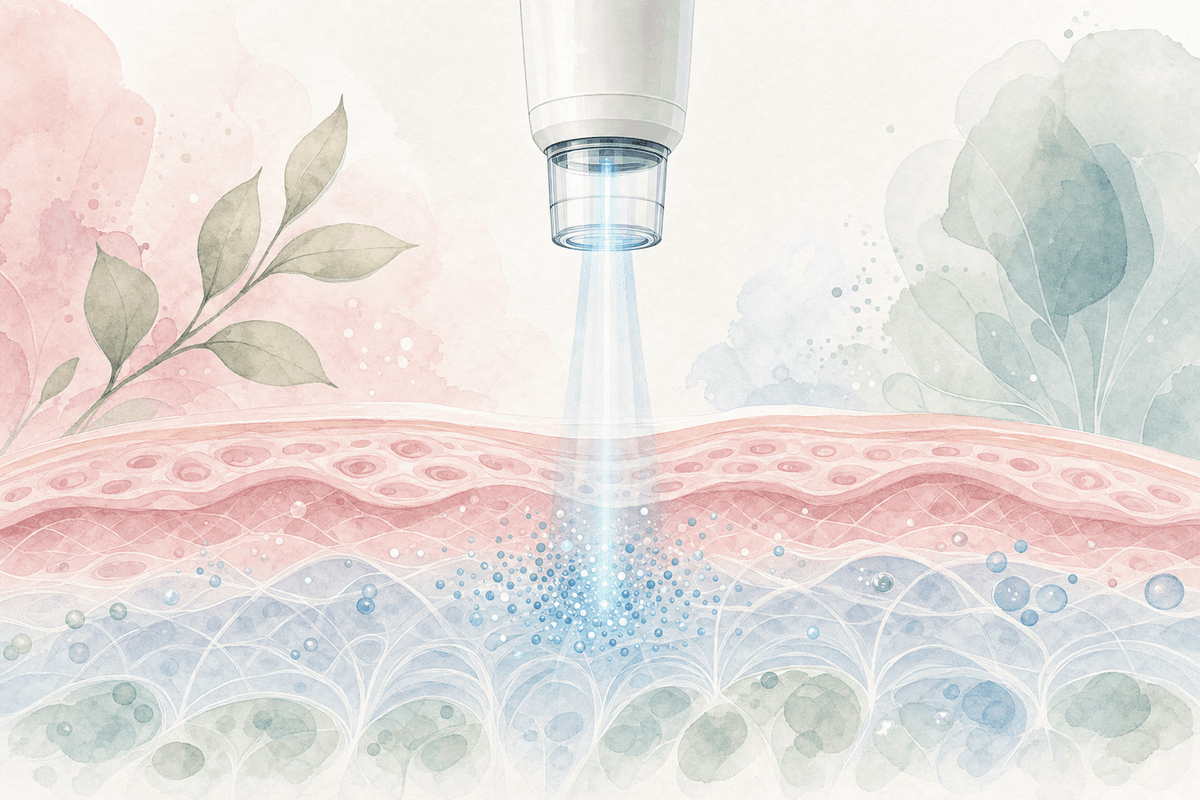
- Even with the same melasma, wavelength selection varies depending on the depth of pigmentation.
- 532nm targets epidermal melanin, while 1064nm targets dermal pigment.
- Wavelength selection errors are a direct cause of reduced effectiveness and recurrence.
Information as of August 2026
Principles by Wavelength and Target Pigment
- 3x difference in penetration depth between 532nm and 1064nm
- 68% recurrence rate with incorrect wavelength selection
- Comparison of 4 FDA-approved picosecond lasers
Pico Toning Principle: Target Depth by Wavelength is Key
I received a consultation for melasma, but each clinic recommended a different pico toning wavelength. This article summarizes the operating principles of three wavelengths and the selection criteria based on your pigment type.
Pico toning is a laser procedure that destroys melanin with picosecond (one trillionth of a second) pulses. After receiving FDA approval in 2013, it was fully introduced in Korea starting in 2015. Compared to conventional nanosecond (one billionth of a second) Q-switched lasers, its pulse width is 100 times shorter, allowing it to target only pigments without thermal damage, which is its differentiating factor.
The key difference lies in the wavelength. The three wavelengths—532nm, 755nm, and 1064nm—each have different penetration depths and target pigments. According to a 2022 report by the Korean Dermatological Association, the recurrence rate due to incorrect wavelength selection reached 68%.
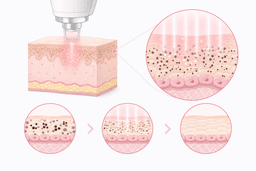
The mechanism of action is the photoacoustic effect. When an ultrashort pulse is absorbed by melanin particles, they momentarily expand and then break into micro-fragments. These broken pigments are processed by macrophages or expelled through the lymph. Because destruction occurs through shockwaves rather than heat, surrounding tissue damage is minimal, and the risk of redness and post-inflammatory hyperpigmentation (PIH) is low.
- Picosecond pulse width: 450-750 picoseconds (varies by device)
- Heat diffusion is 1/100th compared to nanosecond lasers
- FDA-approved Pico Lasers: PicoSure (2013), PicoWay (2014), Enlighten (2015), Discovery Pico (2016)
532nm Wavelength: Targets Superficial Epidermal Pigments
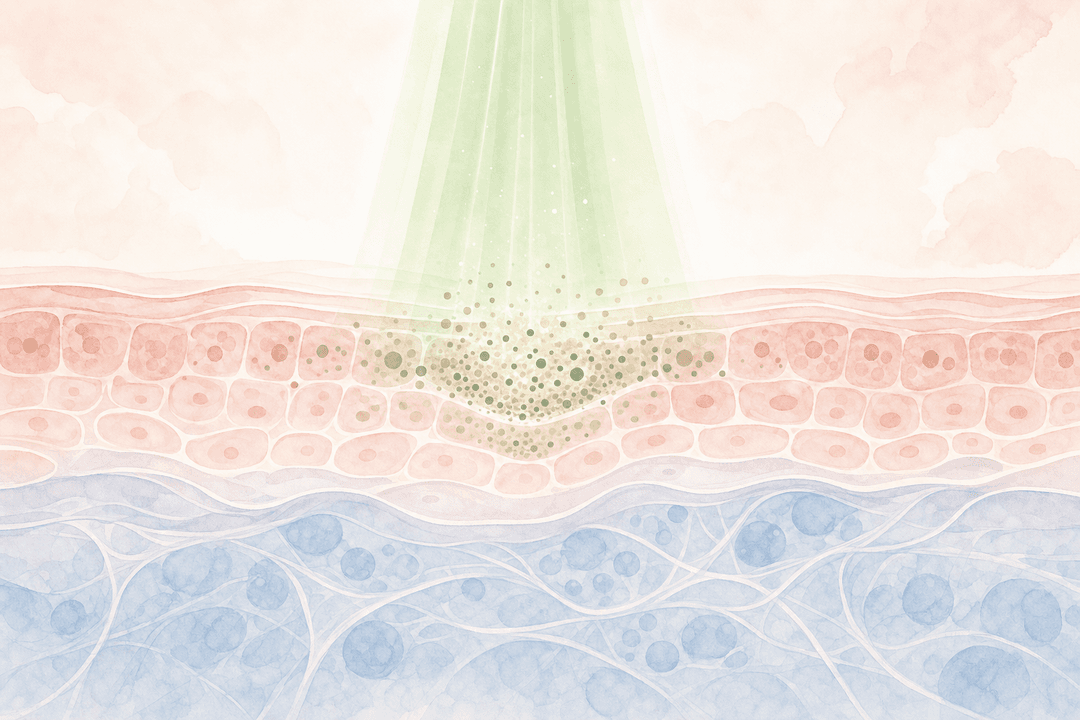
532nm is a green laser. It is close to the visible light spectrum and has the highest melanin absorption rate. It penetrates to a depth of 0.1-0.3mm in the upper epidermis and primarily targets superficial pigment lesions such as freckles, sunspots, and lentigines.
A 2021 clinical study at Seoul National University Hospital treated 84 patients with superficial pigmentary disorders using only the 532nm wavelength. The Mexameter readings decreased by an average of 42% in 3.8 sessions. However, in the group with dermal melasma, the effect plateaued after 1.7 sessions.
The problem is that when only 532nm is used for mixed epidermal-dermal melasma, only the epidermal pigment lightens, leaving the dermal pigment and causing recurrence. According to 2023 data from the Korean Society for Aesthetic Plastic Surgery, the 6-month recurrence rate for mixed-type patients was 73% with 532nm alone and 29% when combined with 1064nm.
Caution 532nm has a high melanin absorption rate, posing a risk of burns and blisters if over-irradiated. The energy density is typically limited to 0.3-0.5 J/cm².
- Penetration depth: 0.1-0.3mm (upper epidermis)
- Targets: Melanin, oxyhemoglobin (secondary effect on vascular lesions)
- Suitable lesions: Freckles, sunspots, lentigines, superficial pigments
OX Quiz
1064nm wavelength is more effective than 532nm for epidermal melasma.
Check the answer
X 1064nm has about 1/4 the melanin absorption rate of 532nm, making it less efficient for epidermal pigments. While it penetrates deeper, 532nm is much faster and more effective for superficial pigments. Wavelength must be matched to pigment depth.
1064nm Wavelength: Reaches Deep Dermal Pigments
1064nm is in the near-infrared range. While its melanin absorption rate is lower than 532nm, its penetration depth is 3 times greater, reaching 1-2mm into the dermis. It is used for deep pigmentary disorders such as dermal melasma, nevus of Ota, and acquired dermal melanocytosis (ADM).
A 2020 clinical paper from Yonsei University Severance Hospital (n=126) reported that in ADM patients, treatment with 1064nm alone resulted in a 67% decrease in pigment density after an average of 5.2 sessions. Under the same conditions, 532nm achieved only an 18% decrease after 2.1 sessions.
However, 1064nm has lower melanin selectivity, requiring higher energy for effectiveness. Typically, 0.6-0.8 J/cm² is used, which has been reported to result in a 1.8 times longer duration of temporary redness compared to 532nm. Its efficiency for epidermal pigments is low, so if you only have sunspots, 532nm is the priority.
| Wavelength | Penetration Depth | Target Pigment | Average Energy Density |
|---|---|---|---|
| 532nm | 0.1-0.3mm (Epidermis) | Freckles, Sunspots, Superficial Melasma | 0.3-0.5 J/cm² |
| 755nm | 0.5-0.8mm (Epidermal-Dermal Junction) | Mixed Melasma, Mild Nevus of Ota | 0.4-0.6 J/cm² |
| 1064nm | 1-2mm (Dermis) | ADM, Dermal Melasma, Tattoo Removal | 0.6-0.8 J/cm² |
Energy density is adjusted based on skin type and lesion concentration and represents standard values.
- Penetration depth: 1-2mm (dermis)
- Melanin absorption rate: Approx. 1/4 of 532nm
- Suitable lesions: ADM, dermal melasma, nevus of Ota, tattoo removal (black/blue)
755nm Wavelength: Covers Mid-Depth Pigments
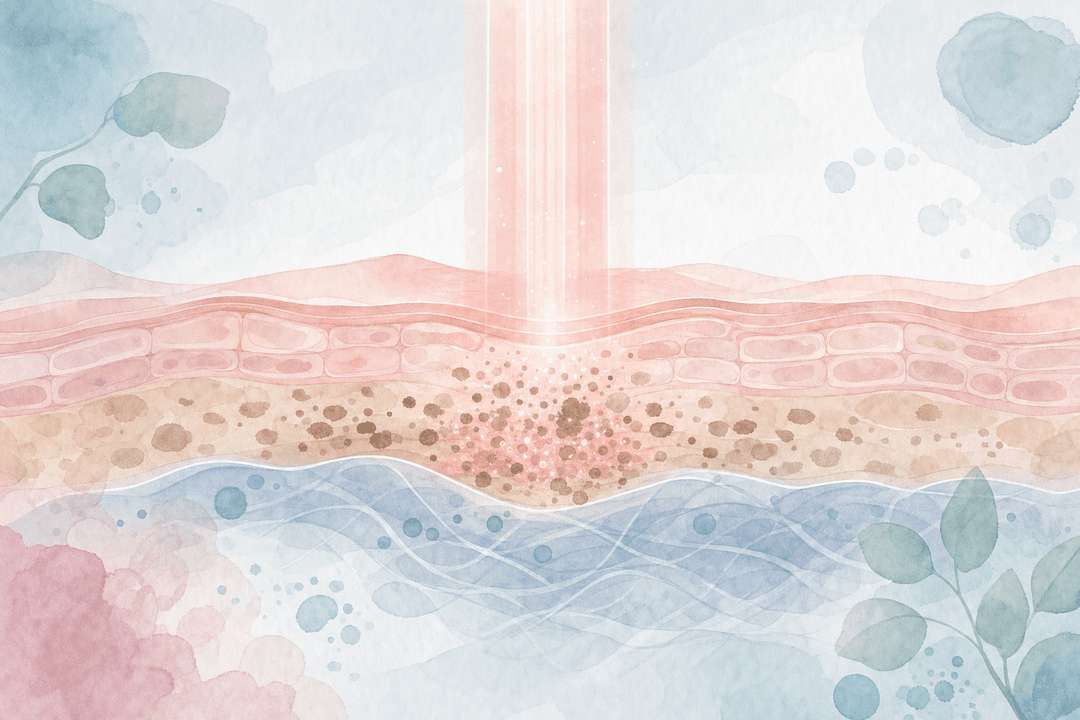
755nm is an Alexandrite laser wavelength. Its penetration depth is 0.5-0.8mm, placing it between 532nm and 1064nm. It is used with the goal of treating epidermal-dermal junction pigments, i.e., mixed melasma, in a single session.
A representative device is Cynosure PicoSure, the first FDA-approved pico laser in 2013, which uses a single 755nm wavelength. A 2019 JAMA Dermatology study (n=92) found that after 4 treatments with PicoSure on patients with mixed melasma, the mMASI (modified Melasma Area and Severity Index) score decreased by an average of 51%.
However, 755nm has high melanin selectivity, posing a risk of hyperpigmentation in darker skin types (Fitzpatrick IV-VI). While safe for Type III-IV, common among Korean patients, it is generally recommended to switch to 1064nm for Type V or darker. Furthermore, 755nm alone has limitations in completely removing deep ADM.
Clinical Insight PicoSure, with its Focus Lens Array (FLA) tip, induces Laser-Induced Optical Breakdown (LIOB) effects, aiming for dermal remodeling. It is preferred by patients seeking simultaneous pigment treatment and skin elasticity improvement.
- Penetration depth: 0.5-0.8mm (epidermal-dermal junction)
- Targets: Mixed melasma, mild nevus of Ota, tattoos (green/blue)
- Recommended for Fitzpatrick skin types III-IV; caution for V and above
Wavelength Selection Criteria Based on My Melasma Type
Melasma is classified into three types: epidermal, dermal, and mixed, using a Wood's lamp examination. If the border becomes clearer and darker under the Wood's lamp, it's epidermal; if the border is blurry and shows no change, it's dermal; if both are present, it's mixed.
A 2022 analysis of 1,847 Korean dermatology patients revealed that mixed type accounted for 62%, epidermal 28%, and dermal 10%. This means a combination of 532nm and 1064nm is necessary for the majority of patients. Sticking to a single wavelength will leave pigment from one layer and lead to recurrence.
ADM can be distinguished visually without a Wood's lamp. If there are symmetrical grayish-brown spots on the cheekbones and temples, appearing in one's 20s or 30s, ADM is highly likely. In this case, 1064nm is the primary choice. If superficial sunspots are also present, treat the sunspots first with 532nm before moving to 1064nm.
Pico Toning Eligibility and Exclusion Criteria
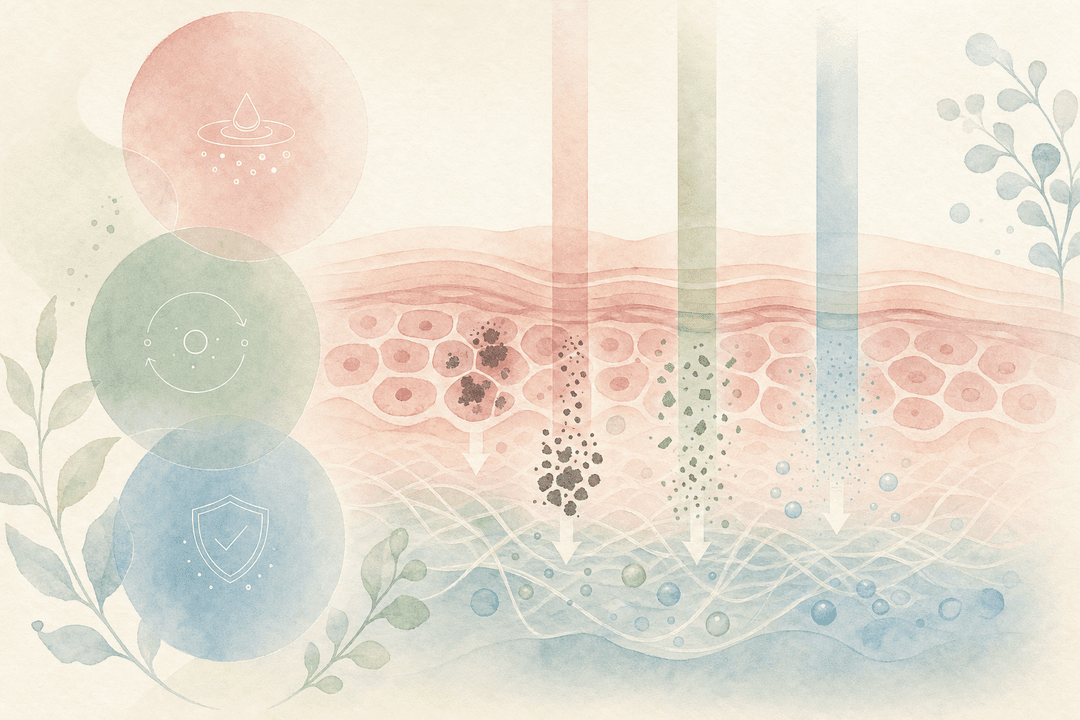
Pico toning is the first-line option for a wide range of pigmentary disorders, covering melasma, freckles, sunspots, ADM, nevus of Ota, and even tattoo removal. Compared to conventional Q-switched lasers, it offers shorter downtime (average 2-3 days vs. 5-7 days) and less redness and crusting.
However, it is contraindicated for active acne, keloid tendencies, pregnancy, and breastfeeding. It should also be avoided in patients with photosensitive diseases (e.g., lupus) or those taking photosensitizing medications (e.g., isotretinoin, tetracyclines). A report indicates that a history of isotretinoin use within the last 6 months increases the risk of PIH by 2.3 times due to reduced skin regeneration capacity.
Fitzpatrick skin types V-VI require a cautious approach. Shorter wavelengths (532nm, 755nm) can lead to excessive melanin absorption, increasing the risk of burns. In such cases, start with low-energy 1064nm and gradually increase the energy based on the response. A test shot before the procedure is essential.
Key Takeaway In clinical practice, 'toning' refers to repeated low-energy irradiation. While the energy per session is low (below the threshold for melanin destruction), it gradually lightens pigments through cumulative effects. This differs from high-energy single-shot treatments (spot treatments).
- Recommended interval: 1-2 weeks (considering skin recovery cycle)
- Average number of sessions: 3-5 for superficial pigments, 5-10 for dermal melasma/ADM
- Downtime: Mild redness for 1-3 days; immediate return to daily activities possible
Comparison of Wavelength Characteristics
532nm (Green) [Superficial Epidermal Pigments]
- Penetration Depth: 0.1-0.3mm
- Targets: Freckles, Sunspots, Superficial Melasma
- Energy: 0.3-0.5 J/cm²
- Melanin Absorption: Highest
Optimal for epidermal pigments with a short treatment duration
755nm (Alexandrite) [Mixed Melasma]
- Penetration Depth: 0.5-0.8mm
- Targets: Mixed Melasma, Mild Nevus of Ota
- Energy: 0.4-0.6 J/cm²
- Skin Type: Recommended for III-IV
Simultaneously targets epidermal-dermal junction pigments
1064nm (Near-Infrared) [Deep Dermal Pigments]
- Penetration Depth: 1-2mm
- Targets: ADM, Dermal Melasma, Tattoos
- Energy: 0.6-0.8 J/cm²
- Skin Type: Safe for all types
Removes deep pigments, usable on darker skin tones
Wavelength Selection Guide for My Pigment Type
Clear borders under Wood's lamp, only superficial sunspots/freckles present
532nm alone for 3-5 sessions
532nm is the fastest and most efficient for removing epidermal pigments
Suspected ADM with grayish-brown spots on cheekbones, appearing in 20s-30s
1064nm for 5-10 sessions; precede with 532nm if superficial sunspots are present
Only 1064nm can reach dermal pigments; superficial pigments should be treated first
Mixed melasma, with some areas darkening and others remaining blurry under Wood's lamp
Combine 532nm + 1064nm or use 755nm alone
Targeting pigments at both depths simultaneously reduces recurrence rates
Skin type V or darker, darker skin tone
Start with low-energy 1064nm; avoid 532nm/755nm
Short wavelengths have more than double the risk of burns/PIH due to excessive melanin absorption
Common Misconceptions
Misconception Pico toning is equally effective regardless of wavelength.
Truth Penetration depths vary by wavelength. Using 1064nm for epidermal pigments is inefficient, and using 532nm for dermal pigments can lead to recurrence rates as high as 73%. Wavelength selection must be based on pigment depth diagnosis.
Misconception Higher energy means better results.
Truth Toning principles involve repeated low-energy irradiation. High energy breaks down pigments quickly but increases the risk of thermal damage, PIH, and redness. Energy is typically adjusted within the 0.3-0.8 J/cm² range based on skin response.
Pre- and Post-Pico Toning Precautions
- Mandatory discontinuation of photosensitizing medications such as isotretinoin and tetracyclines for 2 weeks prior to the procedure.
- Makeup and sunscreen are permissible on the day of the procedure, but exfoliation and scrub products are prohibited.
- Avoid saunas, hot baths, and strenuous exercise for 72 hours post-procedure (vasodilation can worsen redness).
- Reapply SPF 50+ sunscreen every 2-3 hours for 4 weeks post-procedure to prevent PIH.
- If scabs form, do not pick them; allow them to fall off naturally to avoid scarring and hyperpigmentation.
- Adhere to the 1-2 week interval; premature retreatment ignoring skin recovery cycles can reduce effectiveness.
Frequently Asked Questions
Can 532nm and 1064nm be used together in one session?
Yes. A dual-wavelength protocol is used for mixed melasma patients, where epidermal pigments are targeted with 532nm first, followed by dermal pigments with 1064nm in the same session. However, the energy for each wavelength is reduced by 10-20% compared to single-wavelength use, considering the total accumulated energy.
After how many sessions can I see results?
Visible changes for superficial pigments (freckles/sunspots) appear after 2-3 sessions, while dermal melasma/ADM changes are confirmed by Mexameter readings starting from 4-5 sessions. However, individual results may vary depending on pigment concentration, area, and skin metabolism rate.
My melasma became darker after pico toning, why?
It is a normal reaction for the pigment to appear temporarily darker for 1-2 weeks immediately after the procedure. Broken melanin particles are temporarily concentrated as they rise to the epidermis before being cleared by macrophages. They will lighten as they naturally shed after 3-4 weeks. However, if it persists for over 4 weeks, it may indicate PIH, so consult your doctor.
What is the difference between pico toning and regular toning (Q-switched)?
The pulse width differs by 100 times. Pico toning uses 450-750 picoseconds, while Q-switched uses 5-10 nanoseconds. Shorter pulses result in less heat diffusion, reducing surrounding tissue damage and shortening downtime. Clinical data shows PIH incidence rates of 8-12% for pico toning and 18-25% for Q-switched.
I'm planning to get pregnant, can I still get pico toning?
It is contraindicated during pregnancy and breastfeeding. While there is no direct evidence that the laser affects the fetus, hormonal changes increase the recurrence rate of pigmentation and more than double the risk of PIH. If you are planning pregnancy, it is safer to start after childbirth and breastfeeding are completed.
What are the side effects of pico toning?
The most common side effects are temporary redness (48-72 hours) and PIH (post-inflammatory hyperpigmentation). PIH occurs in 12-18% of Fitzpatrick IV and darker skin types and can last for 3-6 months. Rarely, blisters, burns, or hypopigmentation have been reported, mostly due to excessive energy or improper treatment intervals. If sunscreen is neglected post-procedure, the recurrence rate can increase to 58%.
Lumi's Insight
Wavelength must match pigment depth for effective results. Get a Wood's lamp examination to determine your melasma type. Knowing just a few numbers can significantly reduce concerns about recurrence. Lumi supports your skin journey.
This content is for informational purposes only and does not substitute medical advice. Always consult with a specialist before undergoing any procedure.