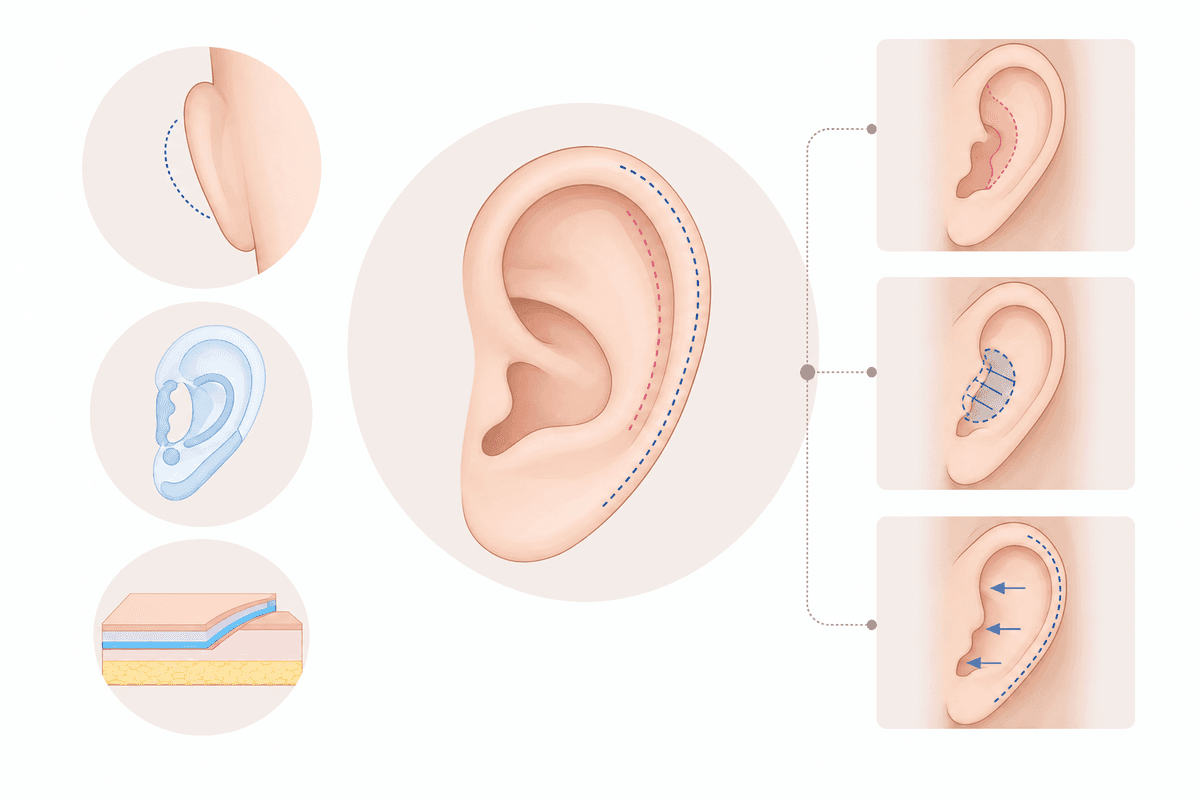
I will honestly explain the 5 steps of the ear surgery process, from consultation to stitch removal.
K-Dia EditorLast updated · 17 minutes ago4,61226 min read
▸The ear surgery process proceeds in five stages: consultation, examination, surgery, recovery, and suture removal. The patient's preparation and verification requirements for each stage are clearly defined.
▸A combination of local and general anesthesia is common, and since the incision is made in the folded area behind the ear, the scar is barely visible.
▸Wearing a compression bandage for the first 72 hours of recovery and avoiding contact with water are crucial for the outcome. Even after suture removal, care to prevent ear folding is required for at least two weeks.
Information as of June 2026
From Anesthesia Methods to Recovery Period
Average Surgery Time: 45-90 Minutes
Suture Removal 7-10 Days Later
Return to Daily Life Within 72 Hours
When I Fold Up the Ear in the Consultation Room
When I gently fold up a patient's ear in front of the mirror in the consultation room, most of them say, "Ah, this is just right." They say, "It looks natural." But the very next question is, "But when is the surgery, and how many days do I need to rest?" The process of ear surgery is more detailed than you might think, so there are clear steps for the patient to take care of at each stage, from consultation to suture removal.
Ear surgery proceeds in a total of 5 stages: Consultation, Examination, Surgery, Recovery, and Suture Removal. In this article, I will organize each stage in chronological order, focusing on what the patient needs to prepare and check. Even what to eat on the morning of the surgery, when to shower, and when the stitches will be removed.
Step 1: Consultation and Design — Determining the ear angle in millimeters
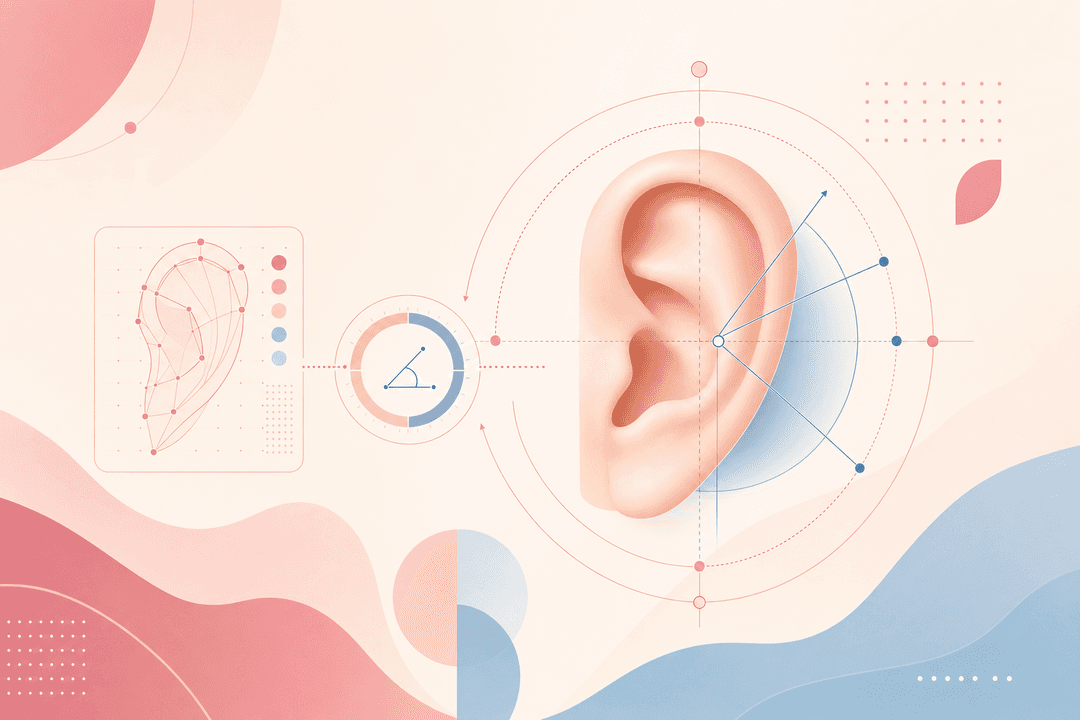
AI-generated illustration
The most important thing in the first consultation is It is to determine how much the antihelix will fold. The antihelix is the cartilage that folds inward along the edge of the ear; if it is weak or absent, the ear appears to detach from the face. The specialist folds the patient's ear with their hands to check if the ear-face angle falls within 20-30 degrees when viewed from the side.
At this time, it is recommended that the patient prepare 2-3 photos of the desired ear shape. "This degree of folding" is much more specific than the word "natural." During the consultation, CT scans or X-rays are not taken; instead, the thickness and elasticity of the cartilage are evaluated through visual inspection and palpation. According to the recommendations of the Korean Society of Aesthetic Plastic Surgery, approximately 70% of ear surgeries can be corrected with sutures alone without cartilage incision, so it is important to determine which case applies to you at this time.
Tip: Please tie your hair back when you come for the consultation. Your ears must be fully exposed so that the specialist can accurately assess left-right symmetry, skin laxity behind the ears, and the position of the tragus (the protrusion in front of the ear canal).
Step 2: Pre-operative Examinations and Preparation for the Day of Surgery
Blood tests (CBC, PT/aPTT) and an electrocardiogram are performed one week before surgery. Anticoagulants such as aspirin and Omega-3 should be discontinued at least 7 days in advance, and smokers are required to quit smoking 2 weeks prior to the surgery. Nicotine constricts the skin's microvessels, slowing down the healing of the incision site.
On the morning of the surgery, you must eat only a light meal (such as toast and milk) and remove all metal accessories, contact lenses, and nail polish. Since ear surgery typically involves a combination of local and sedation anesthesia, fasting is not as strict as with general anesthesia; however, due to the risk of vomiting during sedation, even water is prohibited starting four hours before the surgery. You should wash your hair the night before, and you do not need to wash it on the day of the surgery. Because you cannot shower for at least 3 days after surgery.
Discontinuation of anticoagulants: Aspirin 7 days, Warfarin 5 days, Omega-3 7 days
Fasting time before surgery: 6 hours of solid food, 4 hours of water (based on sedation)
Recommended smoking cessation period: 2 weeks before surgery + 2 weeks after surgery
Step 3: 45-90 minutes in the operating room — Incision, suturing, and fixation sequence
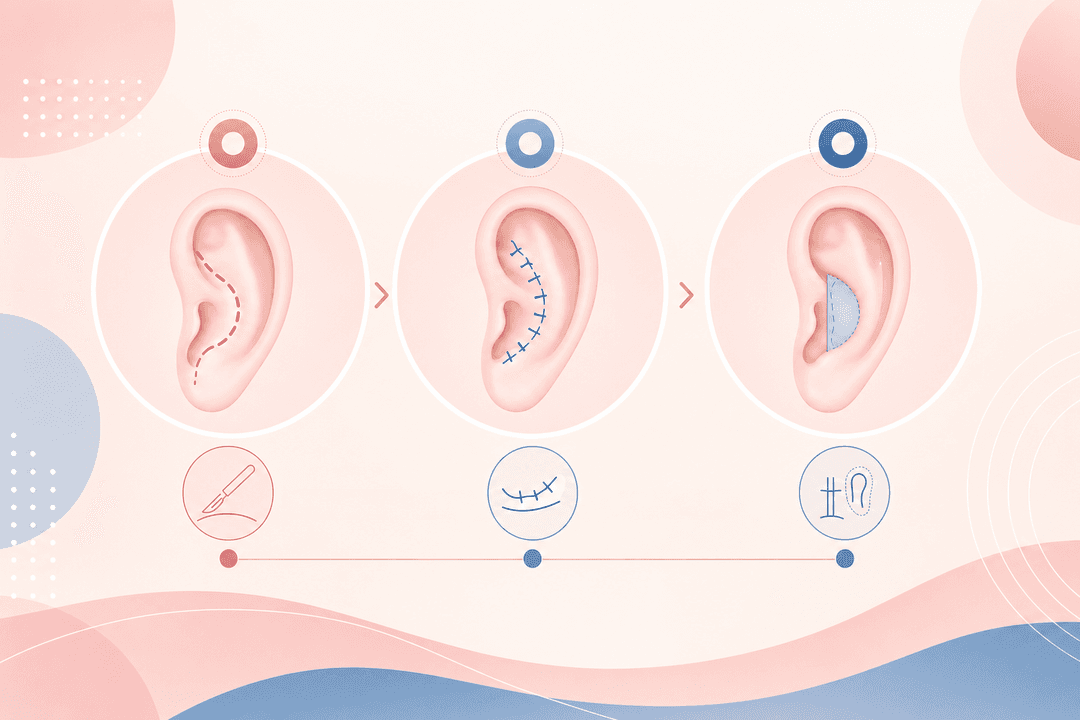
AI-generated illustration
When you enter the operating room, first we inject local anesthesia (Lidocaine 0.5% + Epinephrine 1:200,000) into the skin behind the ear. Then, we lower your consciousness with sedation anesthesia (propofol-based), so the patient barely remembers anything.
When you enter the operating room, we first inject local anesthesia (Lidocaine 0.5% + Epinephrine 1:200,000) into the skin behind the ear. Then, we lower your consciousness with sedation anesthesia (propofol-based), so the patient barely remembers anything. Since it is not general anesthesia, breathing is maintained spontaneously, and you can wake up immediately after the surgery.
The incision is made only about 2-3 cm along the folded groove behind the ear (retroaural opening). When the skin is spread open, the cartilage is exposed. We tie 3-5 points on this cartilage using absorbable sutures (Vicryl 4-0 or PDS 5-0) and fold it inward. We do not cut the cartilage itself; instead, we fix its shape using sutures. In its 2018 safety guidelines for ear surgery sutures, the U.S. FDA announced that the infection rate when using absorbable sutures is 0.8% or less.
Once the suturing is finished, the skin is covered again, and the surface is closed with non-absorbable sutures (Nylon 5-0). This is the part that will be removed later. Finally, the surgery concludes with the entire ear wrapped in gauze and a compression band applied. The total time required is an average of 60-75 minutes for both ears.
Clinical: The number of sutures varies depending on the size of the ear and the thickness of the cartilage. If the cartilage is thick, it may increase to 5-6 sutures, while 3 sutures are sufficient if it is thin. During surgery, a specialist checks and adjusts the angle.
Stage
Time
Materials Used
Patient Condition
Anesthesia
10 minutes
Lidocaine + Propofol
Sleep State
Incision
5 minutes
No. 15 Scalpel Blade
Painless
Cartilage Suturing
30-50 minutes
Vicryl 4-0, PDS 5-0
Painless
Skin Suturing
10 minutes
Nylon 5-0
Painless
Compression Bandage
5 minutes
Gauze + Elastic Bandage
Start of Awakening
Surgery time may vary from 30 to 120 minutes depending on ear size and correction range.
Phase 4: Recovery Phase First 72 Hours — Compression Bands Determine the Outcome
You will rest in the recovery room for 30 minutes to 1 hour immediately after surgery and then go home. You must absolutely not lie down on the day of the surgery and must sleep with your upper body raised at an angle of 45 degrees or more. This is because gravity causes blood to pool towards the ears, which worsens swelling. A semi-sitting position using 2-3 stacked pillows is best.
The principle is to wear the compression band for 24 hours during the 72 hours following surgery. You must not remove it even when showering or washing your face, as these three days are the golden time for the cartilage to fix in its new position. According to 2021 clinical data from the Korean Society of Plastic and Reconstructive Surgeons, the recurrence rate was 12% for the group that wore the compression band for less than 72 hours, and 2.3% for the group that wore it for 72 hours or more.
The pain is milder than expected. Tylenol 500mg is sufficient, and you must take the prescribed antibiotic (cephalosporin) for 5 full days. Swelling peaks 48–72 hours after surgery and then gradually subsides. Applying a cold compress for 10 minutes every 2 hours for the first 48 hours is helpful.
Compression bandage duration: Wear for 24 hours during the first 72 hours, then only while sleeping for 4-7 days.
Swelling peak: 48-72 hours after surgery.
Cold compress frequency: 10 minutes every 2 hours during the first 48 hours.
Shower allowed: 3 days after surgery, avoid getting water on the ears.
Step 5: Suture removal and return to daily routine after 2 weeks.
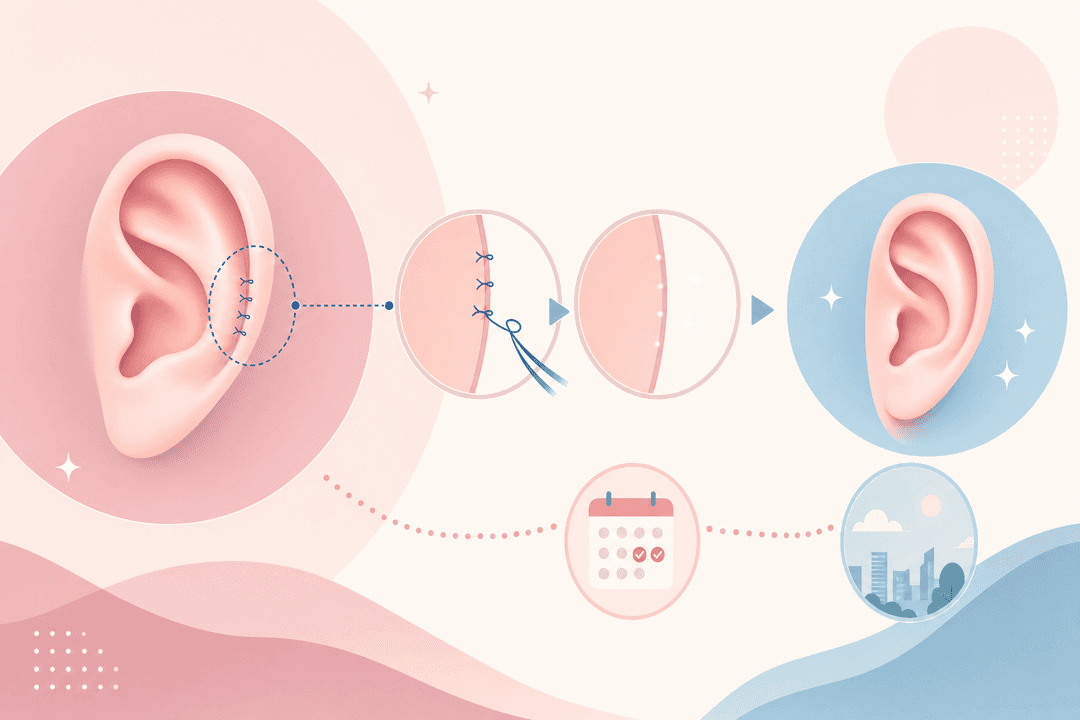
AI-generated illustration
The sutures are removed 7-10 days after surgery. It stings slightly during removal but is over in 1-2 minutes, and no anesthesia is used. You may let water touch your ears when showering starting from the day the sutures are removed, but soap and shampoo are recommended to be used at least 2 weeks later. There is a risk of hyperpigmentation if chemical components come into contact with the incision before it has completely healed.
It is safe to wear a compression bandage while sleeping for another two weeks even after the stitches are removed. If you unconsciously fold your ear or press it against a pillow while sleeping, the cartilage may straighten out again. You can return to your daily routine, but vigorous exercise (jogging, weight training) should be avoided for at least three weeks. This is because an increase in heart rate increases blood flow to the ear, applying pressure to the suture site.
Since the scar is located in the folded area behind the ear, it is barely visible from the front. If you apply a scar ointment (silicone gel, e.g., Dermatix Ultra) twice a day starting two months after surgery, the scar width will decrease to an average of less than 1mm after six months. The final results are evaluated after 6 months. Until then, you should avoid exposure to direct sunlight and apply sunscreen (SPF 50+) behind your ears to prevent pigmentation.
Caution: If you loosen the compression bandage before the stitches are removed, the cartilage may return to its original position. Even if it itches, absolutely do not scratch; only gently tap over the band.
Suture removal time: 7-10 days later
Additional compression bandage: 2 weeks after suture removal, only during sleep
Resumption of vigorous exercise: 3 weeks later
Final result evaluation: 6 months later
Comparison of anesthesia methods for ear surgery
Local anesthesia alone [Awakened state]
Use only lidocaine injection
Conversation possible during surgery
Immediate discharge possible
Cost 200,000-300,000 Won Affordable
For cases where pain sensitivity is low and a quick return to daily life is desired
Local + Sedation Anesthesia (General) [Semi-sedation]
Additional administration of Propofol
Little memory of surgery
Recovery room 30 minutes-1 hour
Most common choice
Recommended for high anxiety or simultaneous correction of both ears
General Anesthesia [Full Sedation]
Anesthesia after tracheal intubation
Surgery time
For procedures over 2 hours
Recovery 2-3 hours
Additional cost of 500,000-800,000 KRW
Only for children (10 years or under) or for the correction of complex deformities
Preparing for ear surgery tailored to your situation
If you are a working professional and want surgery with minimal vacation time
Friday surgery → Weekend recovery → Return to work on Monday
The compression band can be covered with a hat, and if you wear it 24 hours a day for 72 hours, you can take it off during the day on Monday
If you tend to be sensitive to pain and anxiety
Select local + sedation anesthesia + 1 hour of rest in the recovery room
With sedation anesthesia, you have almost no memory of the surgery, so the psychological burden is low, and it costs only 200,000 to 300,000 won more than local anesthesia
If scarring is your biggest concern
Use silicone gel immediately after suture removal + UV protection for 6 months
The incision line behind the ear is not visible from the front, but early care is key to preventing hyperpigmentation
If you want to correct asymmetry in both ears as well
Request angle check during surgery + coordinate number of sutures
If the thickness of the cartilage in the left and right ears differs, the number of sutures is adjusted differently to achieve symmetry. Please mention this during the consultation.
Common misconceptions
Misconception Ear surgery involves cutting cartilage, so recovery takes a long time
Truth Most ear surgeries fix the cartilage using only sutures, without cutting it. Cartilage incision is only applicable to special deformities (cup ears, rep ears), and general protruding ear correction is possible with suturing alone, so recovery is fast.
Misconception: You can wash your hair immediately after the stitches are removed.
Truth: On the day the stitches are removed, rinse lightly with water only, and use soap and shampoo after 2 weeks. If chemical components come into contact with the incision before it has fully healed, the risk of hyperpigmentation increases by more than double.
Absolutely Forbidden Actions After Ear Surgery
!!Avoid removing compression bandages for 3 days after surgery (Cartilage recurrence rate skyrockets to 12%)!!
!!Sleep lying down on the day of surgery (Swelling increases twofold; keeping the upper body upright at a 45-degree angle is essential)!!
Folding, rubbing, or scratching the ears for 2 weeks after surgery (Suture displacement)
!!Intense exercise such as jogging or weight training within 3 weeks (Risk of bleeding if heart rate rises)!!
Going out without UV protection behind the ears for 6 months (Causes hyperpigmentation)
Frequently Asked Questions
Can I go to work the day after surgery?
Yes, it is possible if you can cover the compression band with a hat. However, since the rule is to wear it 24 hours a day for the first 72 hours, having only the band exposed without a hat might be uncomfortable. It is safer to rest for 2-3 days if possible.
Do I have to do both sides even if only one ear is protruding?
No. It is possible to correct just one side. However, please check during the consultation whether the left and right sides are symmetrical when viewed from the front. Occasionally, the angle may be subtly different even on the side that is not protruding, so correction of both sides may be recommended depending on the specialist's judgment.
Does it hurt when the stitches are removed?
It is just a slight sting. It is over in 1-2 minutes without anesthesia, and they say the sensation of the stitches coming out is greater than the pain. If you become overly tense, your muscles may stiffen and cause more pain, so please breathe comfortably.
What is the likelihood of recurrence after ear surgery?
If you wear the compression band for more than 72 hours and wear it additionally while sleeping for 2 weeks, the recurrence rate is 2-3%. Recurrence is mostly caused by neglecting initial compression, so management during the first week is key.
Does ear sensation become dull after surgery? (Side effect)
The area around the incision site (behind the ear) may feel slightly numb for 1-2 weeks immediately after surgery. This is due to local anesthesia and swelling, and in most cases, it returns to normal within 4-6 weeks. However, in extremely rare cases (less than 0.5%), sensory impairment may persist due to nerve damage, so please consult a specialist if there is no improvement after 3 months post-surgery.
Approximately how much does it cost?
For both ears, it is around 1.5 to 2.5 million won. Adding local and general anesthesia costs an additional 200,000 to 300,000 won, and if cartilage incision is required, the cost may go up by 500,000 to 800,000 won. Prices vary significantly by hospital, so please get an accurate quote during the consultation.
This content is for informational purposes only and does not replace medical advice.
As the process and results of ear surgery can vary depending on an individual's ear structure, cartilage thickness, and the scope of correction, please be sure to consult thoroughly with a board-certified plastic surgeon before surgery.
Find the Right Hospital for You at K-Dia