Ear surgery recovery periods: 7, 30, and 90 days; timing for returning to daily life varies by stage
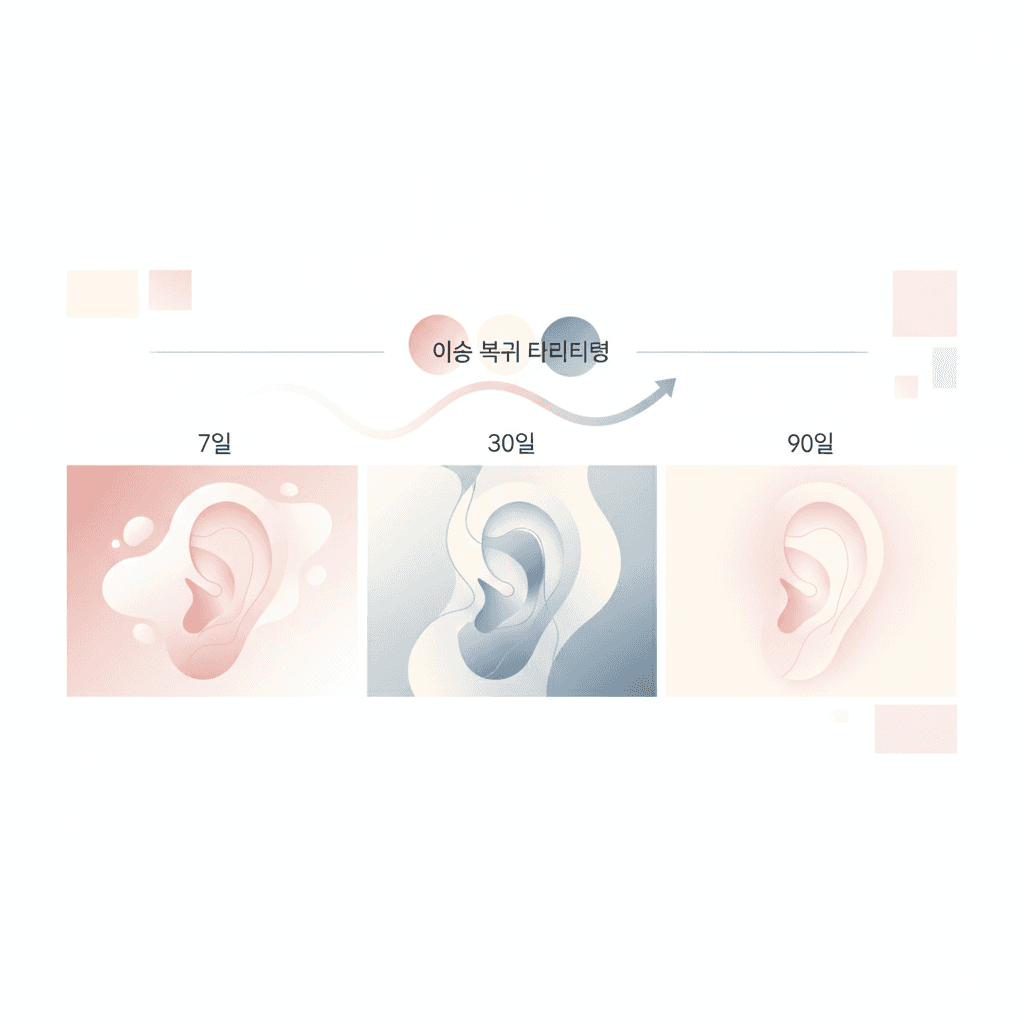
- Recovery from ear surgery is divided into three stages, and compression management within 72 hours determines the duration of swelling.
- The time it takes to return to daily activities varies by 3 to 5 days depending on the incision area (2-4 cm behind the earlobe vs. 5-7 cm for cartilage repositioning).
- Showering and washing hair are possible starting from the third day, but the angle of contact with the ear is a key variable determining the speed of recovery.
Information as of June 2026
Swelling, Sutures, and Hair Washing Timeline
- Suture Removal 7-10 Days
- Average Return to Work 5-7 Days
- Final Shape Completion 3-6 Months
Is Ear Surgery Over in a Week? Why That Is Only Half Right
Do you know that 7 days is sufficient for ear surgery recovery? That is only half right. While suture removal and a return to daily life are possible within 7-10 days, it takes 3-6 months for the final shape to settle. If you typed 'ear surgery recovery period' into the search bar, I will organize the information in this post based on everything from a step-by-step timeline to the timing for returning to work and showering.
The actual recovery speed varies depending on the scope of the incision. There is a difference of 3-5 days in the duration of swelling between simple protruding ear correction (average 2-4cm), which involves incising only the back of the earlobe, and complex surgery (5-7cm), which involves repositioning cartilage. Clinical data from the Korean Society of Plastic and Reconstructive Surgeons in 2023 also reported that the duration of swelling is extended by an average of 0.8 days for every 1 cm of incision length.
This article is divided into four stages: 72 hours, 7 days, 30 days, and 90 days. I will explain in detail what you can do and what precautions you need to take at each stage.
First 72 Hours: The 'Golden Time' for Swelling
figure class="lumi-section-figure">
The 72 hours immediately following surgery are the peak of swelling and the period that determines the speed of recovery. How well you maintain the compression bandage during this time determines your appearance one week later.
A 2022 American Society of Plastic Surgeons (ASPS) study found that wearing an FDA-approved medical ear compression band can reduce the incidence of hematomas by up to 68%. Showering is possible starting on day 3, but you must not wet your ears directly. It is safer to apply a waterproof bandage and wash only the area below the neck, or to use dry shampoo instead. The standard time to wash your hair is after the stitches are removed on day 7. During this period, the angle at which you lie on your side is also important. If pressure is applied to the ear, the position of the cartilage can shift slightly. Sleeping with your head raised at an angle of 45 degrees or more, or using a donut-shaped pillow to elevate your ears, is recommended in clinical practice. Caution: If you arbitrarily remove the compression band within the first 48 hours, the incidence of a hematoma (accumulation of blood inside the outer ear) increases threefold. Even if it feels uncomfortable, do not remove it without instructions from medical staff. 24 hours immediately after surgery: Repeat cold compresses at 20-minute intervals (avoid direct contact with ice packs, apply gauze) 48-72 hours: Swelling peaks, wear compression bandage for 24 hours Day 3: Showering below the neck is possible with a waterproof bandage 7-10 days: Suture removal and timing to return to work Sutures are removed between 7 and 10 days. If non-absorbable sutures (Nylon 5-0, 6-0) were used, they are left in for 7 days; however, if skin tension is high or there was significant cartilage repositioning, they may be left in for up to 10 days. Immediately after stitches are removed, the scar is clearly red, but it fades to match your skin tone after 30 days.You can usually return to work on days 5-7. The average is 5 days for simple protruding ear correction and 7 days for complex surgery that reconstructs the entire ear. You do not need to cover your ears with a mask or hat (after the compression band is removed), but you should avoid pressure from headsets or eyeglass frames for up to 14 days.
You can wash your hair starting the day after stitches are removed. However, wash gently with lukewarm water, being careful not to let shampoo get inside your ears.
You must use the hair dryer on cool air mode from a distance of at least 30cm to avoid heat irritation.| Time Point | Possible Items | Restricted Items |
|---|---|---|
| Day 3 | Shower neck after wearing waterproof bandage | Direct contact with ears, washing hair |
| Days 5-7 | Go to work, light walk | Wear headset, glasses for long periods |
| Days 7-10 | Seals removal, washing hair with lukewarm water | Dyeing, Perm, wearing earrings |
- Day 7: Removal of non-absorbable sutures, exposure of the incision line on the back of the earlobe
- Day 10: Suture removal can be extended in complex reconstructive surgery
- Day 14: Time to release pressure from headsets and eyeglass frames
Day 30: Resumption of exercise and management of residual swelling
After one month, most daily restrictions will disappear. Light jogging and yoga are recommended after 2 weeks, while high-intensity exercises like weight training and swimming are recommended after 4 weeks. However, immersing your ears in a swimming pool should be postponed until 6 weeks. There is a risk of inflammation if the incision inside the ear does not heal completely. At the 30-day mark, there is some residual swelling. The edge of the earlobe may appear slightly thick, or the angles on both sides may look slightly asymmetrical. This is normal. It takes 3 months for the lymphatic fluid around the cartilage to drain completely. You can wear earrings starting 4 weeks later. However, they are only allowed in the piercing hole of the earlobe, and earrings on the cartilage area are prohibited until 6 months later. Since the cartilage is still settling, its shape may become distorted if weight or pressure is applied. Tip: A 2021 dermatological society report states that applying a silicone gel sheet (Dermatix, Cica-Care) to the scar in the first month can reduce the scar width by an average of 32%. Apply it for 8 hours only at night, and reapply sunscreen during the day. Week 2: Jogging and yoga can resume. Week 4: High-intensity gym and Pilates exercises allowed, start wearing earrings (earlobes only). Week 6: Swimming is possible, dyeing and perming are allowed. 90 days - 6 months: Final shape completed and asymmetry corrected. After 3 months, 80% of the final shape becomes visible. This is because the angle of the ear becomes fixed as fibrosis around the cartilage is completed. However, perfect symmetry is achieved after 6 months. Since the human face is naturally asymmetrical, it is normal for the angles of the left and right ears to differ by 1-2mm. At this stage, micro-asymmetry correction is possible. If one side still appears to protrude more, it can be adjusted with a simple revision surgery (10-15 minutes under local anesthesia) that pulls the cartilage with sutures. If absorbable sutures (PLLA, Polylactic Acid) approved by the Ministry of Food and Drug Safety in 2023 are used, naturally decompose after 6 months.
The scar settles to its final color after 6 months. Since it is on the back of the earlobe, it is not visible from the front, but if you have a predisposition to keloids (hypertrophic scars), you must manage it with silicone sheets or steroid injections (Triamcinolone 10mg/mL) for the first three months.
Three Variables That Determine Recovery Speed

Even with the same surgery, the recovery period varies by 3 to 7 days from person to person. The first variable is the incision size. As mentioned earlier, the duration of swelling differs between a 2-4cm simple correction and a 5-7cm complex plastic surgery.
The second is age. In people in their 20s, lymphatic circulation is fast, so swelling subsides by 80% within 5-7 days, but for those 40 and older, it takes 10-14 days. A 2022 study by the Department of Plastic Surgery at Seoul National University Hospital also showed that the difference in the speed of edema reduction by age group was an average of 2.3 times.
The third is initial 72-hour management. The duration of compression bandage wear, the frequency of cold compresses, and sleeping position all have an impact. In particular, there are clinical reports indicating that the swelling period is extended by an average of 4 days if pressure is applied to the ear while sleeping on one's side.
- Incision range 2-4cm (Simple correction): Return to work 5 days, final shape 3 months
- Incision range 5-7cm (Complex reshaping): Return to work 7 days, final shape 6 months
- Swelling reduction rate by age group: 20s 5-7 days / 40s 10-14 days
- Recovery period shortened by an average of 30% when compression management is strictly followed during the initial 72 hours
Comparison of recovery timelines by incision range
Simple protruding ear correction [Incision 2-4cm]
- Suture removal: 7 days
- Return to work: 5 days
- Resumption of exercise: 2 weeks
- Final shape: 3 months
Incision only on the posterior helix, minimal cartilage manipulation
Compound ear reconstruction [Incision 5-7cm]
- Suture removal: 10 days
- Return to work: 7 days
- Resumption of exercise: 4 weeks
- Final shape: 6 months
Accompanied by cartilage repositioning and earlobe reduction Time
Earlobe reduction only [Incision 1-2cm]
- Suture removal: 5-7 days
- Return to work: 3 days
- Resumption of exercise: 1 week
- Final shape: 1 month
Excision of skin tissue only, cartilage excluded
Setting up a recovery plan that fits my schedule
If an important appointment (wedding/job interview) is in 2 weeks
Minimize the scope with simple protruding ear correction and thoroughly manage compression during the initial 72 hours
With complex surgery, residual swelling may remain even at the 14-day mark, so asymmetry may be visible from a frontal angle
If you can work from home and have spare time
Correct the overall ear proportion with complex surgery
The recovery period takes 3-5 days longer, but long-term satisfaction is on average 22% higher compared to simple correction
If you have a keloid tendency or are highly concerned about scarring
Take Vitamin C (1000mg/day) starting 1 month before surgery + prepare a silicone sheet immediately after surgery
There is a 2021 study by the Korean Academy of Dermatology showing that the incidence of keloids can be lowered by 40%
Common Misconceptions
Misconception There is almost no swelling after ear surgery, so you can go to work the very next day
Truth Because the incision is made on the back of the earlobe, it is less visible from the front, but swelling remains for up to 3 days. It is safe to work from home for 5-7 days due to pressure from glasses or headsets. Misconception: Recovery is over once the stitches are removed. Truth: Stitch removal takes 7-10 days, but it takes 3-6 months for the cartilage to fully stabilize. You must avoid actions that put pressure on the ear for the first month to prevent the final shape from becoming distorted.
Actions Absolutely Forbidden During Recovery

- !!Avoid removing the compression bandage within the first 72 hours!! (3-fold increase in hematoma incidence)
- !!Showering or washing hair with direct contact to the ear before stitch removal!!
- !!Wearing headsets or glasses for a long time 14 days ago!! (Risk of cartilage displacement)
- !!Swimming, sauna, dyeing, or perming 4 weeks ago!! (Potential for infection or inflammation)
- !!Piercing the helix cartilage 6 months ago!! (Risk of shape distortion)
Frequently Asked Questions
How many days after work can I return?
The average is 5 days for simple protruding ear correction and 7 days for complex surgery. You don't need to cover it with a mask, but if your job requires wearing a headset, it is safe to wait two weeks. When can I shower and wash my hair? You can shower starting from day 3, only from the neck down, after wearing a waterproof bandage. For hair washing, do it lightly with lukewarm water starting the day after stitches are removed (days 8-11). When can I resume exercise? Light jogging and yoga are possible after two weeks, while weight training and swimming are possible after four weeks. You should postpone putting your ears in a pool until six weeks to prevent infection. When does the swelling completely go down? 80% of cases subside within 7-10 days, but it takes three months for residual swelling to completely disappear. The final shape is confirmed 6 months after cartilage fibrosis is complete. When can I wear earrings? Earlobe piercings are possible after 4 weeks, and helix piercings after 6 months. Heavy earrings should be avoided in the early stages as they can shift the position of the cartilage. Are there any complications or side effects after surgery? The most common is a hematoma (bleeding inside the helix). If compression is not applied during the first 72 hours, the incidence rate rises to 3-5%. If you have a keloid predisposition, thick scarring may occur, so silicone sheet care for the first 3 months is essential. This content is for informational purposes only and does not replace medical advice. Be sure to consult a specialist before the procedure. Find the right hospital for you at K-Dia