The 8 Steps of Rhinoplasty: From Consultation to Recovery, Explained Simply
- Items to prepare starting 2 weeks before surgery and a list of information that must be shared during the consultation
- The actual sequence of procedures on the day of surgery, from anesthesia and incision to plastic surgery and suturing, and the time required for each stage
- Recovery timelines for days 1, 3, 7, 14, and 3 months, along with prohibited behaviors for each stage
Information as of June 2026
The Actual Process Explained by a Specialist
- Average Surgery Time: 90-120 minutes
- Total Recovery Period: 6-12 months
- Required Outpatient Visits: 4-6 times
What 90% Miss Before Deciding on Surgery
Rhinoplasty
The 15% cancellation rate is actually often due to a lack of preparation. You are required to stop taking medications that affect blood clotting (such as aspirin, Omega-3, and Vitamin E) starting two weeks before surgery; this means that there are many people who postpone their appointments after only learning this fact on the day of the consultation. You can think of the rhinoplasty process as starting with preparation before the consultation. It is advisable to bring three photos of your face—frontal, profile, and 45-degree angles—a photo of the nose of a celebrity you admire, and a medical history report if you have ever injured your face in the past. You must also share any history of rhinitis or sinusitis. The internal structure of the nose is crucial in determining the scope of the surgery. According to the 2023 report by the Korean Society of Plastic and Reconstructive Surgeons, if functional improvement (septal correction) is performed together, the surgery time takes about 30 to 40 minutes longer. Caution: If a hospital recommends a CT scan before a consultation, it can be considered a more trustworthy place. We need to check the thickness of the bone or cartilage in advance to accurately plan the silicone thickness or the scope of the osteotomy. Essential items for consultation: Front, side, and 45-degree facial photos, medication history, history of rhinitis. Drugs prohibited starting 2 weeks before surgery: Aspirin, Omega-3, Vitamin E, Ginkgo biloba extract. If accompanied by functional improvement, surgery takes an additional 30-40 minutes.From consultation to confirmed surgery
Preparations for rhinoplasty consultation are not just photos or medical history. You must be able to accurately articulate 'from which angle you are dissatisfied' with your nose to determine the desired scope of surgery.
During the consultation, the specialist first measures the dorsal angle (the angle formed by the bridge of the nose and the forehead). The silicone height is determined based on the average Korean angle of 130–135 degrees. The ideal nasolabial angle is 90–100 degrees, but a difference of just 5 degrees can drastically change your impression. Surgical methods are broadly divided into Open and Closed types. The Open type involves incising the nasal septum to secure a clear view and is primarily chosen when extensive rhinoplasty of the nose is required. The Closed type involves incising only the inside of the nostrils, but it is more difficult, so it is important to find an experienced specialist. Key Point: Confirming surgery immediately on the day of the consultation can be somewhat risky. It is recommended to consult with at least 2-3 places and carefully compare the surgical methods, materials (silicone brand, autologous cartilage harvesting site), and estimated recovery schedule.
| Item | Open | Closed |
|---|---|---|
| Incision Location | Nasal Columella (External) | Inside the Nostril (Internal) |
| Scar | Nasal Columella 3-5mm (Almost invisible after 3 months) | No External Scar |
| Surgery | Wide Field of View | Restricted |
| Recovery Period | Slightly Longer Swelling (+3-5 days) | Fast Swelling |
| Suitable Cases | Tip Rotation, Extension, or Reduction | Bridge Only or Minor Tip Correction |
- Average Nasal Angle: Koreans 130-135 degrees, Westerners 120 degrees
- Abnormal Nasal Angle (Tip Rotation Angle): 90-100 degrees
- Open vs. Close Selection Criteria: Tip Modification Scope and Difficulty
From 2 Weeks Before Surgery to D-Day

The 2 weeks after surgery is confirmed is a really important time to prepare for the day of rhinoplasty. Blood tests (CBC, PT/aPTT) and a chest X-ray are mandatory, and if you are over 40, an electrocardiogram is performed additionally. It is recommended to start quitting smoking at least two weeks in advance. Nicotine constricts capillaries and can increase the risk of skin necrosis by three times. Please also refrain from drinking alcohol starting one week in advance. You must fast from midnight the night before surgery. This is to prevent stomach contents from refluxing into the lungs during general anesthesia. You may only drink water up to 6 hours before surgery.
- Essential tests: Blood tests (CBC, PT/aPTT), chest X-ray, ECG for those 40 years and older
- Smoking cessation start time: At least 2 weeks before surgery
- Fasting start time: 12 AM the night before surgery (Water up to 6 hours before)
Actual sequence on the day of surgery
The anesthesia process for rhinoplasty is conducted under sedation or general anesthesia. Sedation involves inducing sleep by intravenously injecting Propofol, while general anesthesia assists breathing through tracheal intubation.
Once disinfection and draping (covering the surgical site with a cloth so only the area is visible) are completed after anesthesia, the incision begins in earnest.
For the open type, an inverted V-shaped incision is made in the nasal septum, while for the closed type, the mucous membrane inside the nostril is incised. Silicone insertion takes about 15 minutes on average, but if autologous cartilage (ear, nasal septum, or rib cartilage) is harvested at the same time, an additional 30 to 50 minutes is added. Ear cartilage is mainly used for the tip of the nose, and rib cartilage is used when significant height of the nasal bridge is required; however, rib cartilage may leave a scar of about 1 to 2 cm at the harvesting site. After suturing, packing (gauze) is placed inside the nose, and a cast is applied to the outside. The packing is removed after 24-48 hours, and the cast is kept on for 7 days. Clinical The absorption rate of costal cartilage is 10-15%, which is higher than that of ear cartilage (less than 5%). It is said that it should only be used when a significant height needs to be raised, and that resolving the issue with ear or nasal septal cartilage is better in the long run if possible.| Step | Time Required | Content |
|---|---|---|
| Anesthesia | 10-15 minutes | Sedation (Propofol) or General Anesthesia |
| Disinfection and Draping | 5 minutes | Disinfection of the surgical site and dressing Covering |
| Incision | 5-10 minutes | Open (columella) or Closed (inside the nostrils) |
| Silicone Insertion | 15 minutes | Insert after dissection of the nasal bridge space |
| Autologous Cartilage Harvesting and Shaping | 30-50 minutes | Tip Shaping after Harvesting Ear, Septal, or Rib Cartilage |
| Suturing, Packing, Casting | 10-15 minutes | Suturing of the incision site, packing inside the nose, external Cast |
| Total Surgery Time | 90-120 minutes | Add +30-40 minutes with functional improvement |
- Average Surgery Time: 90-120 minutes (Add +30-40 minutes for functional improvement)
- Silicone Insertion Time: 15 minutes
- Additional Time for Autologous Cartilage Harvesting: 30-50 minutes (Varies by area)
Recovery Days 1-7: The Battle Against Swelling
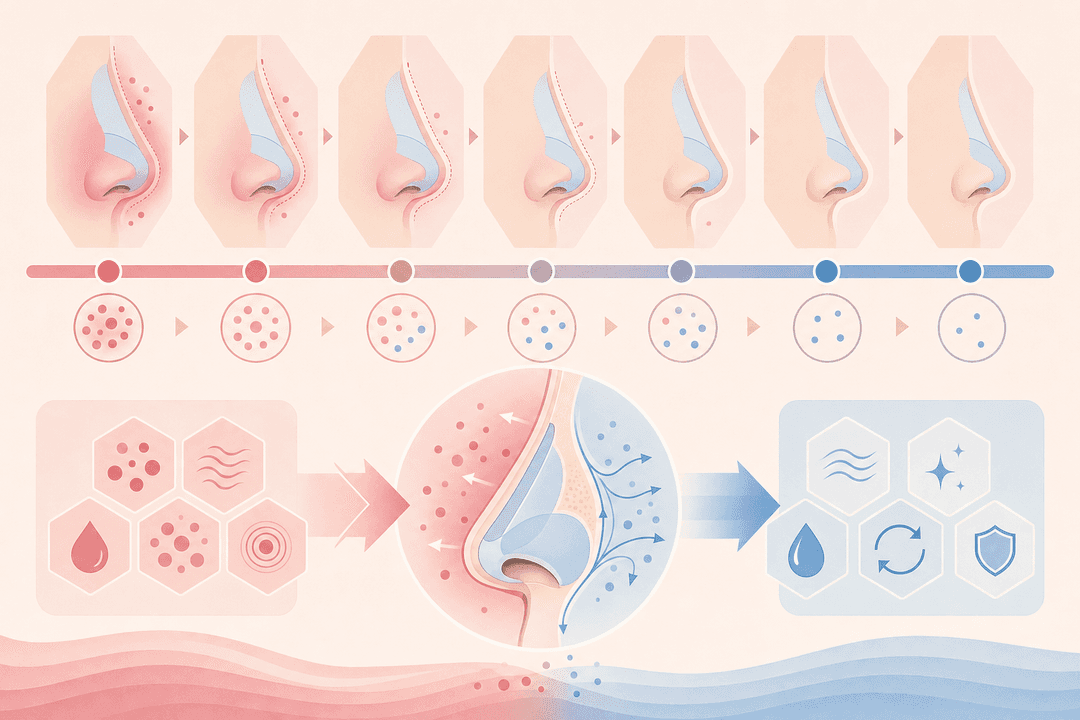
The 24 hours immediately following surgery are the most critical time for managing rhinoplasty swelling. Keep your head elevated above your heart, and applying compresses is strictly prohibited. Hot compresses dilate blood vessels and worsen swelling, while cold compresses can damage the tissue surrounding the silicone. Packing removal is generally done after 48 hours. Once removed, breathing through your nose will become a bit easier, but due to scabs and swelling, it will likely take about two weeks to feel a completely clear opening. The cast is removed on the 7th day. At this time, the rhinoplasty sutures are also removed; for an open rhinoplasty, the sutures on the nasal septum are removed, but for a closed rhinoplasty, if dissolvable sutures were used, there is no need for separate removal. Rhinoplasty Recovery Period: You can go to work or go out during the first week, but wearing glasses is strictly prohibited for up to four weeks. The weight of the eyeglass frame (about 20-30g) presses on the bridge of the nose, which can cause the silicone position to shift. Caution: Do not panic if you feel that your nose shape is 'too high' after removing the cast on day 7. It is still about 20-30% swollen due to edema, and the final outline will gradually appear starting after 3 months.
| Time Point | Condition | Precautions |
|---|---|---|
| Immediately After Surgery | Maximum Edema, Difficulty Breathing | Elevate Head 30 Degrees, No Hot Compresses |
| 24-48 Hours | Before Packing Removal | Breathe Through Mouth Only, Do Not Touch the Nose |
| 3 Days | Edema 70-80% Maintenance | Light walks possible, no bending head |
| 7 days | Cast and stitches removed | Face washing possible, start of glasses ban (4 weeks) |
| 14 days | Swelling reduced by 50% | Resumption of light exercise (running after 4 weeks) |
- Packing removal time: 24-48 hours after surgery
- Cast and stitches removal time: 7 days
- No glasses wear period: 4 weeks (use contact lenses or glasses holder)
Recovery 2 weeks–3 months: The time when the contours become visible
From the second week onwards, swelling subsides by up to 50%, and you can resume your social life in earnest. However, you should still be careful about blowing your nose hard or covering your nose when sneezing.
For rhinoplasty post-care, hospital visits are usually about 4 times in total: at 1 week, 2 weeks, 4 weeks, and 3 months. At the 3-month check-up, the silicone position and the cartilage fixation status are finally checked.
It is recommended to gradually resume exercise starting after 4 weeks. Light jogging is recommended after 4 weeks, weight training after 6 weeks, and swimming or ball sports after 3 months.
Exercise that raises blood pressure can increase the risk of internal nasal bleeding.- Swelling reduction curve: 50% at 2 weeks, 30% at 1 month, less than 5% at 3 months
- Mandatory outpatient schedule: 1 week · 2 weeks · 4 weeks · 3 months (total 4 times)
- Exercise resumption timeline: Jogging 4 weeks, weight training 6 weeks, swimming/ball sports 3 months
6-12 months: Final settlement and long-term management
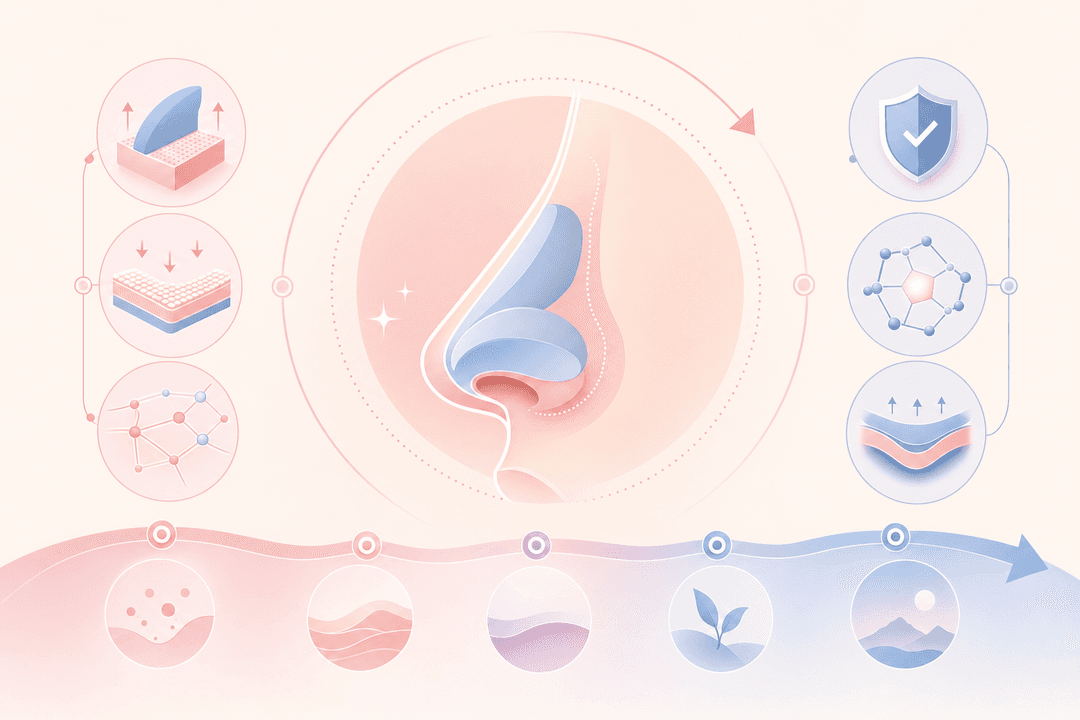
Among the precautions for each stage of rhinoplasty, what many people miss is care after 6 months. It is not over just because the swelling has almost disappeared; it takes at least 6 months for the silicone and autologous cartilage to fully settle. Autologous cartilage can be absorbed by about 10-15%, so the tip of the nose may be slightly lower than immediately after surgery. This is a normal progression, and specialists anticipate this and make it about 10-15% higher from the start. The scar will be completely stabilized after 12 months. The open incision mark (3-5mm on the columella) will fade to a white line after 6 months and become almost invisible after 12 months. Although the closed type does not have external scars, regular checkups are necessary because adhesions in the nasal mucosa may occur. Tip: If the tip of the nose seems to continue lowering even one year after surgery, cartilage absorption may have progressed more than expected. It is safest to decide whether revision surgery is necessary in the second year.
- Autologous cartilage absorption rate: Ear less than 5%, nasal septum 10%, rib cartilage 10-15%
- Scar stabilization period: Color fading after 6 months, complete stabilization after 12 months
- Final contour confirmation time: 6-12 months (individual differences)
Key Summary: 5 Things for a Successful Recovery
The most important thing in the entire rhinoplasty process is 'timing'. Medication adjustment 2 weeks before surgery, no glasses for 4 weeks after cast removal, and resumption of exercise 3 months later—if you do not strictly follow this timeline, the probability of re-surgery can increase by more than double. When consulting, do not just mention the 'shape you want'; please provide specific details about your daily lifestyle patterns (frequency of wearing glasses, exercise habits, business trip schedule). This will allow the specialist to design a surgical method and recovery plan perfectly tailored to you. It is best to manage recovery using numbers. The point at which swelling decreases by 50% (2 weeks), the point at which glasses can be worn again (4 weeks), and the final check-up (3 months)—simply adhering to these three schedules precisely can significantly reduce the risk of complications.
- Key to lowering the probability of revision surgery: Medication control 2 weeks before surgery + No glasses for 4 weeks after surgery + Adherence to regular check-ups every 3 months
- Information to share during consultation: Frequency of wearing glasses · Exercise habits · Overseas travel · History of rhinitis · Past facial trauma
- Principles for the first 3 days that determine recovery speed: Elevate head by 30 degrees · No compresses · Do not touch the nose
- Check points 6 months later for long-term maintenance: Status of silicone fixation · Cartilage absorption rate · Scar stabilization status
Common misconceptions
Misconception The shape looks best immediately after surgery and deteriorates over time
Truth Immediately after surgery, the area is swollen by about 20-30% due to edema. The true contours begin to appear after 6 months. Since the cartilage is built high from the start to account for autologous cartilage absorption, you should view this as a process of 'settlement' rather than 'deterioration'. Misconception You can return to daily life immediately after removing the cast Truth Removing the cast (after 7 days) is just the starting point of recovery. No glasses for 4 weeks, no weight training for 6 weeks, no saunas for 3 months—you must strictly follow these step-by-step restrictions to prevent the silicone from shifting and maintain a beautiful nose.Absolutely Prohibited Actions During Recovery
- Wear glasses or sunglasses for 4 weeks after surgery (use contact lenses or glasses holders)
- Blow your nose hard or block your nose when sneezing for 2 weeks after surgery
- Exercises that increase abdominal pressure, such as weight training, yoga, or Pilates, for 6 weeks after surgery
- Saunas, steam rooms, or hot baths for 3 months after surgery (worsen swelling due to vasodilation)
- Sleep on your stomach for 1 month after surgery (applies pressure to the nose and causes asymmetry)
Frequently Asked Questions
Office workers can return after the cast is removed (7 days), but since about 50% of the swelling remains, you will likely need makeup. If you have a lot of face-to-face work, it is safer to wait 2 weeks. For manual labor or service jobs, 3-4 weeks is recommended.
When can I drink alcohol?
Only very small amounts are allowed starting at least 2 weeks later. Alcohol dilates blood vessels, which can worsen swelling, and there is also a risk of infection before the stitches are removed. It is best to avoid excessive drinking until you have fully recovered (3 months).
Can the silicone become crooked or fall out?
Wearing glasses within 4 weeks or bumping your nose hard can cause the position to shift. Since the silicone is fully fixed to the surrounding tissue after 3 months, you must be careful of external impacts until then. If you suspect that it may be crooked, it is best to visit the hospital immediately. What are the side effects or complications after rhinoplasty? The most common side effect is contracture (a phenomenon where the capsule thickens and the nose becomes hard, 5-10%). Infection (less than 1%), silicone protrusion (a phenomenon where the silicone becomes visible as the skin at the tip of the nose thins, 2-3%), and asymmetry (around 5%) have also been reported. If you smoke or have diabetes, the risk of complications may be higher, so it is important to consult with a specialist before surgery. I heard that autologous cartilage is absorbed; does the tip of the nose become lower? Ear cartilage can be absorbed by less than 5%, while rib cartilage can be absorbed by about 10-15%. Because the specialist anticipates this and makes it about 10-15% higher from the start, the final shape will be almost the same as what was planned. However, since the absorption rate varies greatly from person to person, it is recommended to confirm it during a check-up one year later. When is revision surgery necessary? The main causes are silicone placement asymmetry, deformation due to contracture, and sagging of the nasal tip. It is best to decide on revision surgery at least 6 months later, or preferably after 1 year. You should make a decision after the swelling has completely subsided to avoid unnecessary revision surgery.