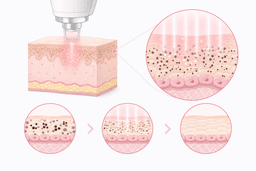
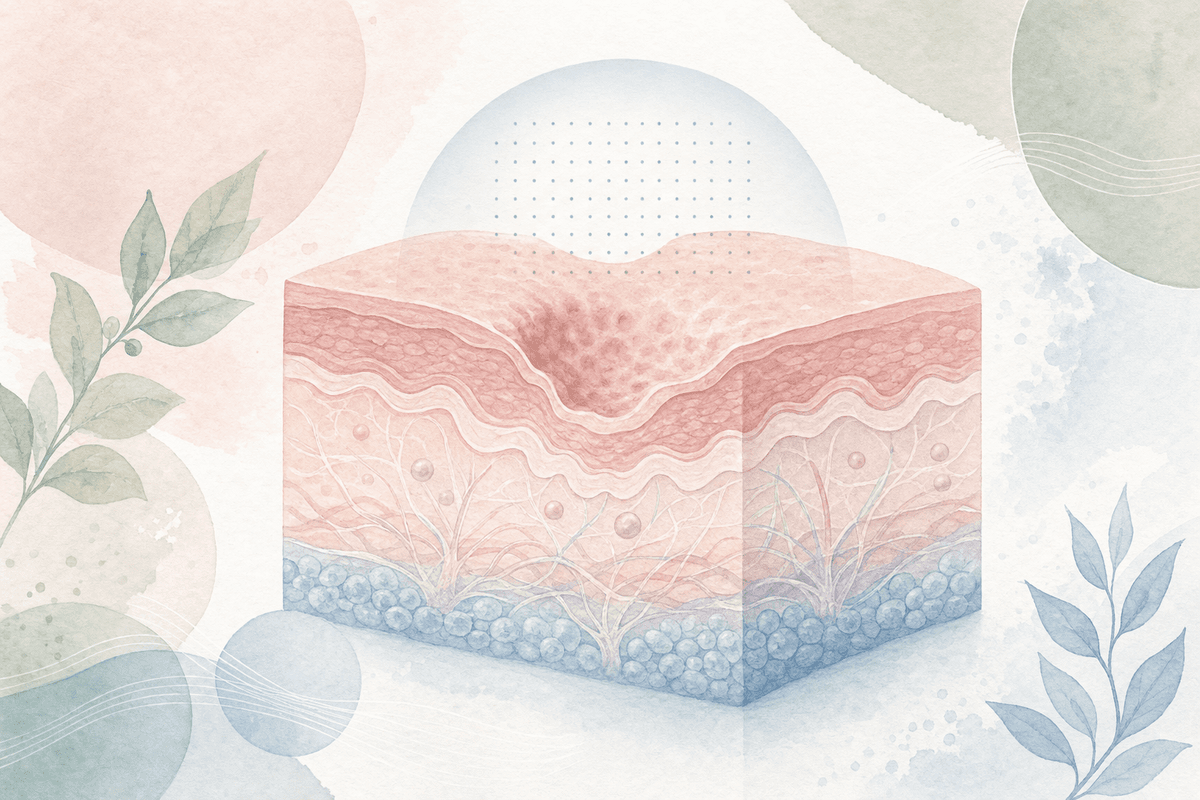
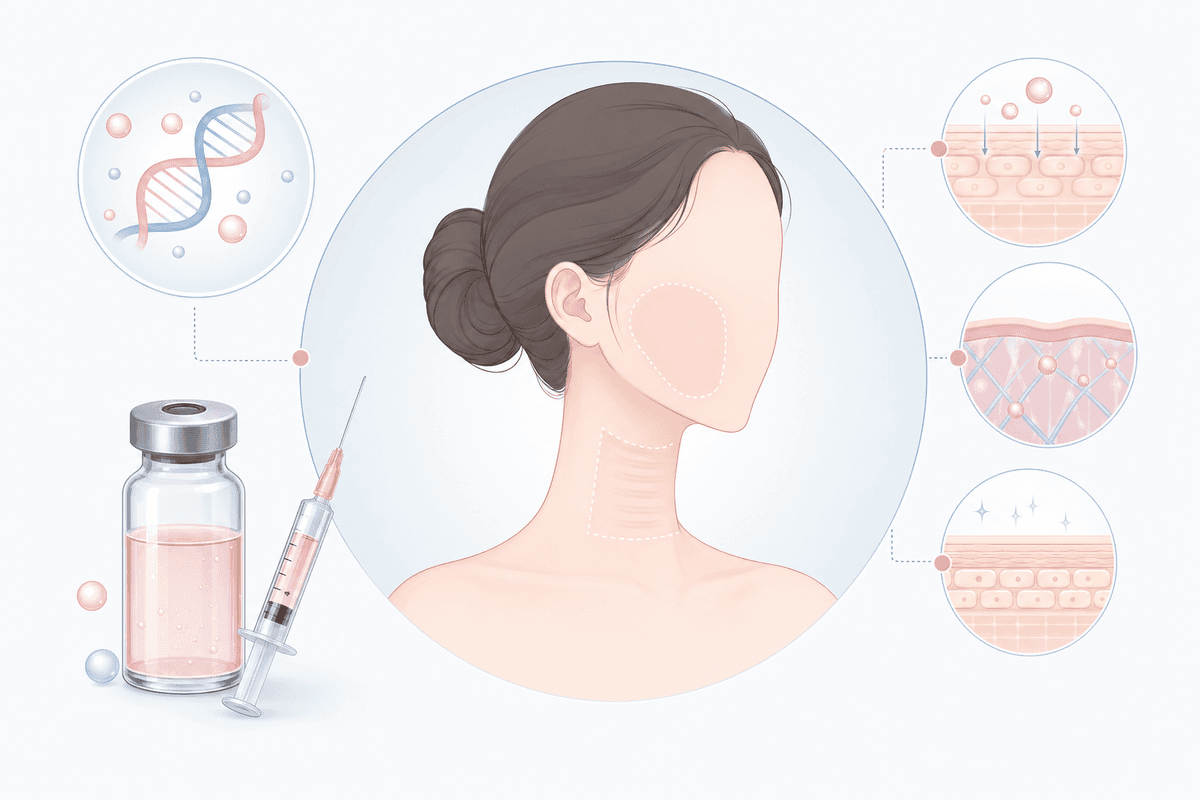
We will properly explain the 3 key principles of thread lifting procedures and the characteristics of each type.
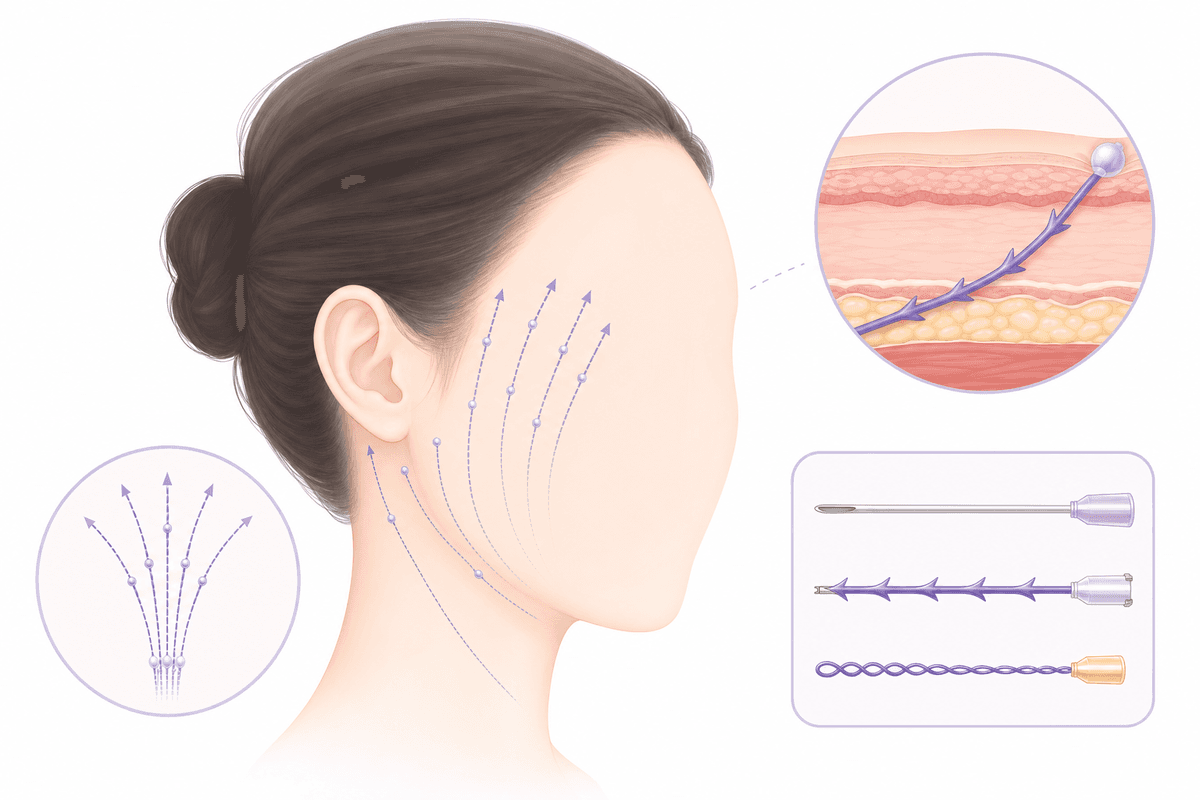
Thread lifting is a non-surgical lifting procedure in which threads inserted into the dermis layer of the skin provide both physical support and biochemical stimulation. The three main materials—PDO, PCL, and PLLA—have completely different degradation rates and collagen production patterns, and the choice depends on the appropriate age group and the degree of sagging. There are approximately 60 types of products approved by the Korean Ministry of Food and Drug Safety alone, and thread types (cog, screw, mesh)…
Information as of June 2026
Procedure Analysis from a Specialist's Perspective
- Mechanism of action for 3 types of thread materials
- Duration differences of 6-24 months
- Comparison of FDA-approved 4th generation materials
One of the Most Common Misconceptions in the Clinic
"Don't threads just lift the face?" — This single assumption reduces satisfaction by 40%. The effectiveness of thread lifting comes more than 70% from the 'fibroblast activation' that occurs around the threads, rather than the physical force of the threads 'pulling' the skin.
According to histological analysis results presented at the Spring Academic Conference of the Korean Dermatological Association in 2019, collagen density in the dermis increased by an average of 28% starting from the 4th week after thread insertion, and this effect lasted for 3-6 months even after the threads were completely dissolved.
In other words, thread lifting is a regenerative procedure that utilizes the body's 'reaction to foreign materials (threads)'. The material, shape, and insertion depth of the threads determine the intensity and duration of this reaction.
Key Takeaway The essence of thread lifting is 'collagen remodeling' rather than 'lifting'. Immediate and long-term effects must be understood separately.
- Average 28% increase in collagen density at 4 weeks post-insertion (Korean Dermatological Association, 2019)
- Over 70% of the effect originates from fibroblast activation
- Effect lasts for 3-6 months even after complete thread dissolution
Thread Lifting Principle: A 3-Stage Mechanism

Stage 1 (Immediate-2 weeks): Physical support by the thread. The cogs (barbs) or screws on the thread hook onto the subcutaneous fat layer and fascia, physically pulling the tissue upwards. The 'pulling' sensation felt at this stage is the entirety of the initial lifting effect.
Stage 2 (2-8 weeks): Foreign Body Reaction (FBR). Macrophages surround the thread surface and recruit fibroblasts. PDO threads begin hydrolysis during this period, and the breakdown product, lactic acid, lowers pH, increasing vascular endothelial growth factor (VEGF).
Stage 3 (8 weeks-6 months): Collagen synthesis peak. Type I and III collagen arranges around the threads, forming a new fibrous network. For PLLA threads, this stage continues up to 12-18 months, and the collagen capsule remains for over 6 months even after the threads are completely absorbed.
The US FDA approved PDO threads in 2015 and PLLA threads (Silhouette InstaLift) in 2019 for facial lifting purposes, and the Korean Ministry of Food and Drug Safety grants approvals under the same standards.
Clinical Insight The duration of stages 2-3 varies depending on the thread material. PDO effects begin to weaken from 8 weeks, while PLLA peaks after 6 months.
| Stage | Duration | Key Changes | Patient Perception |
|---|---|---|---|
| Stage 1 | Immediate-2 weeks | Physical support & tissue repositioning | Tightness & immediate lift |
| Stage 2 | 2-8 weeks | Foreign body reaction, angiogenesis, pH change | Reduced swelling & contour refinement |
| Stage 3 | 8 weeks-6 months | Collagen synthesis & fibrosis | Increased elasticity & natural volume |
- FDA approval for PDO threads: 2015
- FDA approval for PLLA threads: 2019 (Silhouette InstaLift)
- Peak synthesis of Type I & III collagen: 8-12 weeks
Types of Thread Lifts: Comparison by PDO, PCL, and PLLA Materials
PDO (Polydioxanone): The first-generation material, developed earliest. It has a 40-year safety record as a suture material and is hydrolyzed into water and carbon dioxide over 6-8 months in the body. Its rapid dissolution leads to strong initial effects but a short duration.
Representative domestic products include 'Ultrocol', 'Mint Lift', and 'Qoophil', with thread thicknesses varying from USP 2-0 to 6-0 (0.16mm to 0.7mm). The standard number of cogs per thread is 12-20.
PCL (Polycaprolactone): A second-generation material that dissolves slower than PDO, lasting 12-18 months. During biodegradation, epsilon-caprolactone is released, which stimulates adipocyte precursor cells, leading to a volume-enhancing effect. A representative product is 'Happy Lift'.
PLLA (Poly-L-Lactic Acid): A third-generation material. It was first used as a filler (Sculptra) and has the longest dissolution period of 18-24 months. It has the strongest collagen-stimulating effect but a weaker initial lifting effect. Silhouette Soft and InstaLift are made from this material.
As of the Ministry of Food and Drug Safety statistics for 2022, the most commonly used materials in Korea are PDO (58%), PCL (28%), and PLLA (14%) in that order.
Tip If you are in your early 20s or getting the procedure for the first time, consider PDO. If you are in your mid-30s or older and desire longer duration, consider PCL or PLLA.
- PDO dissolution period: 6-8 months
- PCL dissolution period: 12-18 months
- PLLA dissolution period: 18-24 months
- Proportion of PDO thread usage in Korea: 58% (MFDS, 2022)
Classification by Thread Shape: Cogs, Screws, and Meshes
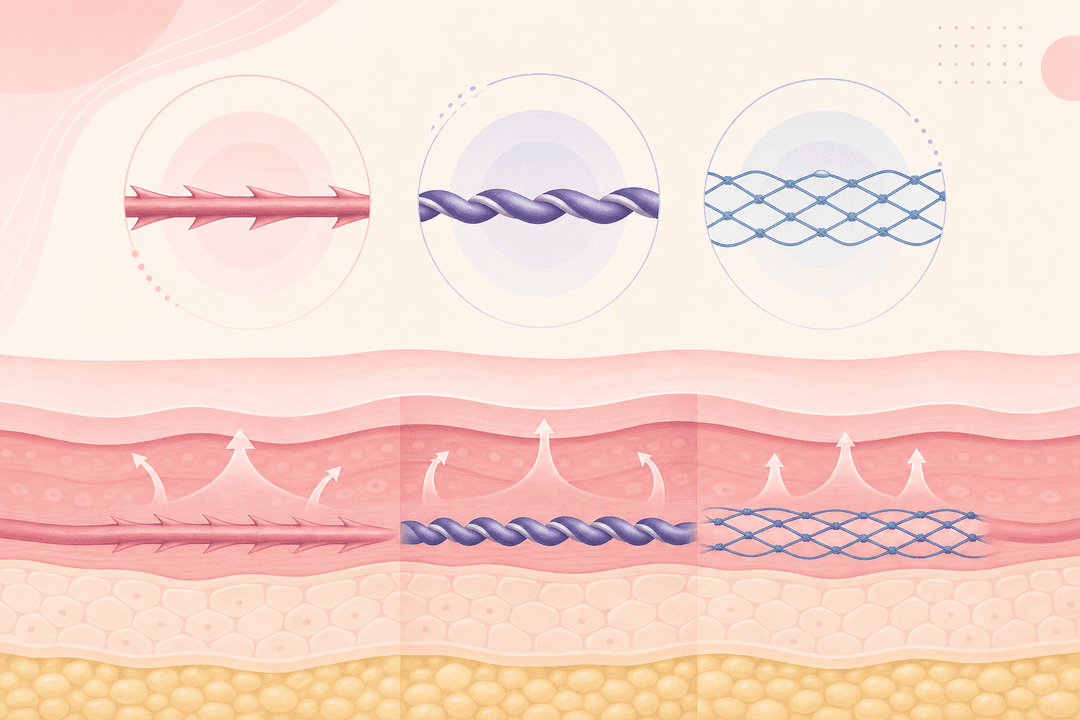
Cog Threads: These threads have barbs on their surface. The barbs hook onto tissues, providing an immediate lifting effect. The barb direction is divided into unidirectional (Uni) and bidirectional (Bi); bidirectional threads offer stronger fixation but are more difficult to insert.
Screw Threads: The entire thread has a twisted, spiral structure. They have a larger surface area for foreign body reaction than cogs, leading to more collagen production, but offer weaker physical support. They are typically inserted into shallower layers (mid-dermis) for improving fine wrinkles and pores.
Mesh Threads: These are formed by weaving multiple threads into a mesh. They can support a wide area and are suitable for treating overall cheek sagging or neck wrinkles. However, insertion time is long (30-40 minutes), and the bruising rate is high (approximately 60%).
According to a 2021 survey by the Korean Society of Plastic and Reconstructive Surgeons, 72% of domestic specialists preferred the method of 'layered mixed insertion' using both cog and screw threads.
| Thread Shape | Primary Insertion Layer | Advantages | Disadvantages |
|---|---|---|---|
| Cog | Subcutaneous fat layer - Fascia | Immediate lift & strong fixation | High bruising rate |
| Screw | Mid-dermis | Excellent collagen production | Weak immediate effect |
| Mesh | Entire subcutaneous fat layer | Broad area support | Long procedure time & high cost |
- Number of cogs per cog thread: 12-20
- Mesh thread procedure time: 30-40 minutes
- Mesh thread bruising rate: Approx. 60%
Thread Lifting Candidates: A Guide by Age and Degree of Sagging
Late 20s - Early 30s: Mild sagging (Grade 1). This is when cheek fat starts to descend slightly or nasolabial folds begin to form. 4-6 PDO cog threads are sufficient, with a duration of 6-9 months. Individuals in this age group recover quickly, allowing a return to daily activities in 3-4 days.
Mid-30s - Early 40s: Moderate sagging (Grade 2). This is characterized by a blurred jawline and drooping corners of the mouth. PCL cog threads or a PDO+PLLA combination are suitable, with 8-12 threads typically inserted. The duration is 12-15 months.
Mid-40s and older: Severe sagging (Grade 3). This includes prominent jowls and neck wrinkles. PLLA mesh threads or high-density PCL insertion (16+ threads) may be considered, and in some cases, combined with radiofrequency procedures like Ultherapy or Thermage. The effect may be limited with thread lifting alone.
However, skin thickness and elasticity are more important than age. If the skin is thin or has very low elasticity (pinch test takes over 5 seconds), fillers or fat grafting are recommended before thread lifting.
Caution For those in their late 40s and older, a combination plan of 'RF + threads' or 'fillers + threads' yields higher satisfaction than thread lifting alone. Find clinics with extensive experience in combination procedures on K-Dia.
- Recommended number of threads for late 20s: 4-6
- Recommended number of threads for mid-30s: 8-12
- High-density insertion for mid-40s: 16+ threads
Contraindications and Pre-Procedure Checklist

Individuals with a history of keloids, autoimmune diseases (lupus, rheumatoid arthritis, etc.), or those who are pregnant or breastfeeding should avoid the procedure. This is due to the risk of persistent inflammatory reactions at the thread insertion sites.
If you are taking aspirin or anticoagulants, you must stop at least 7 days prior. If discontinuation is not possible, the risk of bleeding and bruising increases by over 70%. It is also recommended to stop health supplements like Omega-3 and Vitamin E three days before the procedure.
If you have had facial filler injections within the last 6 months, ultrasound confirmation is essential to ensure the filler and thread insertion layers do not overlap. If fillers and threads are in the same layer, uneven nodules may form.
Smokers must quit smoking at least 2 weeks before the procedure. Nicotine constricts blood vessels, reducing collagen synthesis by 40%, and the risk of tissue necrosis around the threads is three times higher than in non-smokers.
Caution If you have a history of fillers, always confirm their location with ultrasound. Overlapping fillers and threads significantly increase the risk of nodules and asymmetry.
- Bruising rate if anticoagulants are not stopped: Over 70%
- Collagen synthesis rate in smokers: 40% less than non-smokers
- Tissue necrosis risk in smokers: 3 times higher than non-smokers
Comparison of Thread Material Characteristics
PDO [Fast Effect]
- Dissolution period: 6-8 months
- Immediate lifting effect: Strong
- Collagen production: Moderate
- Suitable age: Late 20s - Early 30s
Strong initial effect but short duration requires frequent retreatment.
PCL [Balanced]
- Dissolution period: 12-18 months
- Immediate lifting effect: Moderate
- Collagen production: Strong
- Suitable age: Mid-30s - 40s
Accompanied by a volumizing effect, offering a balance between duration and efficacy.
PLLA [Long-lasting]
- Dissolution period: 18-24 months
- Immediate lifting effect: Weak
- Collagen production: Very strong
- Suitable age: 40s and older
Effects appear gradually but last the longest, with significant collagen remodeling benefits.
Misconceptions
Myth The more threads used, the better the results.
Truth Insertion layer and direction are more important than the number of threads. Even with 8 threads, the outcome differs completely depending on whether they are inserted into different layers (subcutaneous fat, dermis, fascia) or all in one layer. Excessive thread insertion can lead to unnatural pulling and an increased risk of inflammation. The 2020 recommendations from the Korean Society for Aesthetic Plastic Surgery advocate for the 'minimum necessary number' as a principle.
Myth Once the threads dissolve, the effects disappear.
Truth Even after the threads have completely dissolved, the collagen network formed around them persists for 3-6 months. For PLLA threads, the collagen capsule remains for over 12 months after thread dissolution, providing lasting effects. Therefore, the role of the threads is as a 'scaffold to trigger collagen production', and the true effect comes from the collagen your body creates.
Must-Check Items Before Thread Lifting Procedure
- Avoid the procedure if you have a history of keloids, autoimmune diseases, are pregnant, or breastfeeding.
- Discontinue aspirin and anticoagulants at least 7 days prior; Omega-3 and Vitamin E should be stopped 3 days before.
- If you've had fillers in the last 6 months, confirm their location with ultrasound.
- Quit smoking 2 weeks before the procedure. Smoking reduces collagen synthesis by 40%.
- For 2 weeks post-procedure, avoid saunas, steam rooms, and high-temperature environments, and minimize chewing motions (gum, tough foods).
Frequently Asked Questions
When do the effects of thread lifting start to appear?
Immediate effects are felt right after the procedure, but this is solely due to the physical support of the threads. The true effects begin to appear from 4-8 weeks when collagen production starts, peaking at 8-12 weeks for PDO and 12-18 weeks for PLLA. Do not judge the results as 'not great' immediately after the procedure; wait at least 2 months.
Thread lifting vs. Ultherapy: Which is better?
Their purposes differ. Thread lifting involves 'repositioning + collagen production', while Ultherapy focuses on 'collagen contraction + remodeling'. Thread lifting is suitable for significant sagging (Grade 2 or higher), whereas Ultherapy is better for primary concerns of elasticity loss. For individuals over 40, combining both procedures at 3-6 month intervals can create significant synergy.
What are the potential side effects of thread lifting?
The most common side effects are bruising and swelling (70% incidence), which typically resolve within 1-2 weeks. Rarely, the thread ends may be palpable at the insertion site (5%), or infection (less than 1%) or asymmetry (2-3%) may occur. Individuals prone to keloids have an increased risk of excessive fibrosis around the threads and should avoid the procedure. If swelling persists for over a week, accompanied by pain or fever, seek immediate medical attention from your clinic.
When can I resume daily activities after thread lifting?
If bruising is minimal, makeup can cover it after 3-4 days. However, for 2 weeks post-procedure, avoid excessive chewing (gum, tough meats) and sleeping on your side. The threads take 14 days to anchor, and strenuous activity during this period can cause thread migration or reduced effectiveness.
Which thread should I choose among PDO, PCL, and PLLA?
If you are in your late 20s or getting the procedure for the first time, start with PDO. You can see results quickly, and it's more cost-effective. For those in their mid-30s or older seeking longer duration, PCL is recommended. For individuals over 40 aiming for collagen regeneration, PLLA is advised. However, the final decision should be made in consultation with a specialist, considering skin thickness, degree of sagging, and budget.
What is the recommended retreatment interval for thread lifting?
It is generally recommended to retreat every 6-9 months for PDO, 12-15 months for PCL, and 18-24 months for PLLA. However, if the results of the first treatment were unsatisfactory, the insertion layer, thread shape, and number of threads should be re-evaluated before retreatment. Repeating the same approach will only yield the same results.
This content is for informational purposes only and does not substitute for medical advice. Always consult with a specialist before undergoing any procedure.