AI Photo Editing Set to Surge in 2025, 4 Criteria Differentiating It from 2020 Filters

- While 2020 filters only boosted overall brightness, 2025 AI analyzes pupils, lips, and skin separately.
- The deep learning model distinguishes facial structures using one million training images, automatically applying area-specific corrections.
- Depending on lighting, angles, and makeup, the results for the same face can fluctuate by 15-40%.
- Processing time: Under 2 seconds
- Landmark recognition: 128 points
- Error rate: 15-40% depending on lighting conditions
From Overall Brightness in 2020 to Segmented Recognition in 2025
In 2020, filters applied brightness and saturation uniformly across the entire photo. This brightened pupils, skin, and backgrounds equally.
By 2025, AI photo editing divides the face into 128 landmarks for recognition. It identifies pupils, lips, skin, and hair separately, applying different edits to each area.
This difference is the divergence point between Deep Learning and Rule-Based systems.
Rule-based systems apply fixed formulas like "Brightness +20, Saturation +10," whereas deep learning systems learn from over a million facial photos to autonomously determine, "This area is skin, so only blur blemishes; this area is the eye, so enhance clarity."
Training Data Dictates the Outcome
The reason AI editing apps yield different results is because the training data varies.
If App A was trained primarily on selfies of people in their 20s, and App B on ID photos of people in their 40s, then feeding the same face into each app would lead A to focus on enlarging eyes, while B would concentrate on erasing blemishes.
This is why the misconception that "all AI editing is the same" exists. Strengths differ based on the age groups, shooting environments, and editing purposes of the photos used for training.
This is where the differences in user reviews like "This app makes skin look natural" and "That app makes the eyes look strange" originate.
True/False Quiz
AI photo editing apps always produce the same result for the same face, even if the lighting changes.
Check Answer
X When the color temperature shifts from 3000K to 6500K, the AI interprets the skin tone differently from the start. The error rate can range from 15-40% depending on the input conditions.
Lighting and Angle Changes Can Affect Results
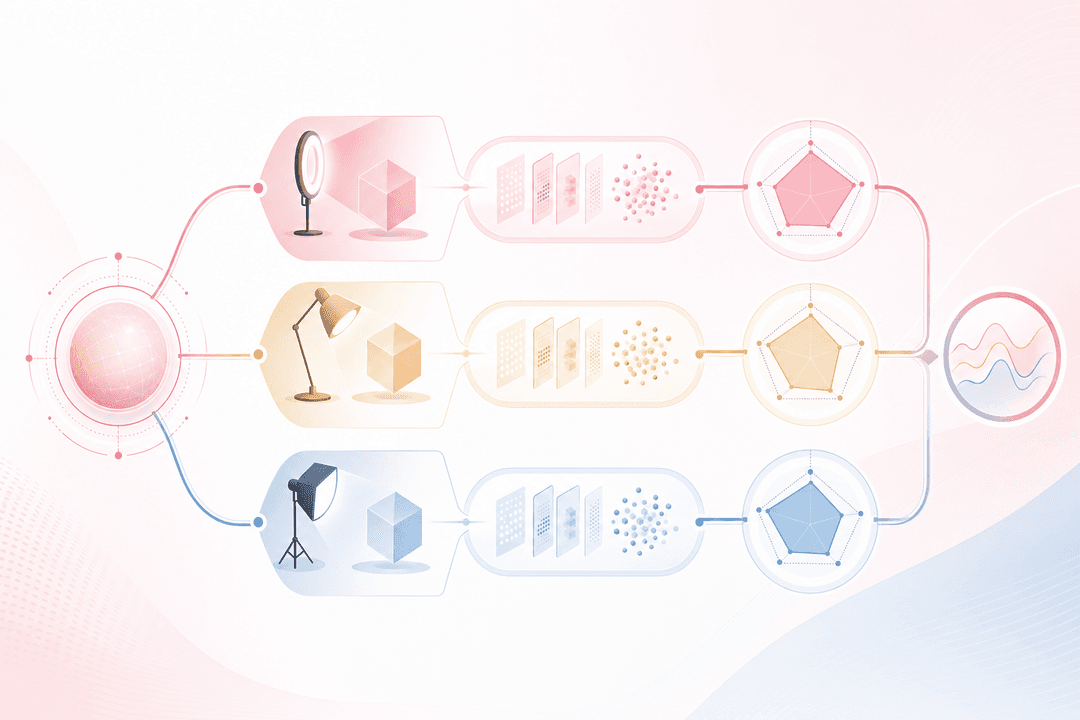
A limitation of AI editing is that the error rate can increase by 15-40% depending on the quality of the input photo.
If you input a frontal selfie taken under fluorescent lighting and an outdoor side-profile photo into the same app, the skin tone assessment will differ.
When the lighting color temperature changes from 3000K (warm white) to 6500K (daylight), the AI perceives it as different skin.
Results also vary between faces with makeup and bare faces. If foundation covers pores, the AI may not be able to read the original skin texture, leading to over-editing or skipping the edit altogether.
This is why you might experience situations like, "It looked natural yesterday with the same app, but it looks strange today."
Caution You can check an app's consistency by comparing 2-3 photos taken with the same angle and lighting. If the results vary each time, the app likely lacks sufficient training.
Why AI Editing Results Shouldn't Be Used as a Basis for Procedures
Some people mistakenly believe AI editing results can be used as a simulation of "what my face could look like." Frankly, that's risky.
AI only judges based on 2D images and doesn't know the actual skin thickness, muscle structure, or bone positioning.
If you take a photo with enlarged eyes from editing to a plastic surgery clinic, you might hear, "This is impossible due to your bone structure."
AI editing serves as reference material, indicating "how it might look from this angle," not as a diagnosis or a treatment plan.
If you intend to use it for consultations at a dermatology or plastic surgery clinic, it's more realistic to bring the original photo along with the edited one and use it solely for explaining your desired direction, such as "I'd like a change like this."
- Confirming the source of training data is the first quality criterion.
- Test with photos taken at consistent lighting and angles.
Deep Learning vs. Rule-Based Comparison
Deep Learning AI Editing [Mainstream in 2025]
- Segmented recognition (128 landmarks)
- Over 1 million training images
- Processing time: Around 2 seconds
- Lighting/angle error: 15-40%
Natural-looking but sensitive to input quality
Rule-Based Filters [2020 Method]
- Uniform application to the entire image
- Fixed formulas (brightness/saturation adjustments)
- Instant processing
- High consistency but unnatural
Background changes along with the subject, resulting in a strong artificial look
Misconceptions
Myth All AI editing is the same, and differences between apps are due to UI design.
Truth If the training data (age group, shooting environment, editing purpose) differs, even the same face will be edited completely differently. Strengths vary based on whether the training focused on skin or facial contours.
How Not to Use AI Editing Results
- Demanding "Do this for me" based on edited photos as a treatment goal — 2D images don't account for bone/muscle structure.
- Self-diagnosing skin condition using photos with makeup — AI might mistake foundation for natural skin.
- Not checking the save/delete policy before uploading facial photos — Some apps reuse them as training data.
Frequently Asked Questions
Why do AI editing results vary each time?
Changes in lighting color temperature, shooting angle, or the presence of makeup cause the AI to interpret the same face as different data, altering the intensity of edits for each area.
Where are my facial photos stored after uploading them to an app?
It varies by app, but some reuse them as training data or store them on cloud servers for a certain period. Always check the privacy policy before use.
Can I bring AI-edited photos to a plastic surgery consultation?
Use them only for explaining your desired direction and always bring the original photos. 2D edits don't reflect bone/muscle structure, so there can be a significant discrepancy with actual procedures.
References
- Trends in Deep Learning-Based Facial Recognition Technology — Korea Information Processing Society, 2024
- Study on Image Color Temperature and AI Judgment Errors — Computer Vision Society, 2023
Lumi's Take
AI editing is merely a reference for "how it might look from this angle," not the definitive answer for your face. It's wise to take multiple photos with varying lighting and choose an app that provides consistent results. While it's good to have expectations for edited photos, don't let those expectations become your standard for reality assessment.
This content is for informational purposes only and does not substitute medical advice. Always consult with a specialist before undergoing any procedures.