7 Steps to Liposuction Recovery: A Step-by-Step Guide to Returning to Daily Life
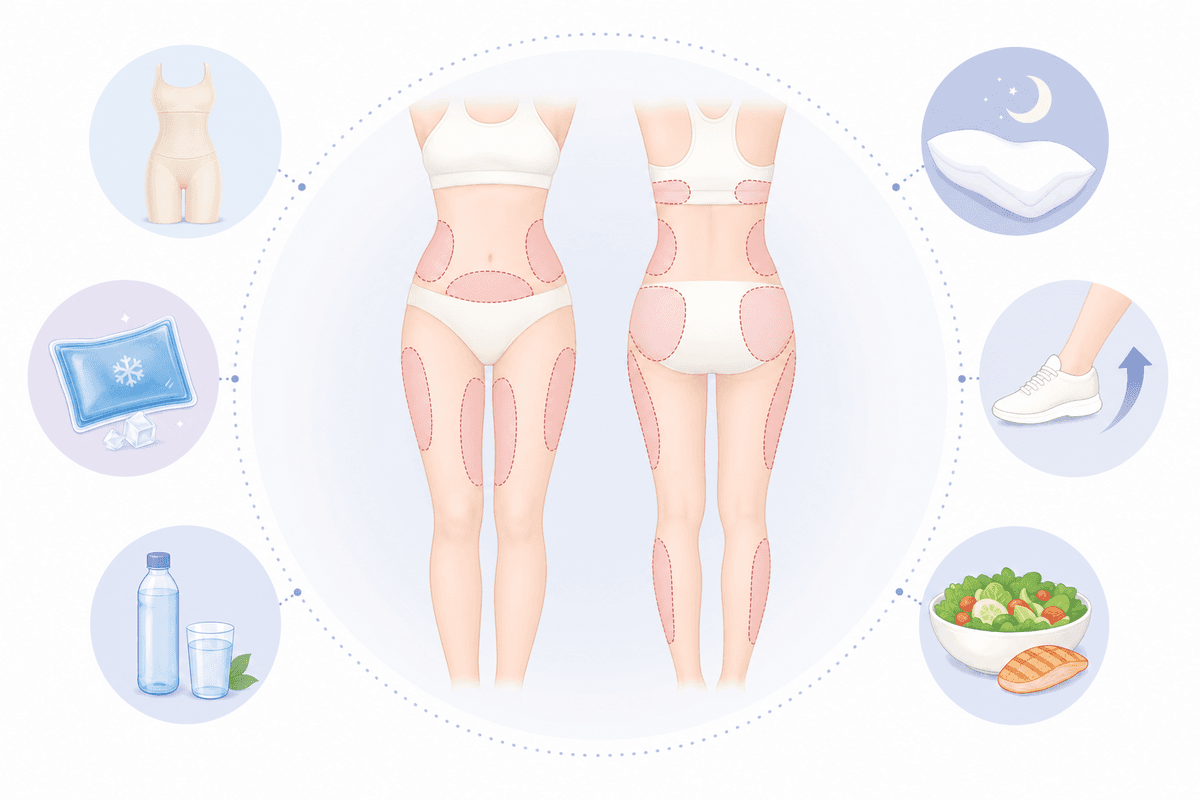
- 90% of liposuction recovery management is determined once the 3-day acute phase is passed.
- The timing of abdominal band compression determines the final body line.
- Recovery speeds vary by area and can differ by up to twofold.
Information as of June 2026
3-Month Post-Surgery Full Recovery Roadmap
- It takes an average of 12 weeks for full recovery
- You can return to work in about 7-10 days
- You must wear a compression garment for 6-8 weeks
The Results Created by the Misconception that Recovery Takes Only 2 Weeks
Did you know that you recover from liposuction in 2 weeks? Actually, that is only half true. Even if you look fine on the outside, true recovery is not completed until 3 months later.
Management points at every stage are really important during the liposuction recovery period. The first 72 hours after surgery are the acute inflammatory phase, and depending on how compression and drainage are managed during this period, the results over the next 12 weeks can differ by more than 60%.
According to clinical data from the Korean Society of Aesthetic Plastic Surgery in 2021, the average complete recovery for patients with abdominal liposuction was 84 days. The recovery period varied significantly depending on the body part, with the thighs taking 98 days and the arms 63 days.
Returning to daily life and complete recovery are different concepts. You can return to work in about 7 to 10 days, but you should expect the final lines to settle nicely about 3 months after surgery.
- Acute Phase (0-3 days): You must focus 90% of your attention on fluid drainage
- Subacute Phase (4-14 days): The duration of compression garment wear determines the prevention of contractures
- Remodeling Phase (15 days-12 weeks): This is the period when skin contraction and collagen rearrangement occur
Day 0-3: Acute Phase Immediately After Surgery - Drainage Is Everything
The 72 hours starting from the day of surgery are a very critical period for fluid and blood drainage. If the drainage volume is less than expected during this period, the risk of seroma may increase. The drainage tube is usually removed within 24 to 48 hours after surgery. For areas with a high volume of suction, such as the abdomen, it may be kept in place for up to 48 hours. Pain can be most severe during the first 48 hours. It feels similar to muscle soreness, but it is usually well controlled with prescribed painkillers. The compression garment should be worn immediately after surgery, and the rule is to wear it for 24 hours during this stage. You should think of it as taking it off only briefly when showering. Caution: Exudate may continue to flow even after the drainage tube is removed. Change the gauze frequently, and if more than 100mL comes out per day, you must contact the hospital immediately.
| Hour | Symptoms | Care Points |
|---|---|---|
| 0-6 hours | You may experience chills after waking up from anesthesia | Keep your body warm and drink plenty of fluids |
| 6-24 hours | Pain may be most severe | Please take painkillers on time |
| 24-48 hours | Intensive drainage It happens | Check the drainage volume and maintain compression |
| 48-72 hours | Swelling begins | It is good to apply a cold compress and sleep with your upper body elevated |
Day 4-14: Subacute Phase - The Beginning of the Compression War
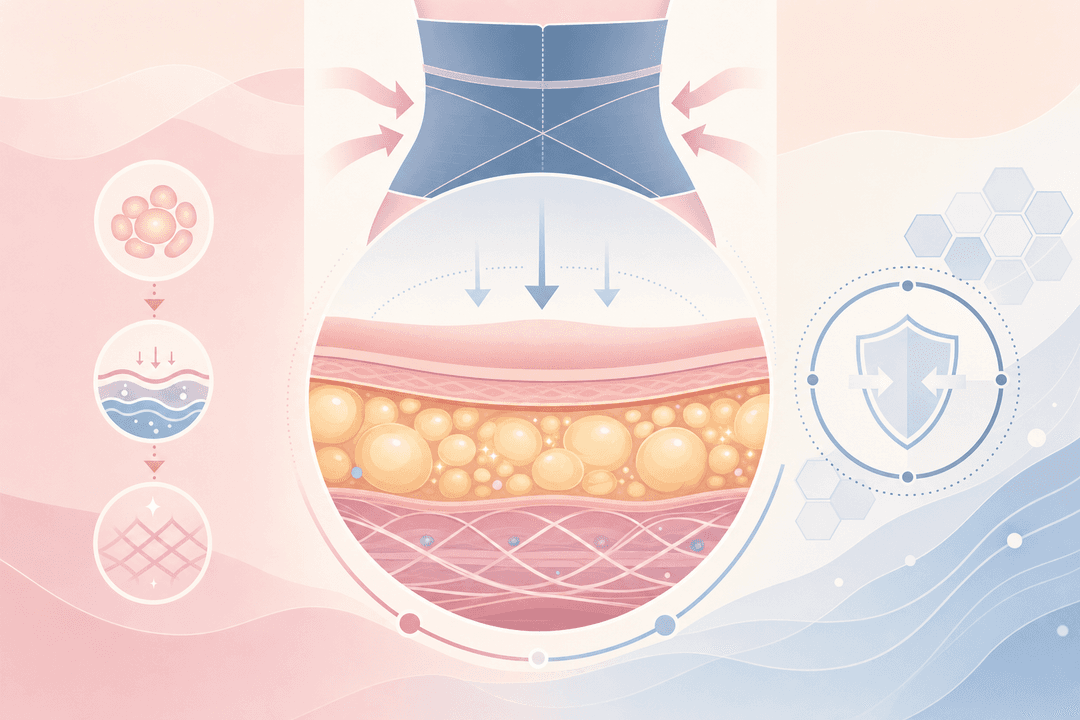
Swelling can be most severe from day 4 to 2 weeks. Swelling may be more severe on days 5-7 than immediately after surgery.
It is no exaggeration to say that the time of wearing the compression garment during this period determines the final outcome. It is recommended to wear it for more than 20 hours a day, and you should think of taking it off briefly only when showering or washing the compression garment.
Showering is possible from 3-5 days after surgery. Check that the sutured area has healed properly before starting, and it is best to keep it short, under 10 minutes. Returning to work is usually on the 7th to 10th day. It may take about 7 days for office workers and 10 to 14 days for service workers. Tip: Wearing thin cotton underwear under the compression garment can reduce skin irritation. Change it every day, and it will be convenient to have at least two compression garments ready.
- Period of most severe swelling: 5-7 days after surgery
- Period of darkest bruising: 7-10 days (It turns yellow and is absorbed afterward)
- Wearing compression garment: Please make sure to keep it on for at least 20 hours a day
Day 15-30: Early remodeling - The battle against hardness
After two weeks, it will look like you have almost fully recovered on the outside. However, an inflammatory reaction is still ongoing beneath the skin.
A characteristic of this stage is that you can feel hard tissue (induration). The skin may feel stiff as fibrous tissue fills the space where the fat was removed. You must continue to wear the compression garment, but you can reduce the duration to 16–18 hours a day. It is recommended that you wear it while sleeping at night. Light walking is possible starting 3 days after surgery, and stretching is possible after 2 weeks. Please hold off on strength training and cardio a little longer. Week 5-8: Mid-stage recovery - The lines are starting to show. Liposuction — Week 5-8: Mid-stage recovery - The lines are starting to show. AI-generated illustration. From week 5, the actual lines will finally start to reveal themselves. You can directly experience the effects of the surgery as the swelling subsides by more than 70%. Wear the compression garment for 6 to 8 weeks. From this point on, you can wear it only during the day and take it off at night. Light strength training is possible after 6 weeks. If you had lower body surgery, it is recommended to start with upper body exercises, and if you had upper body surgery, start with lower body exercises. It is good to loosen up hard areas with massage and radio frequency (RF) treatment. Receiving care at the hospital or trying self-massage with a foam roller at home will also be helpful. Clinical According to the 2019 journal Plastic and Reconstructive Surgery, the group that started lymphatic massage 6 weeks after surgery had a final satisfaction rate 28% higher than the group that did not. Week 9-12: Completion Stage - Final Line Confirmation You can consider the final results to be almost confirmed by 3 months. This is the time when 10-20% of the remaining swelling has completely subsided and the skin finishes contracting. If there are still hard areas remaining at this stage, it is also a good idea to receive additional high-frequency or ultrasound treatments. Please make active use of the aftercare program provided by the hospital. It is okay to return to normal exercise intensity. However, please be careful, as rapid weight gain can cause remaining fat cells to enlarge. Recovery speeds vary slightly by body part. It takes an average of 12 weeks for the abdomen, 14 weeks for the thighs, and about 9-10 weeks for the arms and calves.
| Body Part | Complete Recovery Period | Compression Garment Wearing |
|---|---|---|
| Abdomen | 12 weeks | 6-8 weeks |
| Thighs | 14 weeks | 8 weeks |
| Arms | 9 weeks | 6 weeks |
| Calves | 10 weeks | 6-7 weeks |
| Face (Double Chin) | 8 weeks | 4-6 weeks |
- Final line confirmation: 12 weeks post-surgery
- Complete swelling disappearance: 3-6 months
- Skin contraction complete: 6 months (If skin elasticity is good, it may be completed in as little as 3 months)
3 variables determining recovery speed

Even with the same surgery, recovery speeds can differ by up to twofold. The amount of fat removed, age, and aftercare are the key variables.
The more fat removed, recovery may be slightly slower. If you have removed more than 2 liters, it is recommended to allow an additional 2 weeks to the standard recovery period. There is an average difference of about 3 weeks in recovery speed between those in their 30s and under and those in their 40s and over. The better the skin elasticity, the faster the contraction and the less stiffness tends to be. It is said that there was a 35% difference in final satisfaction between patients who strictly adhered to the compression garment wearing schedule and those who did not. For inhalation volumes of 2L or more, you should expect an additional 2 weeks to be added to the recovery period. Skin contraction speed may be 30% slower in those over 40. It is said that adherence to compression garments reduces the incidence of contractures by 40%. It has been reported that quitting smoking and drinking reduces the incidence of complications by 60%.
Comparison of recovery difficulty by body part
Abdomen
Because the suction volume is high, the drainage period is long, and the hardness tends to last the longest
Arm [Lower]
- Recovery Period: 9 weeks
- Compression: 6 weeks
- Return to Work: 7 days
- Start Exercise: 5 weeks
Recovery is fast because the suction volume is low and movement is minimally restricted It's comfortable
Thigh [Upper]
- Recovery period: 14 weeks
- Compression garment: 8 weeks
- Return to work: 10-14 days
- Start exercise: 8 weeks
Because muscles are adjacent over a large area, pain and swelling can be severe, and wearing a compression garment can be the trickiest part
Guide to Determining Return Timing by Body Part and Occupation
I am an office worker and If you have had abdominal liposuction You can return to work 7 to 10 days after surgery For sedentary jobs, pain management is easier because there is less movement, and you can work even while wearing a compression garment
If you are an athlete or trainer class="lumi-decision-rec">It is recommended to return to full activity 8-10 weeks after surgery
High-intensity exercise carries a risk of suture damage and seroma, so you should gradually increase the intensity after wearing the compression garment.
If you are over 40 and have aspirated more than 2L
Plan to add about 3 weeks to the standard recovery period.
Since skin contraction is slow and hardness may persist for a long time, it is necessary to actively combine post-operative care (massage and RF).
Common Misconceptions
Misconception You only need to wear a compression garment for 2-3 weeks
Truth Wearing it for 6-8 weeks is the standard. It is recommended to wear it 24 hours a day for the first 2 weeks, and then only during the day for the following 4-6 weeks. Stopping too early can double the risk of contractures. Misconception You can exercise immediately once the swelling subsides Truth Even if there is no visible swelling on the outside, internal inflammation can persist for up to 6 weeks. Please remember that strength training is possible after at least 6 weeks, and aerobic exercise after 4 weeks.Symptoms requiring immediate hospital contact during recovery
- If the surgical site is hot (38 degrees or higher) and red
- If exudate continues to flow at a rate of more than 100 mL per day
- If only one side is abnormally swollen or the pain is too severe
- If swelling persists for more than 3 weeks even with a compression garment
- If the skin color changes (turns dark or necrosis is suspected)
Frequently Asked Questions
When can I shower?
You can shower from 3 to 5 days after surgery. It is best to check the suture site carefully, keep the time under 10 minutes, and wash it gently without rubbing. Can I take off the compression garment to sleep? You must wear it even while sleeping for the first 4 weeks. From the 5th week, it is fine to wear it only during the day, but if possible, wearing it at night until the 6th week can lead to better results. When can I drink alcohol? The general rule is to abstain from alcohol for at least 4 weeks. Alcohol increases blood flow, which can worsen swelling and slow down wound healing. The hard area remains even after 3 months. It is generally recommended to monitor the situation for up to 6 months. If swelling still remains, improvement can be expected through high-frequency or ultrasound treatments or steroid injections.
Major side effects after liposuction and how to deal with them?
Seroma is the most common occurrence and develops when drainage is insufficient. Infection is rare, occurring in less than 1% of cases, but you should visit a hospital immediately if you experience fever and pain. Since skin necrosis mainly occurs in smokers, it is essential to quit smoking for 4 weeks before and after surgery.
What precautions should be taken after returning to work?
Continue wearing a compression garment and it is recommended to walk for 5-10 minutes during lunchtime to help blood circulation. Staying in the same position for a long time can worsen swelling.
This content is for informational purposes only and cannot replace medical advice.
Please be sure to consult with a specialist before the procedure. Find the right hospital for you on K-Dia