3 Methods for Eye Correction Surgery: Is It Always Incisionless? 5 Cases Where Incision is Necessary
K-Dia EditorJust published12 min read

- Whether double eyelid surgery is possible depends not on skin thickness but on muscle elasticity.
- The procedure is divided into three types—buried suture, partial incision, and full incision—based on the strength of the eyelid-lifting muscle (levator function) and skin condition.
- The decision to perform an incision is determined not by preventing recurrence but by skin laxity and the need for muscle resection.
Information as of November 2026
The strength of your eyelids and skin thickness make the difference.
Non-incisional method: 3-5 year duration
Incisional method: Recurrence rate below 5%
Levator muscle resection: 3-5mm
Eyelid correction methods: Eyelid lifting strength comes first
If you've ever looked in the mirror and wondered, "Is my eye looking small because of my double eyelid or my eyelid lifting strength?", this article will break down the 3 eyelid correction methods and 5 cases requiring incision, based on specific metrics.
Eyelid correction is a surgery to strengthen the muscles that lift the eyelid (levator palpebrae superioris and Müller's muscle).
The methods are divided into non-incisional, partial incision, and full incision. The selection criteria are the strength of the lifting muscle (eyelid lifting power) and skin thickness (Korean Society of Plastic and Reconstructive Surgeons, 2023).
Non-incisional vs. Incisional: What's the difference?
The non-incisional method involves pulling and fixing the levator muscle with sutures. It's performed through 3-5 small holes without skin incision, and the average duration is 3-5 years.
This method is suitable when the levator muscle elasticity remains and the skin is thin.
The incisional method involves opening the skin to directly shorten the levator muscle (3-5mm resection) or fix it to Müller's muscle. Partial incision involves opening only a part of the double eyelid crease, while full incision opens the entire crease.
The recurrence rate is below 5%, which is lower than the non-incisional method, but the recovery period is 2 weeks longer.
Table:
Category | Non-incisional Method | Partial Incision | Full Incision
---|---|---|---
Incision Area | None (3-5 holes) | 1/3 of double eyelid crease | Entire double eyelid crease
Muscle Treatment | Pulled with sutures | Muscle shortening | Muscle shortening + fat removal
Duration | 3-5 years | Semi-permanent | Semi-permanent
Recovery Period | 3-5 days | 7-10 days | 10-14 days
The cost may vary depending on the condition of the eyelids, the clinic, and additional procedures (whether a double eyelid surgery is performed simultaneously).
OX Quiz
Non-incisional eyelid correction cannot be performed if the skin is thick.
Check Answer
X. Levator muscle elasticity is more important than skin thickness. If the levator muscle function is normal (MRD 3mm or more), non-incisional surgery is possible even with slightly thicker skin. Conversely, if the levator muscle is stretched, incision may be necessary even with thin skin.
5 Cases Requiring Incision for Eyelid Correction
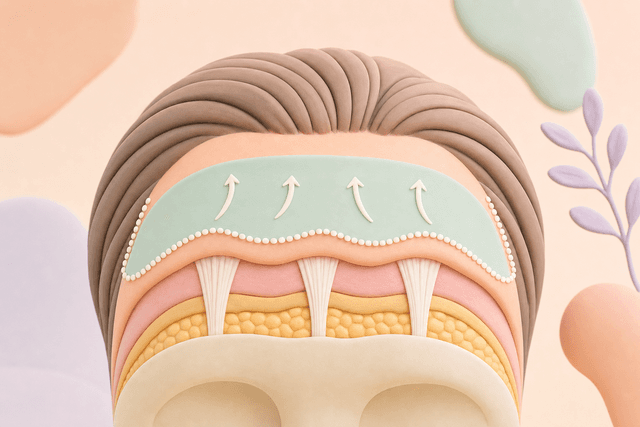
5 Cases Requiring Incision for Eyelid Correction — Plastic Surgery Information Medical Aesthetics Infographic
AI Generated Illustration
If you fall into any of the following 5 categories, an incisional method is recommended. ① When levator muscle function is weak with MRD (Marginal Reflex Distance) of 2mm or less, ② When the skin is thick or sagging (dermatochalasis), ③ When blepharoptosis is moderate or severe (eyelid covers the pupil by more than 2mm), ④ History of non-incisional method loosening within 1 year, ⑤ When undergoing simultaneous double eyelid surgery.
In reality, levator muscle elasticity is more decisive than skin thickness. If the levator muscle is stretched, the effect of the non-incisional method will not be maintained.
In such cases, physically shortening (resecting) the muscle is necessary for effects to last over 6 months without recurrence.
Key Takeaways
Eyelid correction is not a double eyelid surgery but a muscle function restoration surgery. The non-incisional method is chosen when levator muscle elasticity remains, and the incisional method is chosen when the muscle itself needs to be shortened.
The method is determined by a comprehensive assessment of MRD measurement, skin thickness, and previous procedure history, and can vary depending on individual differences even with the same symptoms.
It is essential to undergo a levator function test before surgery to reduce the risk of revision surgery.
Non-incisional method revision rate is about 15-20% after 3 years.
With the incisional method, scars are hidden within the double eyelid crease and are almost invisible after 6 months.
Choosing the Right Method Based on Your Situation
Non-incisional Method [Fast Recovery]
MRD 3mm or more (normal levator function)
Thin skin with no sagging
First surgery or more than 5 years since last surgery
Recovery: 3-5 days, Duration: 3-5 years
Partial Incision [Balanced Option]
MRD 2-3mm (moderate functional decline)
Normal skin thickness, slight sagging
Only a portion of the double eyelid line needs correction
Recovery: 7-10 days, Semi-permanent duration
Full Incision [Minimal Recurrence]
MRD 2mm or less (moderate to severe blepharoptosis)
Thick skin or severe sagging
History of recurrence within 1 year after non-incisional method
Recovery: 10-14 days, Recurrence rate: below 5%
Common Misconceptions
Myth: Eyelid correction always lasts longer with incision.
Truth: If levator muscle elasticity remains and the skin is thin, the non-incisional method can last 3-5 years. Whether to incise or not is determined by levator muscle function and skin condition, not by preventing recurrence. Unnecessary incisions only prolong recovery time.
Pre- and Post-Surgery Precautions
Avoid bending your head down (reading, prolonged smartphone use) for 2 weeks after surgery, as this can delay swelling.
Do not rub your eyes for 1 month after non-incisional surgery to avoid loosening the sutures.
Scar management (silicone sheets, ointments) for incisional surgery should begin 2 weeks after surgery and continue for 6 months.
Frequently Asked Questions
Which is more natural, non-incisional or incisional eyelid correction?
Naturalness is determined by design and surgeon's skill, not the method. Both non-incisional and incisional methods, when performed appropriately, result in minimal difference.
When do scars from incisional surgery become unnoticeable?
Incisions hidden within the double eyelid crease begin to fade after 3 months and are almost unnoticeable after 6 months (individual variation exists).
What are the potential side effects of eyelid correction?
Overcorrection (eyes appearing too large), incomplete eyelid closure (lagophthalmos), and asymmetry are rare side effects. Adjustments can be made within 2 weeks after surgery.
References
1. Guidelines for Blepharoptosis and Eyelid Correction Surgery — Korean Society of Plastic and Reconstructive Surgeons, 2023
2. Levator Function and Ptosis Correction Outcomes — Journal of Plastic and Reconstructive Surgery, 2022
Lumi's Word
The choice between non-incisional and incisional methods isn't about which is "better," but about which is right for *your* eye condition. An MRD measurement can clarify the direction, so be sure to ask during your consultation. Your eyelid lifting strength is measured by numbers, after all.
This content is for informational purposes only and does not substitute for medical advice. Always consult with a specialist before undergoing any procedure.
Find a Clinic That's Right for You on K-Dia