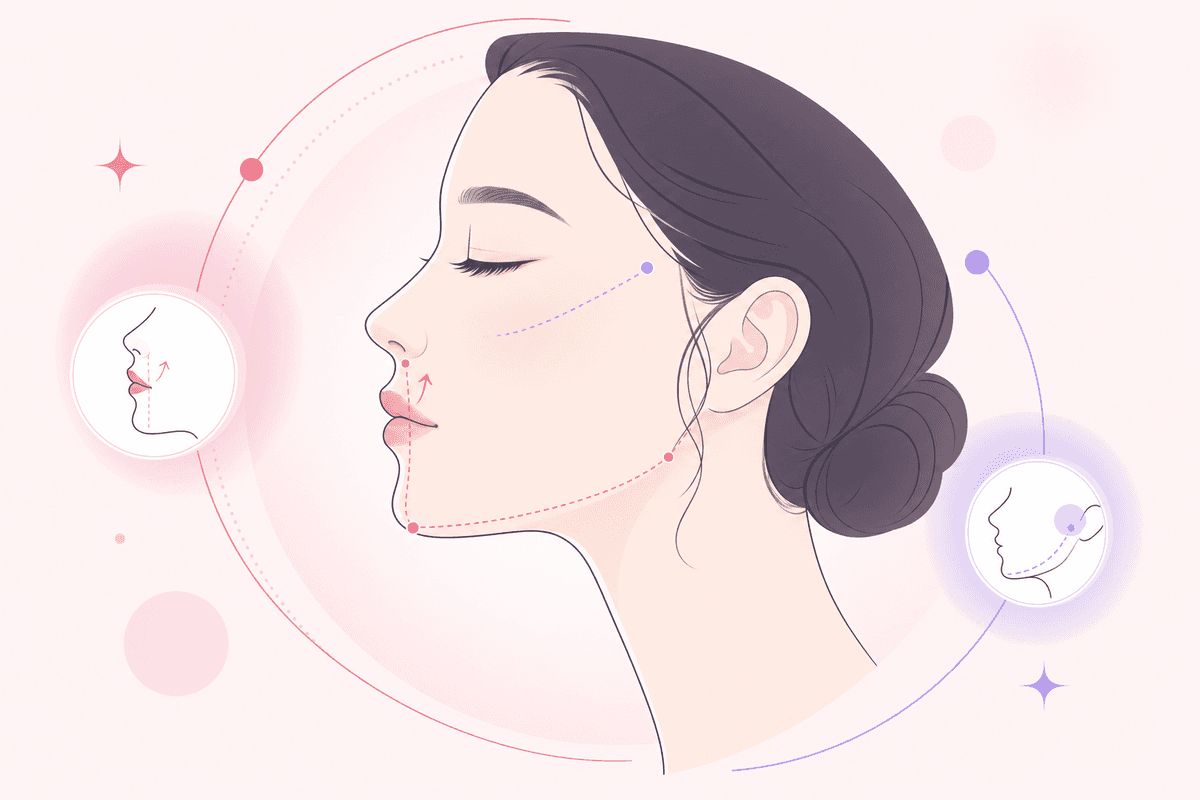
This is a surgery that reduces a long philtrum by excising the skin under the nose and slightly lifts the upper lip to create a distinct mouth shape.
Philtrum reduction surgery is a procedure that shortens the length of the philtrum by excising a portion of the skin beneath the nose when a long philtrum (the space between the nose and the upper lip) makes one look older or stifled. The upper lip is slightly curled upward, increasing lip and tooth exposure and creating a distinct, youthful appearance.
It is suitable for cases where the lower part of the face appears long due to a long philtrum, cases where the upper lip is thin or teeth are barely visible when expressionless, or cases where you want to improve the impression of the mouth area that looks aged.
Skin is incised along the boundary of the nostrils (below the columella), and scarring is minimized using double suturing. Periosteal fixation and other methods reduce nostril shape deformation and widening of the incision line. Typically, reductions are made by the millimeter.
The stitches are removed after 5 to 7 days, and the redness of the incision line fades over several weeks. The scar is hidden along the border under the nose and becomes less noticeable over time.
Excessive resection can lead to an upturned nasal tip, drooping nasal wings, and unnatural exposure, so a conservative design is important. Those prone to scarring require management of the incision line.
Lip fillers are a procedure to increase lip volume, while philtrum reduction is a surgery that shortens the length under the nose to change the proportions of the mouth shape. They are often considered together.
The incision line is hidden at the border of the nostril and double-sutured so that it is not easily visible over time, but management of initial redness is necessary.
Yes, it is possible. Many dermatology and plastic surgery clinics in Korea treat foreign patients, and there are also many hospitals that offer consultations or interpretation support in foreign languages such as English, Chinese, and Japanese. On K-Dia, you can compare hospital information and real reviews, and consult directly via chat before your visit.
It usually takes about 5 to 7 days to return to daily activities, and the recovery period is 5 to 7 days for stitch removal and several weeks for redness. If you are traveling for a short time, it is recommended to schedule your trip with ample time to check your progress immediately after the procedure, and to discuss post-recovery care methods and precautions with the hospital in advance.
Costs vary significantly depending on the hospital, the scope of the procedure, the equipment and materials used, and the anesthesia method. Since Korea has a well-developed infrastructure for procedures, making consultations and price comparisons relatively easy, it is recommended to compare quotes from multiple hospitals rather than relying on just one. You can check event prices and actual reviews by hospital on K-Dia.
This information is for general understanding only and is not medical advice. Always consult a medical professional before deciding on any procedure.
