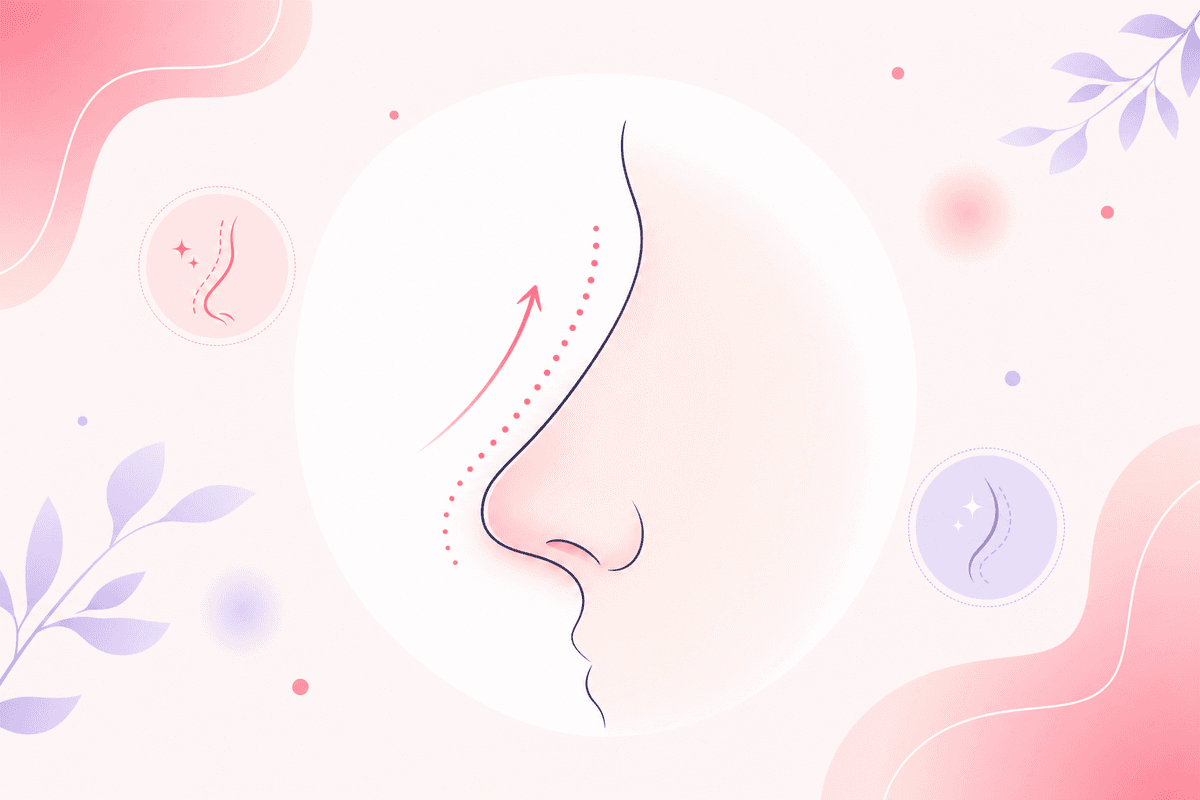
This is a rhinoplasty procedure that lowers the upturned tip of the nose and lengthens it to make the nostrils less visible from the front.
Upturned nose and short nose correction is a surgery that rotates and extends a nose that is lifted upward, making the nostrils highly visible from the front, downward. To elongate the tip of the nose, sufficient support is required; therefore, a rigid support is created using autologous cartilage, such as septal cartilage, to fix the tip downward. It is classified as a high-difficulty rhinoplasty.
It is suitable for cases where the nostrils are excessively visible from the front, where a short nose makes the philtrum appear long, or where an upturned tip of the nose makes one look younger or unnatural. It is also performed in conjunction with the correction of a hump or deviated nose.
Typically, an incisional (open) approach is used to create a support structure for the tip of the nose using autologous cartilage, such as septal cartilage, ear cartilage, or rib cartilage, extending and fixing it downward. The results vary depending on the amount of extension and the availability of skin.
The splint is removed after 5 to 7 days, and swelling subsides over 2 to 4 weeks. The natural shape of the nose tip settles over 3 to 6 months. Initially, the nose tip may feel firm and appear slightly upturned.
If the skin is short and firm, there is a limit to the amount of extension, and excessive lengthening may compromise the strength and naturalness of the nasal tip. Since weak support can cause the nose to lift again over time, a robust structural design is essential.
To lower the tip of the nose, an autologous cartilage support is key rather than a nasal bridge implant. This is a different approach from simply raising the nasal bridge.
It will hold if there is sufficient support, but it may partially revert if skin tension is strong, so firm fixation is important.
Yes, it is possible. Many dermatology and plastic surgery clinics in Korea treat foreign patients, and there are also many hospitals that offer consultations or interpretation support in foreign languages such as English, Chinese, and Japanese. On K-Dia, you can compare hospital information and real reviews, and consult directly via chat before your visit.
It usually takes about 7 to 10 days to return to daily activities, and the recovery period involves wearing a splint for 5 to 7 days and swelling for 2 to 4 weeks. If you are traveling for a short time, it is recommended to schedule your trip with ample time to check your progress immediately after the procedure, and to discuss post-recovery care and precautions with the hospital in advance.
Costs vary significantly depending on the hospital, the scope of the procedure, the equipment and materials used, and the anesthesia method. Since Korea has a well-developed infrastructure for procedures, making consultations and price comparisons relatively easy, it is recommended to compare quotes from multiple hospitals rather than relying on just one. You can check event prices and actual reviews by hospital on K-Dia.
This information is for general understanding only and is not medical advice. Always consult a medical professional before deciding on any procedure.
