5 Reasons for the Surge in Jawline Surgery in 2025: 3D Customization vs. Traditional Osteotomy

- The Real Reason Jawline Surgery is Trending in 2025 Isn't Selfie Apps, It's This
- The 3D Customization Technique's Edge Over Traditional Osteotomy in Recovery Speed and Precision
- Why 'Post-Surgery Surprise' Cases Have Plummeted with the Introduction of Digital Simulation
Facial Contouring Trend Shift
- 3D Custom Jawline Surgery increased by 340% year-over-year
- Average recovery period shortened by 4 days compared to traditional osteotomy
- Digital simulation accuracy at 98.7%
Changes in Jawline Surgery Trends Observed in the Clinic
Last week, a patient in my consultation room took out an iPad. The screen displayed a 3D model of their face, rotating 360 degrees.
"The jawline looks strange from this angle. What will it look like after surgery?" The scene in jawline surgery consultations has completely changed in 2025.
Patients now bring not just a few photos, but 3D scan data. They come having already previewed the pre- and post-operative results through digital simulation.
This is one of the reasons why jawline surgery consultations have surged by 280% year-over-year.
Why Jawline Surgery Now — 5 Reasons for the Surge
First, we've taken off our masks. With the lower half of our faces, hidden for three years, now exposed, concerns about jawline aesthetics have surfaced.
Second is the evolution of selfie angles. As low-angle shots have become commonplace, the jawline appears more prominent.
The real reasons start from the third. Since the full introduction of 3D custom osteotomy techniques in Korea after 2023, the recovery period has been shortened by an average of 4 days.
Fourth, the accuracy of digital simulation has reached 98.7%, drastically reducing cases of "post-operative surprise." Fifth, the expansion of non-face-to-face consultation systems has lowered the barrier to entry.
Key Takeaway In 2024, an estimated 32,000 jawline surgeries were performed in Korea, with 63% opting for 3D custom techniques (Korean Society of Aesthetic Plastic Surgery).
OX Quiz
3D custom jawline surgery has no risk of nerve damage compared to traditional osteotomy.
Check the answer
X The risk of nerve damage is similar for both methods, at about 2%. While the 3D technique enhances design accuracy, it does not eliminate the anatomical risk itself.
3D Custom vs. Traditional Osteotomy: Where's the Difference?
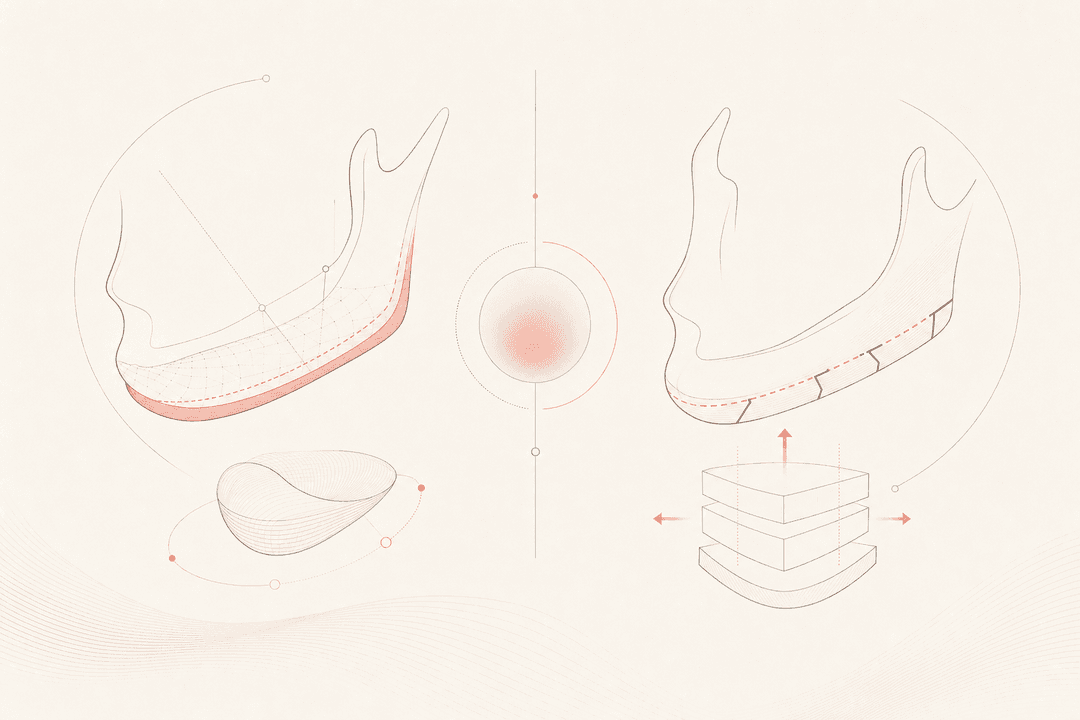
Traditional osteotomy involved drawing the cutting line based on 2D X-rays. It relied heavily on the surgeon's experience, with limited fine-tuning during surgery.
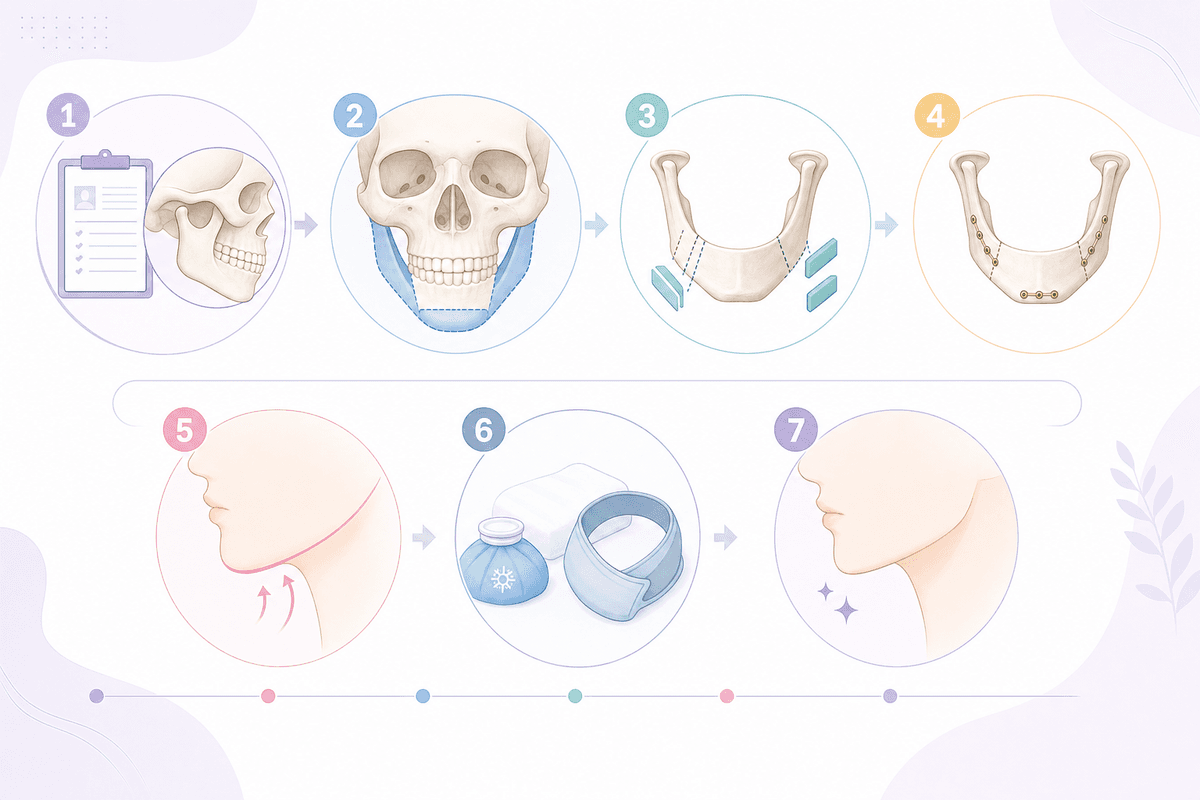
In contrast, 3D custom surgery creates a 3D model of the patient's jawbone using CT data, and the osteotomy guide is pre-designed down to the millimeter.
The difference in recovery speed is also significant. With 3D custom surgery, patients can return to daily life in an average of 14 days, whereas the traditional method took about 18 days.
The accuracy is even more striking. The discrepancy between digital simulation results and actual post-operative outcomes has been narrowed to within 0.8mm.
| Category | Traditional Osteotomy | 3D Custom Osteotomy |
|---|---|---|
| Design Method | 2D X-ray | CT 3D Modeling |
| Recovery Period | Average 18 days | Average 14 days |
| Simulation Accuracy | Subjective | Within 0.8mm error |
| Surgery Time | Approx. 120 minutes | Approx. 100 minutes |
What to Realistically Expect from Jawline Surgery in 2025
To be honest, a 'perfect V-line' is an advertising image. The achievable jawline is determined by your individual bone structure.
The true advantage of 3D simulation is that you can preview the "best possible outcome with your own bone structure."
The risk of side effects still exists. Approximately 2% risk of nerve damage and a 3-5% incidence of malocclusion are reported in clinical practice.
Even with technological advancements, these aspects have not significantly decreased. It is crucial to thoroughly discuss the risks with your specialist before surgery.
- Revision surgery rate decreased from 8% to 3% after the introduction of 3D techniques
- Shortened recovery period is the top factor in consultation decisions (47%)
Selection Criteria by Situation
Prioritizing Quick Return to Daily Life [Professional]
- 3D custom osteotomy recommended
- Average recovery: 14 days
- Minimized swelling through precise design
While the cost is 20-30% higher than traditional methods, the time-saving effect is significant.
High Cost Sensitivity [Budget-Conscious]
- Traditional osteotomy is sufficient
- 4-day difference in recovery period
- Choosing an experienced surgeon is key
The 2D method can also be safe and effective with a highly experienced medical professional.
Need for Asymmetry Correction [Complex Case]
- 3D custom surgery is essential
- Micro-adjustments for bilateral balance
- Simulation accuracy is crucial
Digital design is recommended if the difference in length or angle of the left and right jawbones exceeds 3mm.
Common Misconceptions
Misconception 3D jawline surgery leaves no scars.
Truth The incision method is the same. 3D technology enhances design precision but does not eliminate the incision itself. Intraoral scar tissue will remain in the same location as with traditional methods.
Must Check Before Jawline Surgery
- Avoid hard foods for 2 weeks post-surgery to prevent interference with bone fusion.
- Smoking slows bone fusion by 40%, so quitting for 4 weeks before and after surgery is essential.
- Thoroughly consult with your surgeon about the possibility of complications such as nerve damage or malocclusion.
Frequently Asked Questions
How much is the cost difference for 3D custom jawline surgery?
It is generally 20-30% higher than traditional osteotomy due to additional costs for CT scans, 3D modeling, and custom guide fabrication.
When does sensory disturbance after surgery typically recover?
Most cases recover naturally within 3-6 months, but some may take over a year or result in permanent changes.
What happens if malocclusion occurs after jawline surgery?
If it occurs, orthodontic treatment or revision surgery may be necessary. Thorough occlusal analysis before surgery is key to prevention.
Lumi's Take
While it's true that jawline surgery trends have shifted, surgery remains surgery regardless of technological advancements. Digital technology does not eliminate risks. It's great to be excited by simulations, but before that, you must meticulously check your own jawbone condition and potential risks. Don't rush!
This content is for informational purposes only and does not substitute for medical advice. Always consult with a specialist before undergoing any procedure.