I will honestly explain the 5 steps of the liposuction surgery process, from consultation to recovery.
- Liposuction proceeds in five stages: consultation, design, anesthesia, suction, and recovery. There are specific preparations and precautions that patients must be aware of for each stage.
- The choice between general anesthesia and local (tumescent) anesthesia depends on the amount and area removed, and the speed of recovery is determined by compression, cold compresses, and posture management during the first 72 hours.
- Postoperative swelling peaks 3 to 5 days after surgery, and wearing a compression garment for 4 to 6 weeks is key to maintaining results and preventing unevenness.
Information as of June 2026
Actual Timeline of Anesthesia, Incision, and Recovery Period
- Average Surgery Time 2-4 Hours
- Compression Garment Wearing 4-6 Weeks
- Return to Daily Life Typically 7-10 Days
Things You Must Know Before Surgery
Liposuction is 'in just one hour while lying down' Do you think that’s the end? You are only half right. In reality, there are five closely connected steps from consultation to recovery, and the results and recovery speed vary significantly depending on how the patient prepares for each stage. I will explain the liposuction surgery process step-by-step, from start to finish, including details that the hospital doesn't tell you.
First, you need to know that liposuction is not weight loss, but a procedure for contouring. The American Society of Plastic Surgeons (ASPS) guidelines classify it as 'body contouring' and recommend limiting the suction volume per area to within 3-5 liters for safety reasons. Clinical data from the Korean Society of Aesthetic Plastic Surgery also shows that large areas such as the abdomen, thighs, and upper arms require 2-3 liters, while calves and jawlines require 200-500cc.
The surgical process is broadly divided into five stages: ① Consultation and planning ② Pre-operative preparation ③ Anesthesia and suctioning ④ Suturing and recovery room ⑤ Compression garment care and return to daily life. There are items that the patient must check personally at each stage, and please remember that the first 72 hours of care determine the speed of recovery from swelling and bruising.
Key Point: The amount of liposuction is not proportional to weight loss. Even if 3 liters are removed, the weight change is only around 2-3 kg, but the visual change in body lines appears as a reduction of more than one size. Mirrors and measuring tapes are more accurate indicators than scales.
The U.S. FDA approved liposuction in 1982, and the tumescent technique, developed by Dr. Jeffrey Klein in 1987, is currently the global standard.
According to statistics from the Korean Ministry of Food and Drug Safety (2023), there are approximately 80,000 liposuction procedures annually, with the abdomen and thighs accounting for over 60% of the total.
The average surgery time varies by area, ranging from 2 to 4 hours, while complex areas like the abdomen and flanks take over 3.5 hours.
Stage 1: Consultation and Surgical Design; Half of the Decision Is Made Here.
figure class="lumi-section-figure">
In the first consultation, the liposuction area, amount, anesthesia method, and recovery schedule are all determined. The doctor compares a photo taken while standing with a photo taken while lying down, because fat distribution differs depending on the direction of gravity. The thickness of the abdominal fat layer can differ by up to 30% between standing and lying down. During the consultation, you must ask about the anesthesia method and suction technique. General anesthesia is mainly used for large-volume suction of 3L or more or for complex areas, while tumescent (local anesthesia) is primarily used for single areas of 2L or less. Tumescent is a method that injects Klein solution (Lidocaine 0.05-0.1% + Epinephrine 1:1,000,000) into the fat layer to reduce bleeding and provide a local anesthetic effect. The design is drawn directly with a marker while standing. Based on navel-centered symmetry, pelvic bone position, and flank lines, the suction prohibition zones (superficial fat preservation areas) are also marked. During this process, patients must make specific requests, such as "make this part a bit more" or "make this part more natural," to reduce complaints after surgery like "it didn't go down as much as I expected." Tip: In many cases, the design is based on the clothes worn during the consultation. If you go wearing underwear or tight leggings, the doctor can determine the lines more accurately. Jeans are not recommended because they cover the hip line.
- The tumescent technique reduces blood loss by more than 90% compared to the traditional method, virtually eliminating the need for blood transfusions (Klein, Dermatologic Surgery 1990)
- In domestic clinical practice, the average design time for abdominal liposuction is 15-20 minutes, during which the final line agreement is reached with the patient.
- The method of anesthesia also affects the recovery room stay time. With general anesthesia, you can go home after 2-3 hours of observation, whereas with tumescent, you can go home after 30 minutes to 1 hour of observation.
Steps 2-3: Actual timeline from anesthesia to liposuction on the day of surgery
On the day of surgery, you are admitted in a state of fasting for at least 8 hours. If the procedure is under general anesthesia, an anesthesiologist secures an intravenous line and induces sedation with propofol; if it is tumescent, Klein solution is slowly injected into the suction site over 20 to 30 minutes. This solution swells the spaces between fat cells, allowing the cannula (suction tube) to enter smoothly. The actual liposuction involves inserting a cannula through a 3-4mm incision and moving it back and forth and side to side to suck out the fat. For the abdomen, entry is divided into multiple points, such as below the navel and 2-3 spots on the flanks, while for the thighs, it is done above the knee and below the buttocks. Suctioning from a single area at multiple angles is necessary to prevent unevenness. During the surgery, the amount of suction and bleeding is checked in real-time. Typically, 30-40% of the suctioned fluid is pure fat, and the remainder is Klein solution. If 3L is suctioned, the actual fat removed is about 1-1.2L. The surgery takes 1-1.5 hours per area, and over 3 hours for complex areas like the abdomen and flanks. Once the suction is finished, the incision is sutured with 1-2 stitches and a compression garment is applied immediately. This compression helps reduce swelling to aid in faster recovery and is the first step in helping the skin adhere to the new line. In the recovery room, blood pressure and pulse are monitored. After resting for 2-3 hours, you will either go home or be admitted for one night.
| Area | Average suction volume | Surgery time | Incision points |
|---|---|---|---|
| Entire abdomen | 2-3L | 2.5-3 hours | Below the navel, both sides |
| Inner thigh | 1.5-2L | 2-2.5 hours | Above the knee, Groin |
| Forearm | 500-800cc | 1-1.5 hours | Underarms, inner elbows |
| Calves | 300-500cc | 1 hour | Behind the knees, above the ankles |
Suction volume and time may vary depending on individual fat distribution and body type
- The standard cannula diameter is 3-5mm, and for delicate areas such as the face and forearms, a 2-3mm micro cannula is used Use it
- According to the recommendations of the American Society of Plastic Surgeons, suctioning more than 5L at a time increases the risk of complications, so split surgery is recommended
- In domestic clinical practice, the average stay in the recovery room for general anesthesia is 2-3 hours, and you can go home after observing the tumescent for 30 minutes to 1 hour
Stage 4: From immediately after surgery to 1 week, when swelling and bruising are most severe
Swelling begins in earnest starting from the night of the surgery. The peak of swelling is 3-5 days after surgery. At this time, the suction site swells up so much that it may actually look thicker than before the surgery. This is a normal reaction, a combination of residual Klein solution and an inflammatory response.
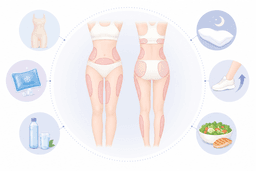
For the first 3 days, cold compresses + maintaining an elevated position are key.
If you have undergone abdominal liposuction, sleep with your upper body raised 30 degrees and keep your thighs elevated above your heart by placing your legs on a cushion. This speeds up the rate at which swelling subsides due to gravity. Apply cold compresses for 15 minutes, 4 to 5 times a day, while wearing the compression garment. Bruising begins to spread as a yellowish color starting 2 to 3 days after surgery and almost disappears by 7 to 10 days. People with severe bruising may use bromelain (pineapple enzyme) supplements or arnica ointment, but clinical effectiveness varies greatly from person to person. What is certain is that smoking and drinking make bruising last more than twice as long. The compression garment must be worn 24 hours a day as a rule, and should only be removed for about 30 minutes during a shower. Showering is possible starting 3 days after surgery, and the incision site is protected with a waterproof bandage. You can return to your daily routine once the stitches are removed on the 7th day, but 'daily life' is based on office work, and exercise and saunas are prohibited for at least 4 weeks. Caution: If you wear the compression garment loosely because of severe swelling, the likelihood of the skin healing unevenly increases. Even if it is uncomfortable, you must wear it tightly for the first two weeks. Adjust it if it makes breathing difficult, but it is normal to feel a little stuffy. At the peak of swelling, the suction site may swell to 110-120% of its pre-surgery circumference. This gradually fades over 4-6 weeks. The bruise changes from yellow to green to brown and disappears during the hemoglobin breakdown process, taking an average of 7-10 days. Wearing a compression garment is recommended for a minimum of 4 weeks, and up to 6 weeks for large areas such as the abdomen and thighs (Korean Society of Aesthetic Plastic Surgery Guidelines). Stage 5: 2 weeks - 3 months, the time when the final lines are formed. After 2 weeks, 60-70% of the swelling subsides and the lines become visible to some extent. From this point, you can reduce the compression garment to 12 hours a day (mainly at night) and begin light stretching and walking exercises. However, high-intensity exercises such as running, weight training, and Pilates are still prohibited. The final results are completed 3-6 months after surgery. As deep edema gradually subsides, you will feel the skin tightening; if there is unevenness or asymmetry at this stage, consider a touch-up (revision surgery). According to domestic clinical data, the touch-up rate is around 5-8% of the total. After removing the compression garment, weight management begins to prevent the yo-yo effect. Since liposuction reduces the number of fat cells, the same area does not gain weight severely again, but if fat increases in surrounding areas or visceral fat, the overall silhouette can collapse. It is generally recommended to aim to maintain your pre-surgery weight within ±2kg. To summarize the restrictions during the recovery period: smoking for at least 4 weeks (delaying recovery due to obstructed blood flow), drinking for 2 weeks (worsening bleeding and edema), saunas and steam rooms for 6 weeks (recurrence of edema due to heat), and swimming and yoga for 4 weeks (risk of sutures separating due to pressure changes and stretching). If you do not adhere to this period, the results may be ruined, so please be sure to be patient.- Satisfaction at the 3-month mark after surgery averages 85-90% in domestic clinical trials, and rises to over 90% at 6 months.
- Touch-up is mainly required for asymmetry, depression, or unevenness, and revision surgery is possible after at least 6 months.
- If your weight increases by more than 5kg compared to before surgery, fat tends to accumulate first in areas other than the suction site (arms, back).
Please make sure to remember this.

The most important thing during the liposuction procedure is observing the timing of each step and contraindications. Thoroughly checking the design during the consultation, minimizing swelling through 72-hour care immediately after surgery, and wearing the compression garment for 4 to 6 weeks until completion are crucial factors in determining the results. While recovery varies greatly from person to person, the general flow remains the same: the first week is difficult due to bruising and swelling, the lines start to become visible from the second week, and the final result is achieved in three months. If you rush to remove the compression garment or start exercising during this process, the risk of unevenness or recurrence increases, so please follow the medical staff's instructions precisely. During the consultation, confirm the suction site, anesthesia method, and recovery schedule in detail, and review the design in both standing and lying positions. Manage swelling with cold compresses and an elevated position for 3 days immediately after surgery; return to office work is possible after suture removal on the 7th day. Wear the compression garment 24 hours a day for the first 2 weeks, then adjust to 12 hours a day until weeks 4-6. No smoking, drinking, or sauna use for at least 4 weeks
Comparison of Anesthesia Methods
General Anesthesia [Large volume inhalation of 3L or more]
- Intravenous Propofol Infusion
- Complete unconsciousness during surgery
- Observation in the recovery room for 2-3 hours
- Complex areas such as the abdomen and flanks
Anesthesiologist on-site is mandatory; 1-night hospitalization recommended
Tumescent (Local Anesthesia) [Single site under 2L]
- Local injection of Klein solution
- Maintains consciousness, blocks pain only
- Discharge from recovery room after 30 minutes to 1 hour
- Small areas such as forearms and calves
Over 90% reduction in bleeding, same-day discharge possible
Sedation anesthesia + tumescent [Medium inhalation volume (1.5-3L)]
- Low dose of propofol + Klein solution
- Light sedation
- Recovery 1-2 hours
- Medium areas such as the entire thigh Area
Less burden than general anesthesia and more comfortable than tumescent
Choosing the right recovery strategy for me
Combined abdominal + flank liposuction, if you work in an office
Surgery on Friday → Intensive care over the weekend → Work from home on Monday → Return to work on Tuesday
Lying down and applying cold compresses for the first 3 days reduces swelling by 70%, and after that, you can perform office work wearing only a compression garment
Small amount of liposuction on the upper arms and calves, If you want a quick return
Tumescent anesthesia + Discharge on the same day + Return to daily life after 3 days
Recovery is fast because there is less swelling and bruising in small areas. However, compression sleeves are mandatory for 4 weeks.
If you are not confident about recovery because it is your first surgery
1 night hospitalization + accompanying guardian + working from home for the first week
You can lower the risk of complications by extending the observation time in the recovery room and receiving initial care at the hospital
If you are in your 20s or 30s with an exercise routine
6 weeks of complete rest → resume with light cardio → weight training after 8 weeks
If you start exercising impatiently, the sutures may separate or fat may shift. Start after the lines have been fixed.
Common Misconceptions
Misconception If you have liposuction, that area won't gain weight again.
Truth While the number of fat cells decreases, the remaining cells can grow larger. If your weight increases by more than 5kg, fat will accumulate in other areas (arms, back) first, and then gradually build up in the liposuction site as well. Maintaining your pre-surgery weight ±2kg is the standard for preventing the yo-yo effect.
Misconception I heard it's okay to wear a compression garment for only 2 weeks.
Truth The first 2 weeks are for managing swelling, and weeks 2-6 are the fixation period for the skin to adhere to the new lines. If you take it off during this period, there is a high chance that bumpy or sagging skin will remain. The standard is to wear it for at least 4 weeks, and 6 weeks for the abdomen and thighs.
If these symptoms appear after surgery, contact the hospital immediately
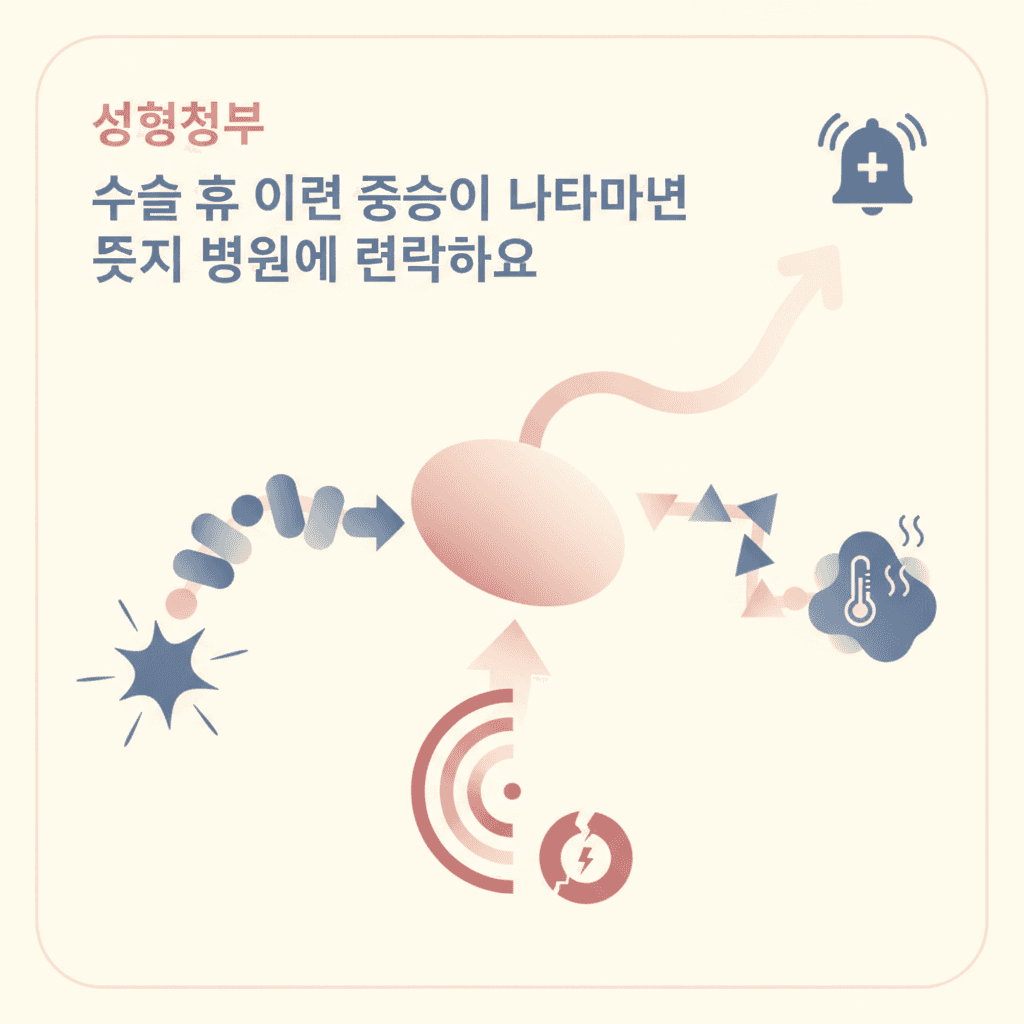
- High fever of 38 degrees or higher for 2 days or more Persistent (Suspected Infection) Yellow or green discharge or foul odor from the suction site (Possibility of Abscess) Severe swelling and pain in only one leg (Risk of Deep Vein Thrombosis) Chest tightness or difficulty breathing (Pulmonary Embolism Emergency) The suture site separates or bleeding does not stop
Frequently Asked Questions
Can I go home alone on the day of liposuction surgery?
General anesthesia requires a guardian to accompany you. Even tumescent local anesthesia may leave you feeling dizzy, so we recommend having a guardian or a designated driver ready. Driving on the day of the procedure is strictly prohibited. Can I use shapewear instead of a compression garment? Regular shapewear has weak pressure and is not tailored to specific areas, so it is less effective at preventing bumps. Medical compression garments are designed with pressure in mmHg units, so the recovery speed is significantly different. When and how should I shower? You can take a lukewarm shower starting 3 days after surgery. Protect the incision site with a waterproof bandage and keep the shower short, under 5 minutes. Pat dry and put the compression garment back on immediately. How many months after surgery will the scar remain? A 3-4mm incision fades to a level that is almost invisible within 6 months to 1 year. Applying silicone gel sheets or scar ointment early on can reduce hyperpigmentation. If you have a keloid predisposition, please consult with a doctor in advance. What is the risk of side effects or complications? Infection and bleeding occur in less than 1% of cases, while contour irregularity appears in 5-8% of cases and can mostly be corrected with touch-ups. Severe complications such as deep vein thrombosis and pulmonary embolism occur in less than 0.1% of cases, but you must go to the emergency room immediately if you experience high fever or difficulty breathing. The risk increases if you smoke, are obese, or have underlying conditions, so be sure to inform them during your consultation. Is revision surgery possible if I am not satisfied with the results? Touch-ups (re-liposuction or fat grafting) are possible after at least 6 months. The decision is made after the swelling has completely subsided and the final line has been examined. Initial dissatisfaction is mostly due to swelling, so please wait up to 3 months.
This content is for informational purposes only and does not replace medical advice. Please consult a specialist before the procedure.