Cost differences by area, why is it like this? Will it be different?
100cc extraction volume is a bigger difference than you think.
Anesthesia method determines both cost and safety.
Equipment differences differentiate result uniformity and recovery speed.
Medical staff experience and hospital infrastructure are hidden cost factors.
Just remember this and comparing quotes becomes easy.
Find a cost plan that fits your situation.
Frequently Asked Questions The moment I was flustered after receiving the estimate
As soon as I sat down in the consultation room chair, I received two sheets of paper. One was for the abdomen only, and the other was for the abdomen plus flanks combined; the price difference was greater than I expected. I wondered, "Is there really this much difference for just a little bit of flanks?" but after hearing the explanation, I understood.
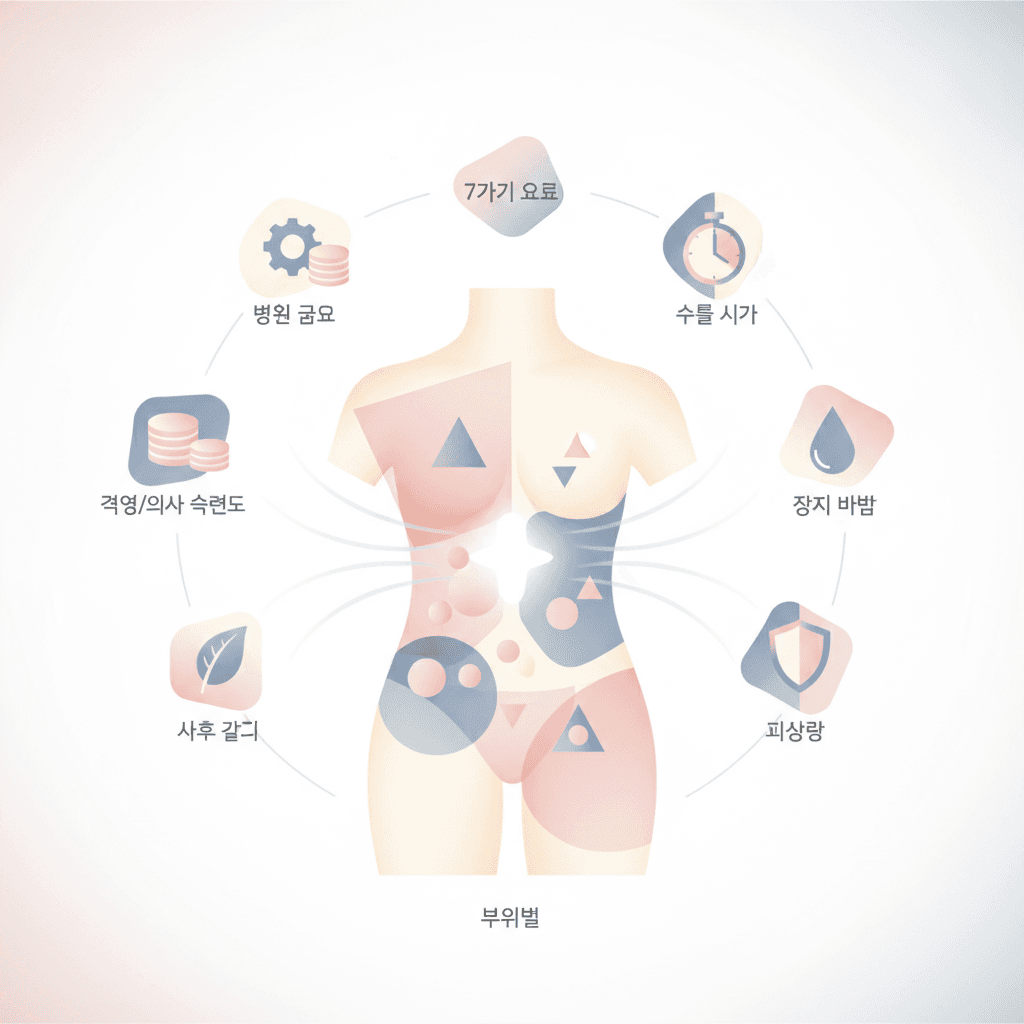
The cost of liposuction is not determined simply by the "number of areas," but rather by a complex interplay of seven factors, including the extraction volume, anesthesia scope, type of equipment, and recovery management. This is why the cost estimate can more than double, even for the same thigh procedure, depending on whether you choose to treat only the front, include the back, or also the inner side.
In this article, I will summarize the 7 key factors that create cost differences and the price structure by body part. Knowing just this before comparing quotes will enable you to make a reasonable choice that suits your body.
Why are costs so different by body part?
When comparing the entire abdomen with the upper arms, although the abdomen has a larger surface area, the cost per unit area is lower than that of the upper arms. The abdomen has a thick and wide layer of fat, allowing for a large amount to be extracted at once, but the upper arms have thin skin and are densely packed with nerves and blood vessels, so high precision is required.
According to the 2022 clinical data from the Korean Society of Aesthetic Plastic Surgery, the average extraction volume for abdominal liposuction is 1,500–2,500cc, while for the upper arms it is 200–400cc; however, the procedure time for the upper arms is 60–70% of that for the abdomen. It is structured so that the smaller the area, the higher the 'difficulty premium' attached.
For areas like the inner thighs and calves, the fat layer is thin and the boundary with the muscle is ambiguous, so the selection of equipment and the proficiency of the medical staff directly affect the results. The cost increases for these areas because the use of high-end equipment, such as RFAL, is higher.
Tip: The reason the combined abdominal and flank quote is cheaper than separate ones is that the anesthesia and sterilization areas are shared, and extraction efficiency is higher in a single session. When combining connecting areas, it is not a 'bundle promotion guide,' but an actual cost-saving effect.
Area
Average Extraction Volume Range
Difficulty Characteristics
Equipment Preference
Whole Abdomen
1500-2500cc
Large Area, Thick Fat Layer
Selection of Standard Suction Tube + High Frequency
Front + Side of Thigh
1200-2000cc
Muscle Boundary Precision Necessary
High frequency/ultrasound preferred
Forearm
200-400cc
Thin skin, nerve density
Fine cannula essential
Calf
300-600cc
Need to differentiate between muscle hypertrophy
High frequency/low power preferred
100cc extraction volume makes a bigger difference than you think
Plastic Surgery Info — Extraction Volume 100cc, It's a Bigger Difference Than You ThinkAI Generated Illustration The estimate states 'based on 1500cc for the abdomen,' but if the doctor says during the consultation 'it looks like it will actually be around 2000cc ' Additional costs may be incurred . As the extraction volume increases, the dosage of anesthetic, the difficulty of recovery management, and the surgery time all increase.
The safe extraction volume based on FDA-approved equipment standards is up to 5,000cc per kg of body weight, but in actual clinical practice, inpatient observation is often recommended if 3,000–4,000cc is exceeded at once. As the extraction volume increases, post-processing costs also rise as fluid replenishment, compression garment strength, and the frequency of blood tests increase.
Some hospitals specify the ‘extraction volume within the basic range’ and charge an additional fee per 100cc for the excess.
When getting a quote, making sure to check the ‘extraction volume limit’ and the ‘policy for exceeding the limit’ is the way to avoid being flustered later.
Average cost increases by 15-25% for every 100cc increase in extraction volume (including anesthetics, time, and post-treatment)
Inpatient observation rate for extractions over 3000cc is 68% (Korean Society of Plastic and Reconstructive Surgeons 2021)
Approximately 40% of hospitals charge additional costs per 100cc when the extraction volume limit is exceeded
Anesthesia method determines both cost and safety
Sedation and General anesthesia do not have a large cost difference Although it is not, there is a difference in safety and recovery speed. Since sedation anesthesia lowers consciousness while maintaining spontaneous breathing, the presence of an anesthesiologist is important.
General anesthesia is commonly used for large areas like the abdomen, while a combination of sedation and local anesthesia is common for the forearms and calves. According to the American Society of Anesthesiologists (ASA) guidelines, the recommended rate for general anesthesia is over 80% for extractions of 3,000cc or more.
There are cases where only local anesthesia (tumescent) is used, but this is limited to small extractions or short procedures. Although it is the lowest cost, there may be discomfort during the procedure, and it is not used if the extraction volume is large due to the risk of anesthetic toxicity.
Caution: If you insist on using only local anesthesia to save on costs, the doctor may not be able to extract enough, or the patient may experience pain midway, causing the procedure to be stopped. Choosing an appropriate anesthesia method within a safe range is also beneficial for the results.
Differences in equipment affect result uniformity and recovery speed.
High-frequency liposuction (RFAL, BodyTite, AccuTite, etc.) is 30-40% more effective in improving skin elasticity than standard suction cannula (Journal of Cosmetic Dermatology 2020). High-frequency energy contracts collagen in the dermis layer, simultaneously caring for sagging skin.
Ultrasonic liposuction (VASER) selectively emulsifies only fat cells, resulting in minimal nerve and blood vessel damage, and shortening the recovery period for bruising and swelling by 20-30% compared to conventional liposuction. However, costs increase due to high equipment operating expenses and consumable unit prices.
While conventional suction cannula (PAL, power-assisted) can produce sufficiently good results in the hands of a skilled doctor, combining high-frequency and ultrasonic methods is advantageous for patients over 40 with low skin elasticity or for those with a large volume of extraction. The choice of equipment varies depending on age, skin condition, and the area treated.
30-40% improvement in skin elasticity with radiofrequency liposuction (Journal of Cosmetic Dermatology 2020)
20-30% reduction in recovery time for bruising and swelling with ultrasound liposuction (Korean Society of Aesthetic Plastic Surgery 2021)
Unit cost of VASER equipment consumables is about 50% higher than that of a standard suction cannula
Medical staff experience, hospital infrastructure, and hidden cost factors
Even for the same abdominal procedure, the reason the quote differs between a specialist with 10 years of experience and a specialist with 3 years of experience is not due to an experience premium, but because of the difference in reoperation rates and complication rates. According to a 2022 survey by the Korean Society of Plastic and Reconstructive Surgeons, the reoperation rate for doctors with over 10 years of experience averaged 2.1%, while for those with less than 5 years, it was 5.8%.
The presence of an anesthesiologist, emergency equipment, and the size of the recovery room are also reflected in the cost. Hospitals equipped with recovery rooms certified by the Ministry of Food and Drug Safety often include services such as inpatient observation, IV administration, and compression garment replacement; therefore, even if the initial estimate appears high, the structure is such that post-treatment costs are not charged separately.
Conversely, places with lower initial estimates may charge separately for compression garments, painkillers, and progress monitoring, or set a low upper limit on extraction volume, which may result in additional costs. When comparing quotes, it is important to carefully check the 'scope of included items'.
Key Point: If the quote states 'includes 1 compression garment', check if there are separate costs for additional garments or replacements. You need 2-3 sets during the 4-6 week recovery period, and this alone makes a difference in additional costs.
Just remember this and comparing quotes becomes easy
AI Generation Liposuction costs are determined not simply by the ‘number of areas,’ but by seven factors: extraction volume, anesthesia method, equipment, medical staff experience, scope of post-treatment, and hospital infrastructure. This is why costs vary even for the same abdominal procedure depending on whether the standard is 1,500cc or 2,500cc, and whether high-frequency treatment is combined with standard suction.
Items you must check when comparing quotes are: ① extraction volume limits and policies regarding exceeding them, ② anesthesia method and whether a board-certified anesthesiologist is present, ③ type of equipment and whether skin tightening is included, and ④ scope of post-treatment coverage such as compression garments, follow-up care, and IV fluids. Even if the initial estimate is low, the total cost can be reversed if additional expenses are added later.
When comparing estimates, it is essential to check 4 things: extraction volume limit, anesthesia method, equipment type, and post-treatment scope
Combining abdominal and flank procedures results in an average cost reduction of 15-20% compared to performing them separately
Combining radiofrequency and ultrasound increases initial costs by 30% but reduces the reoperation rate by more than 50%
For extraction volumes of 3000cc or more, whether inpatient observation, IV fluids, and compression garment replacement are included affects the total cost by 20-30%
Comparison of Costs and Safety by Anesthesia Method
Local Anesthesia (Tumescent) [Small Extraction]
Maintains spontaneous breathing, conscious
Suitable for small extractions of 500cc or less
Lowest anesthesia cost
Possibility of discomfort during the procedure
Primarily used for extractions in the forearm and calf areas
Combination of sedation and local anesthesia [Medium Range]
Decreases consciousness and blocks pain
Suitable for 1000-2000cc range
On-site anesthesiologist recommended
Fast recovery and easy return to daily life
Frequently used for single areas such as the thigh and abdomen Select
General Anesthesia [Large-scale Extraction]
Complete unconsciousness
Over 3000cc or multiple sites combined
Anesthesiologist required
Inpatient observation recommended
Select for extensive procedures such as abdominal + thigh binding
Find a cost plan that fits your situation
Considering both abdomen and flanks, if you have a generous budget
Select Bundled Procedure + Radiofrequency Combination
Shared Anesthesia and Post-treatment Save 15-20% Compared to Separate Procedures, Also Cares for Skin Elasticity to Lower Probability of Reoperation
If You Only Want Small Areas Like Forearms or Calves
Select Sedation Anesthesia + Precision Cannula Combination
For High-Difficulty Areas Even with Small Areas, Equipment and Medical Staff Proficiency Determine Results; Prioritize Precision Over Cost
If You Are 40 or Older and Worried About Skin Elasticity
Combined radiofrequency (RFAL) treatment recommended
Initial cost is 30% higher, but skin tightening effect maintains a smooth line without sagging, and the reoperation rate is reduced by half
If you intend to decide based only on initial cost while comparing quotes
Must check the upper limit of extraction volume and the scope of post-treatment inclusion
Even if the initial quote is low, the total cost can be reversed if additional expenses are incurred; whether compression garments, progress monitoring, and IV fluids are included makes a 20-30% difference
Common misconceptions
Misconception The more areas treated, the higher the cost
Truth If connected areas (abdomen + flanks, inner + outer thighs) are combined, they share the anesthesia and sterilization scope, making it 15-20% cheaper than treating them separately. The 'total extraction volume' and 'continuity of scope' have a greater impact on the cost than the number of areas.
Misconception A standard suction cannula is sufficient, and high-frequency treatment is overtreatment
Truth If you have low skin elasticity or are over 40, combining high-frequency treatment is actually helpful in preventing skin sagging. If only standard suction is performed, fat is removed but skin remains, often leading to revision surgery. The necessary equipment varies depending on age and skin condition.
Things You Must Never Compromise When Trying to Cut Costs
AI Generated Illustration
!!Absentee Status — Safety depends on emergency response capabilities when extracting over 3000cc!!
Failure to check the additional cost policy for exceeding the extraction limit — Cost disputes may arise later as the actual cost turns out to be higher than expected
Failure to check if post-treatment items such as compression garments, follow-up care, and IV fluids are included in the estimate — Total costs increase by 20-30% due to separate expenses
!!Failure to check equipment and anesthesia methods based only on the initial estimate — Losses in recovery time and consistency of results!!
Judging solely based on medical staff experience without data on reoperation rates or complication rates — Reoperation rates differ by more than double between those with over 10 years of experience and those with less than 5 years of experience
Frequently Asked Questions
Abdominal liposuction, how much does it cost to extract 2000cc?
Costs vary by hospital, region, equipment, and anesthesia method We cannot specify the exact amount as it has changed. However, since costs increase by an average of 15-25% for every 100cc increase in extraction volume, if you received a quote based on 1500cc, please keep in mind the possibility of a 20-30% additional cost for 2000cc and be sure to check the 'extraction volume overrun policy' during the consultation.
How much cheaper is it to combine the inner and outer thighs compared to doing them separately?
The procedure of combining connected areas results in an average cost reduction of 15-20%. This is because the anesthesia area, sterilization preparation, and recovery room usage are shared, and extraction efficiency is increased in a single session. However, if the total extraction volume exceeds 3000cc, additional costs for hospitalization and observation may apply.
How much more expensive is radiofrequency liposuction than regular liposuction, and is the effectiveness certain?
When combined with radiofrequency (RFAL), the initial cost increases by about 30%, but the rate of improvement in skin elasticity is 30-40% higher, and the reoperation rate drops to less than half (Journal of Cosmetic Dermatology 2020). If you are over 40 or concerned about skin sagging, it may be more economical in the long run.
The quote says '1 compression garment included,' do I need to buy another one?
You need 2-3 compression garments during the 4-6 week recovery period. If only one set is included, you will need to purchase 1-2 additional sets for washing and replacement or rent them from the hospital; it is advisable to confirm during the consultation whether these costs are separate.
Are there additional costs if side effects or complications occur?
If uneven skin, pigmentation, or infection occur after the procedure, additional costs may be incurred for re-procedures, laser treatment, or medication prescriptions. Since 're-surgery guarantee policies' vary by hospital, please clearly confirm who bears the costs in the event of complications during the consultation and be sure to check the details specified in the contract.
Do I need to be hospitalized if more than 3,000cc is extracted? Are hospitalization costs separate?
The recommended rate for inpatient observation when the extraction volume is 3,000cc or more is 68% (Korean Society of Plastic and Reconstructive Surgeons 2021). Some hospitals include hospitalization fees, IV fluids, and follow-up checks in the quote, while others charge separately. Even if the initial quote is low, the total cost can be reversed if hospitalization fees are separate, so it is essential to confirm this during the consultation.
This content is for informational purposes only and does not replace medical advice. Liposuction costs vary significantly depending on individual body type, extraction volume, area, and hospital, so be sure to consult with a specialist and check the detailed items on the quote before the procedure.
Find the right hospital for you at K-Dia