Comparison of Contouring Types 2025: 7 Choices – 3-Type Contour, Double Jaw, and Mini V-Line
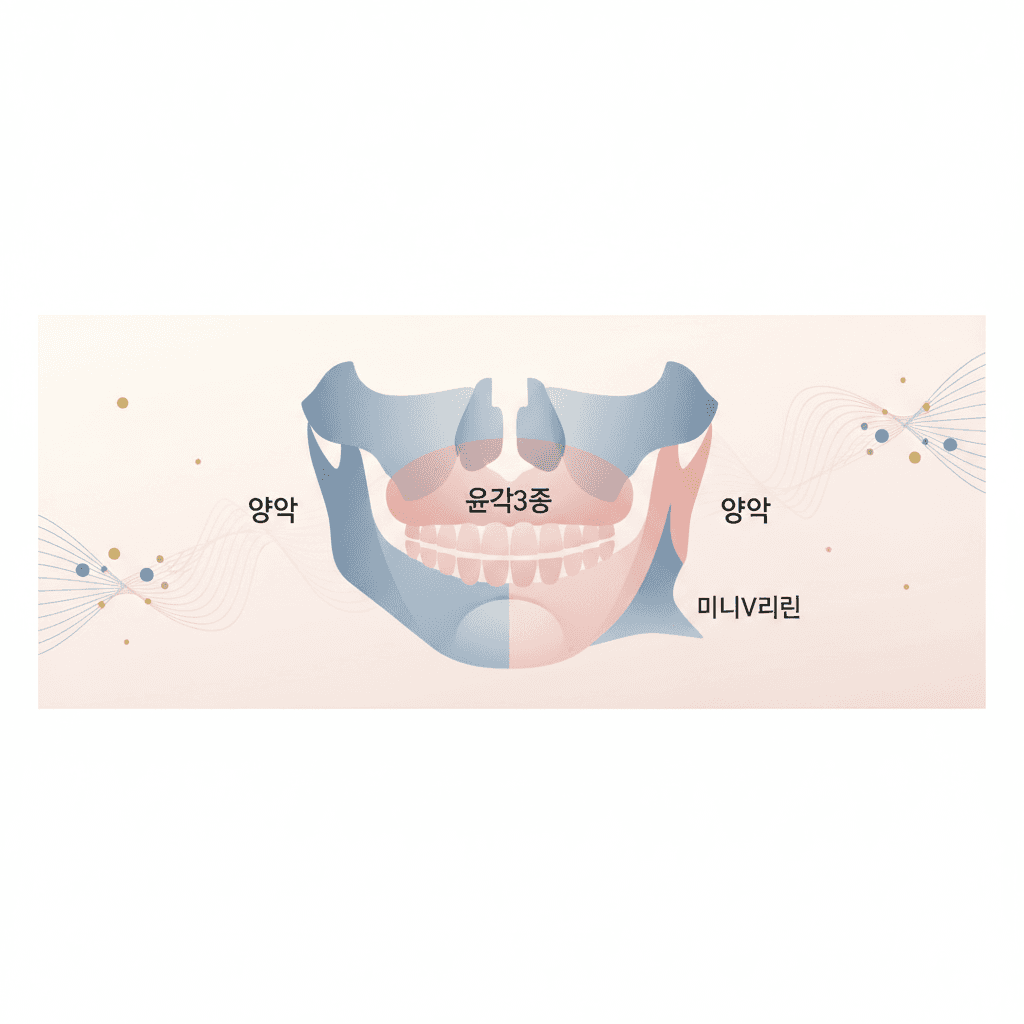
The scope of osteotomy differs between the 3-part facial contouring procedure and orthognathic surgery—the branching point is determined by the presence or absence of occlusal issues. Mini V-line shortens the incision length by 50%, but there are clear limitations for protruding cheekbones or asymmetry of 4mm or more. The 2025 guidelines of the Korean Academy of Maxillofacial Plastic Surgeons suggest 3D CT-based simulation as the primary selection criterion.
Information as of June 2026
Customized surgical methods by skeletal type
- 32,000 annual facial contouring surgeries in Korea
- Recovery period: 2 weeks to 6 months
- Reoperation rate: 3% to 12%
Choosing facial contouring surgery: Why are 90% confused during the first consultation?
The most frequently asked question in the clinic is, "Is the 3-part facial contouring sufficient, or do I need to undergo double jaw surgery as well?" These two have completely different purposes for osteotomy. Contouring surgery is broadly divided into seven types — cheekbone reduction, square jaw resection, chin augmentation (V-line), double jaw surgery, mini V-line, forehead and nose combined contouring, and facial asymmetry correction. The top three of these are grouped together and referred to as the "Contouring Trio." According to a 2024 report by the Ministry of Food and Drug Safety, the annual number of contouring surgeries performed in Korea is 32,000. Of these, 42% are the Contouring Trio, 18% are double jaw surgeries, and 23% are single-area surgeries. The problem is that while patients initially thought they only needed to "shaving down their cheekbones," CT analysis revealed that 30% of cases required the Trio because they also had mandibular angle hypertrophy and a receding chin. Key Point: For contouring surgery, the primary selection criterion is not the "desired line," but the "current skeletal structure." If judged solely based on photos without 3D CT, the error rate can rise to 40%.
3-Type Contouring vs. Orthognathic Surgery: Differences in Osteotomy Range and Occlusal Involvement
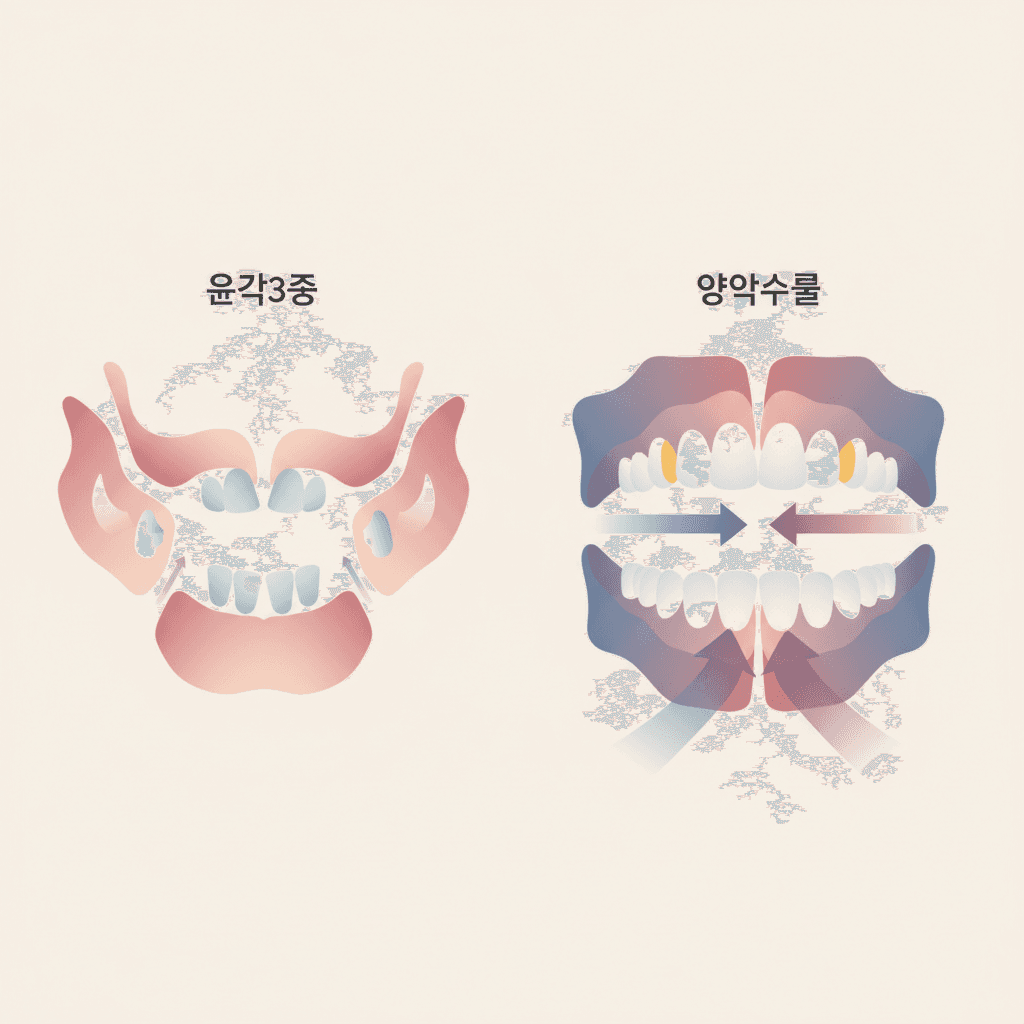
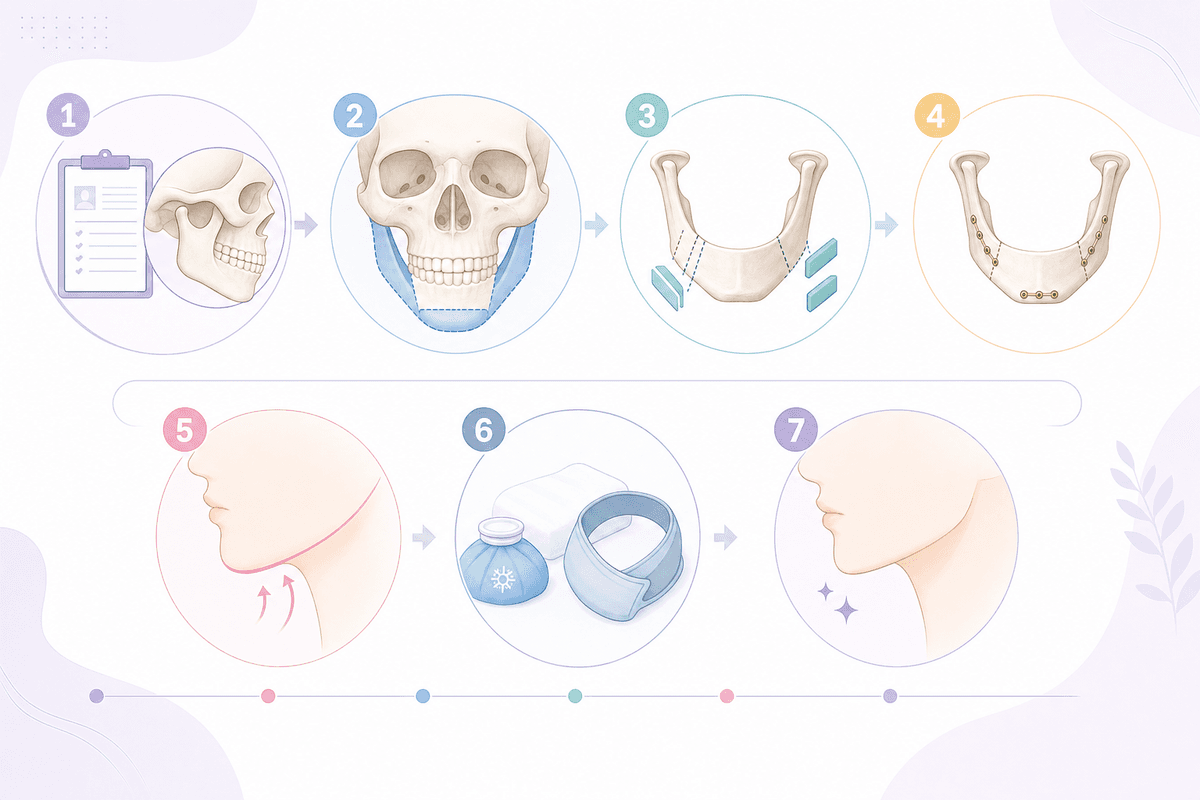
The 3-Type Contouring Surgery is a cosmetic procedure that involves the resection and repositioning of the cheekbones (zygomatic arch), mandibular angle (square jaw), and chin (chin). It does not affect dental occlusion.
Bottom jaw surgery corrects occlusal malocclusion by advancing and retracting the maxilla (Le Fort I) and mandible (BSSRO) together. It is essential when accompanied by prognathism, retrognathism, or facial asymmetry.
The 2023 guidelines of the Korean Academy of Maxillofacial Plastic Surgery recommend orthognathic surgery as a primary procedure when the occlusal error is 3mm or more or the open bite is 2mm or more. If the results fall below these criteria, the 3-Type Contouring Surgery is sufficient.
The surgery time is 3.5 to 4 hours for the 3-Type Contouring Surgery and 5 to 6 hours for orthognathic surgery. The amount of bleeding under general anesthesia is reported to be an average of 250ml for the 3-Type Contouring Surgery and 450ml for the Orthognathic Surgery.
| Classification | 3-Type Contouring Surgery | Orthognathic Surgery |
|---|---|---|
| Osteotomy Site | Cheekbone·Mandibular Angle·Chin | Entire Maxilla·Mandible |
| Occlusal Intervention | None | Orthodontics Required |
| Average Surgery Time | 3.5~4 hours | 5~6 hours |
| Recovery Period | 2~3 weeks return to society | 4~6 weeks return to society |
| Reoperation Rate | 3~5% | 8~12% |
- Average cost of 3-Type Facial Contouring: 8~12 million KRW (Based on Seoul, 2025)
- Average cost of Orthognathic Surgery: 15~25 million KRW
- Occlusal readjustment rate after Orthognathic Surgery: 12% (Korean Association of Orthodontists) 2024)
Mini V-Line: 50% reduction in incision, but limitations for cheekbone protrusion and asymmetry
Mini V-Line is a reduction-type contouring procedure that trims only a portion of the mandibular angle and the chin using a minimal incision (3–4 cm) inside the mouth. It has spread rapidly among office workers in their 20s since 2019.
The advantages include a surgery time of 1.5–2 hours and a recovery period of 7–10 days, which is half that of the standard 3-type contouring procedure. The scar is also located on the oral mucosa, so there is no external exposure.
However, the effectiveness is limited in cases of cheekbone protrusion of 4 mm or more, left-right asymmetry of 5 mm or more, or receding chin depth of 6 mm or more. According to a 2024 announcement by the Korean Society of Aesthetic Plastic Surgery, satisfaction in such cases was only 54%. On the other hand, if the goal is to 'soften a slightly angular jawline,' satisfaction with the Mini V-Line rises to 88%. It is an optimized option when skeletal issues are mild. Caution: The Mini V-Line is suitable for cases where 'the cheekbones are fine, but only the jawline is angular.' If both the cheekbones and the square jaw are large, a standard 3-part contouring procedure is required. Selection Criteria by Skeletal Type: 20s vs. 40s, Office Workers vs. Students Students and job seekers in their 20s prefer the 3-part contouring procedure or the Mini V-Line, aiming for a recovery period of 2 to 3 weeks. Many people try to time their appointments before school breaks or job hunting. Office workers in their 30s and 40s consider full orthodontic treatment, including double jaw surgery. This is because the prevalence of accompanying temporomandibular joint disorders or sleep apnea reaches 35%. For the protruding cheekbone type (zygomatic arch width 140mm or more), patients choose either cheekbone reduction surgery alone or the three-part contouring procedure. For the square jaw type (mandibular angle 120 degrees or less), mandibular angle resection surgery alone is highly likely. If facial asymmetry is 5mm or more, double jaw surgery is the primary recommendation. A 2023 study by Severance Hospital showed that the reoperation rate was 18% when the three-part contouring procedure was performed alone in this case. Tip: If you have temporomandibular joint pain or an open bite, collaboration between the Department of Orthodontics and the Department of Oral and Maxillofacial Surgery is essential. Functional improvement is the priority, not merely for cosmetic purposes.
The Emergence of 3D CT Simulation and Digital Guides
In 2025, the Korean Association of Maxillofacial Plastic Surgeons [will standardize] 3D CT scanning and virtual surgical simulation prior to contouring surgery It has been recommended as a protocol. Based on CT data, the osteotomy angle and displacement distance are designed in 0.5mm increments, and a 3D-printed guide is used during surgery. This method is reported to reduce the error rate by 62% compared to the conventional freehand method. Particularly in orthognathic surgery, occlusal readjustment is required even if the upper and lower jaws are misaligned by just 1mm, so the number of hospitals applying digital guides is rapidly increasing. However, the prediction accuracy of 3D simulation for changes in soft tissues (skin and fat) is only about 75%. One must keep in mind the possibility that the skin may not follow the skeletal changes as closely. Clinical Find hospitals that provide 3D CT simulation as standard on K-Dia. The pre-operative visualization stage increases result satisfaction by 20%.
- Approximately 120 hospitals nationwide to adopt 3D CT-based simulation by 2025
- Average surgery time reduced by 20% when using digital guides
- 92% achievement rate of error less than 1mm (2024 Yonsei University study)
Recovery period and return to society: Timeline by surgery
For the 3-part facial contouring surgery, facial swelling reaches a high level during the first week after surgery. 70% recovery begins from the second week, and by the third week, it is possible to go to work without a mask.
For orthognathic surgery, a two-week upper and lower jaw fixation (IMF) period is required, during which only liquid food is consumed. Return to social life takes 4 to 6 weeks. For Mini V-Line, swelling subsides in 7 to 10 days, and you can return to daily life in 2 weeks. However, consuming hard foods is permitted starting 4 weeks after surgery. You must avoid strong impacts (vigorous exercise, saunas, and alcohol) for 6 months after any contouring surgery, as this is the bone fusion process. A 2023 study by Seoul National University Hospital found that the reoperation rate was three times higher when this guideline was not followed. Tip: If you are an office worker, consider the 3-part contouring surgery after securing 3 weeks of annual leave, and consider double jaw surgery if you secure 4 weeks or more. If the occupation allows for working from home, cases of returning to work within 2 weeks are reported.
Comparison of the 3 Major Types of Facial Contouring Surgery
3 Types of Facial Contouring [Cosmetic Purpose]
- Osteotomy: Cheekbone, Mandibular Angle, Chin
- Surgery Time: 3.5~4 hours
- Return to Society: 2~3 weeks
- Occlusal Intervention: None
- Cost: 8~12 million KRW
Optimal when there are no occlusal issues and the goal is only external improvement
Orthognathic Surgery [Function+Aesthetic]
- Osteotomy: Entire Maxilla and Mandible
- Surgery Time: 5~6 hours
- Return to Social Life: 4~6 weeks
- Occlusal Intervention: Essential Orthodontics
- Cost: 15~25 million KRW
Primary Choice When Accompanied by Prognathism, Micrognathia, or Open Bite
Mini V-Line [Minimally Invasive]
- Osteotomy: Part of Mandibular Angle and Chin
- Surgery Time: 1.5~2 hours
- Return to Social Life: 7~10 days
- Occlusal intervention: None
- Cost: 4~7 million KRW
Effective for mild angular jaw and normal cheekbones
Common misconceptions

Misconception If you undergo the 3-part contouring procedure, you do not need double jaw surgery
Truth If the malocclusion is 3mm or more, temporomandibular joint problems will recur with the 3-part contouring procedure alone. According to a 2024 report by the Korean Academy of Maxillofacial Plastic Surgery, the reoperation rate within 5 years for such cases reached 22%. The occlusal status must be checked first through collaboration with the Department of Orthodontics.
Misconception Mini V-line is weak in effect
Truth If skeletal problems are mild (mandibular angle 110–115 degrees, left-right asymmetry 3mm or less), the satisfaction rate for Mini V-line rises to 88%. The problem is that it is difficult to determine whether your skeletal condition is mild without a CT scan. Please request a 3D CT scan during your consultation.
Frequently Asked Questions
How do I choose between the 3-Type Contouring Surgery and Orthognathic Surgery?
Orthognathic surgery is the priority if the occlusal error is 3mm or more, the open bite is 2mm or more, or if accompanied by temporomandibular joint pain. If there are no occlusal issues and you only want to improve your appearance, the 3-Type Contouring Surgery is suitable. We recommend a collaborative consultation between the Department of Orthodontics and the Department of Oral and Maxillofacial Surgery.
Does the Mini V-Line reduce the cheekbones as well?
Since the Mini V-Line only addresses the mandibular angle and the chin, there is no change to the cheekbones (zygomatic arch). If cheekbone protrusion is 4mm or more, cheekbone reduction surgery must be performed separately. Is 3D CT simulation absolutely necessary? The 2025 academic society guidelines recommend 3D CT as the standard protocol. It allows for the design of bone thickness, nerve location, and osteotomy angles in 0.5mm increments, reducing the error rate by 62%. Internal skeletal structures cannot be identified from images alone. When can I start exercising after contouring surgery? Light walking is permitted after 2 weeks, jogging after 4 weeks, and weight training and ball sports after 3 months. Since strong impacts interfere with bone fusion, caution is required for 6 months. What are the side effects and complications of contouring surgery? The main side effect is nerve damage (inferior alveolar nerve and facial nerve), which may cause numbness or sensory abnormalities to persist for 3 to 6 months. Rarely, malunion, bone resorption, and recurrence of asymmetry are reported, in which case revision surgery is necessary. The infection rate is less than 1%, but oral hygiene management after surgery is essential. Individual differences exist, and sufficient consultation with a specialist is required.
Does the face shape return after contouring surgery?
While the bone resection site is permanent, the face may appear visually angular if soft tissues (skin and muscle) sag. A sagging rate of 20% is reported after 5 years in those aged 40 and older. Weight management and facial muscle exercises are recommended for long-term maintenance.
This content is for informational purposes only and does not replace medical advice. Always consult with a specialist before the procedure.