Ultherapy vs Thermage: Why There's a 3x Price Difference for the Same Lifting Treatment
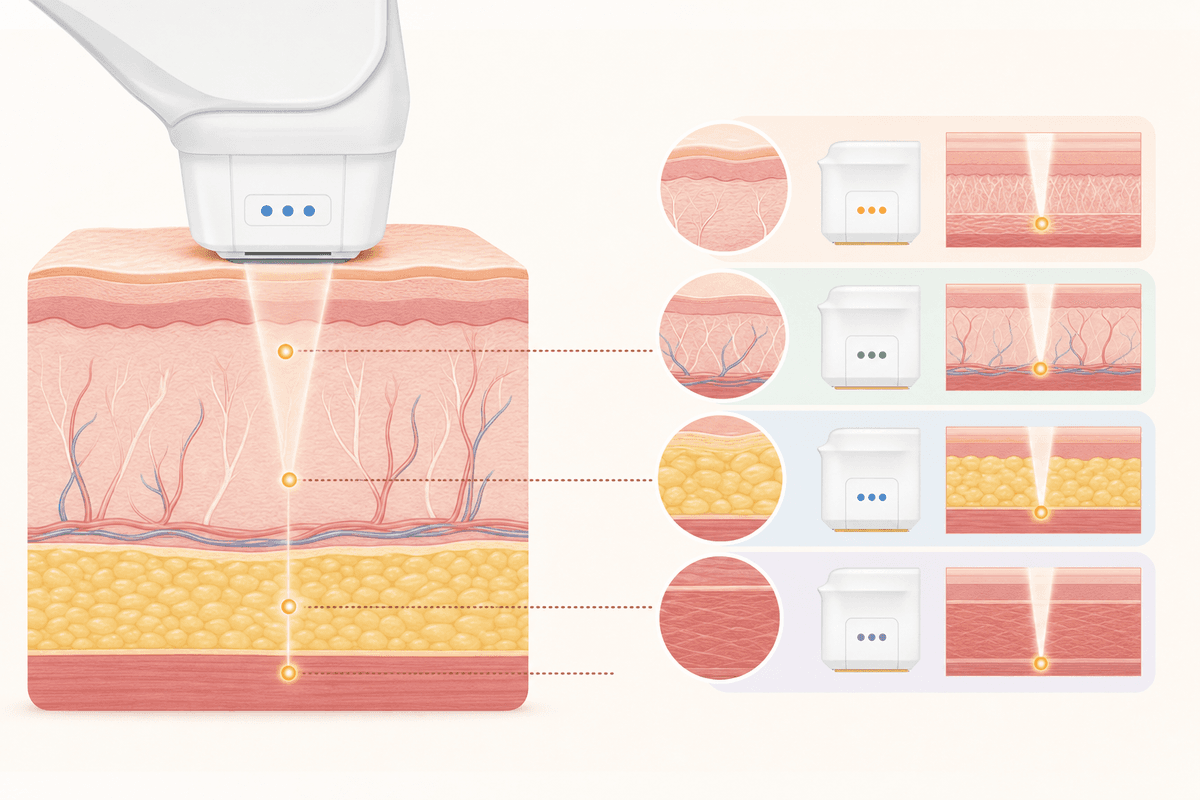
Ultherapy delivers thermal energy to the fascial layer via ultrasound (HIFU) for structural lifting, while Thermage focuses on dermal collagen regeneration through radiofrequency (RF)—their depths of action and mechanisms are completely different. Ultherapy excels at improving sagging and facial contours, while Thermage shows strength in elasticity, pores, and fine lines. Though the cost differs by 2-3 times, comparing them as "more expensive = better" is a misconception. For those in their 30s and under, Thermage and InMode are the priority for elasticity management, while for those in their 40s and above, Ultherapy and Shrink are the first choice for addressing sagging. Combo protocols combining both procedures on the same day are also actively being applied in clinical practice.
Information as of June 2026
Selection Criteria Based on HIFU·RF Operating Principles
- Ultherapy 4.5mm, Thermage subcutaneous fat layer
- FDA approval 2009 vs 2002
- Effect duration 12-18 months vs 6-12 months
Why does every lifting consultation recommend different treatments?
If you've been wondering which to choose between Ultherapy and Thermage, this article will walk you through the operating principles of both treatments, their effectiveness differences, and selection criteria by age and concerns.
While both treatments are classified as 'non-incisional lifting,' the type of energy used and the depth of penetration are completely different. Ultherapy uses ultrasound (HIFU, High-Intensity Focused Ultrasound) to deliver heat to the fascia layer (SMAS) at 4.5mm depth, while Thermage uses radiofrequency (RF) to primarily induce collagen remodeling in the dermis layer.
This difference is the key that determines effects, pain level, and cost. So let's break down exactly what each treatment does inside the skin and which one suits which concern.
Key Point Ultherapy received FDA approval in 2009 for lifting effects, and Thermage in 2002—both are fully approved by Korea's MFDS. However, equipment models (Ultherapy genuine vs similar HIFU, Thermage FLX vs CPT) show significant differences in output and safety, so verifying the device name is essential.
Ultrasound vs radiofrequency—penetration depth in the skin differs from the start
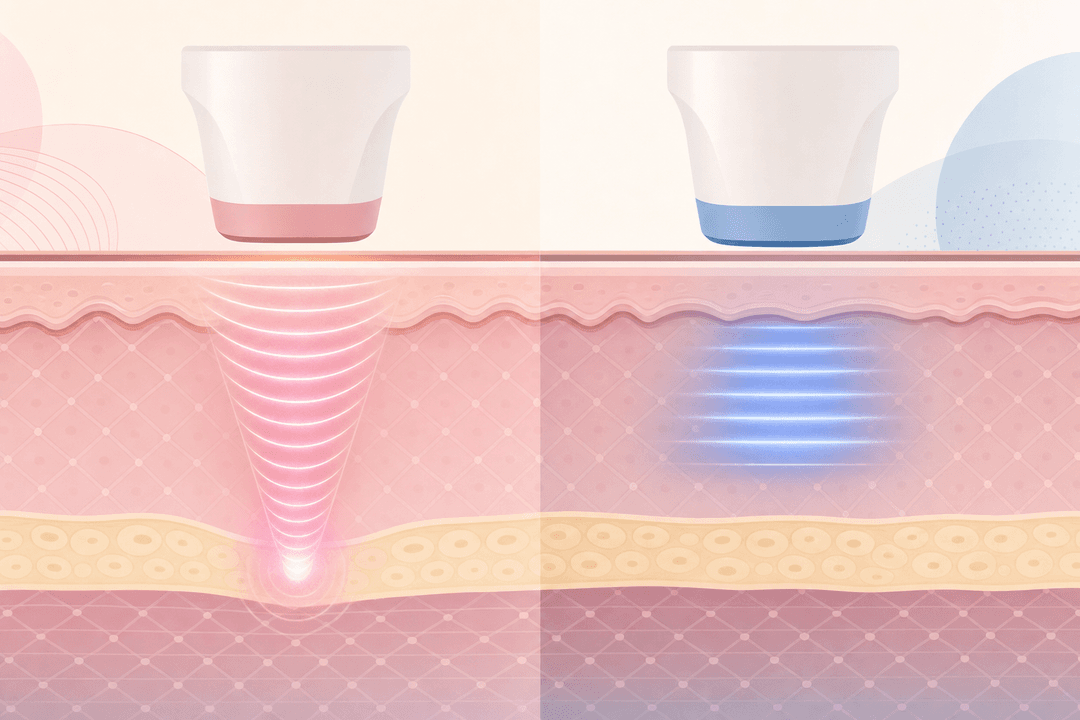
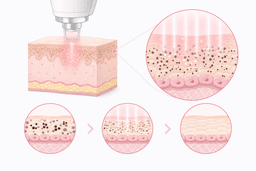
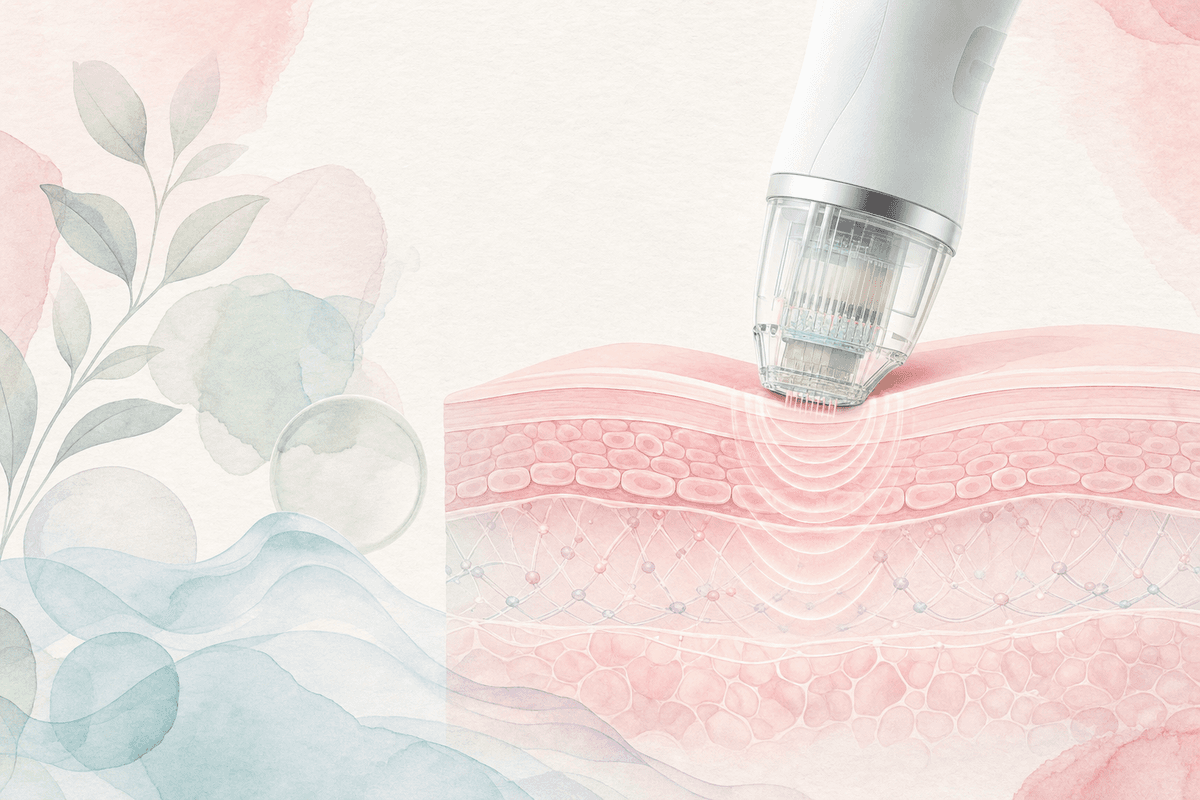
HIFU in Ultherapy concentrates ultrasound waves at a single point, like focusing light through a lens, creating thermal coagulation points at 65-70℃ at three depths: 1.5mm, 3.0mm, and 4.5mm. In particular, 4.5mm is the only non-surgical lifting option that directly reaches the fascia layer (SMAS).
The SMAS is a thin fibrous membrane that envelops the muscles beneath the skin—and in facelift surgery, lifting this layer is the key. Ultherapy creates a 'structural' lifting effect by contracting this layer with heat.
Conversely, Thermage applies radiofrequency evenly across the entire skin, primarily delivering 40-45℃ heat to the upper dermis to early subcutaneous fat (approximately 2-3mm). Since RF energy generates heat based on tissue resistance, it doesn't burn a single point intensely like HIFU. Instead, it gently contracts and regenerates collagen fibers across a broad area.
The Thermage FLX model uses Total Tip 3.0·4.0cm² tips to cover a large area at once, and a real-time impedance sensor reads skin thickness and moisture to automatically adjust output. In contrast, Ultherapy requires precise targeting while viewing the ultrasound image layer-by-layer, resulting in greater pain per shot.
- Ultherapy: 4.5mm SMAS targeting, 65-70℃ thermal coagulation point, 0.5-1.2J output per shot
- Thermage: 2-3mm dermis to subcutaneous fat, 40-45℃ volumetric heating, 400-900 pulses
- HIFU is focused point heating, RF is dispersed plane heating
Ultherapy vs Thermage differences—which treatment suits which concerns
Ultherapy excels at sagging and contouring improvement, while Thermage is strong for elasticity, pores, and fine lines. Let's look at specifics.
When Ultherapy should be your first choice: When you want to restore contours that have lost 'definition'—like nasolabial folds, jawline sagging, eyebrow drooping, and neck wrinkles. A 2022 clinical report by the Korean Dermatological Association showed that among 96 moderate-sagging patients aged 40 and above, 72% experienced an average upward shift of 2.1mm in jawline and eyebrow position six months after Ultherapy alone.
When Thermage should be your priority: When you want to smooth rough 'surface' skin texture—like enlarged pores, reduced elasticity, and fine lines. In Thermage FLX clinical studies, 78% of patients in their 30s-40s showed an average 18% reduction in pore size and 23% increase in collagen density three months post-treatment (Solta Medical, 2017).
In fact, the two treatments aren't competitors but rather complementary with different roles. Many medical institutions use a 'combo protocol' that follows Ultherapy SMAS lifting with Thermage for skin texture refinement.
| Category | Ultherapy | Thermage | InMode |
|---|---|---|---|
| Number of shots | 300-600 shots | 400-900 pulses | Variable by area |
| Treatment time | 40-60 minutes | 50-70 minutes | 30-50 minutes |
| Anesthesia | Topical anesthesia | Topical anesthesia | Topical or sedation |
| Recovery | Immediate resumption of daily activities | Immediate resumption of daily activities | Minimal bleeding spots 2-3 days |
| Recommended re-treatment | 12-18 months | 6-12 months | 6-10 months |
Costs may vary depending on the number of shots, treatment area, and medical facility. The figures above represent average ranges for full-face treatment.
Pain, recovery, and duration—practical details
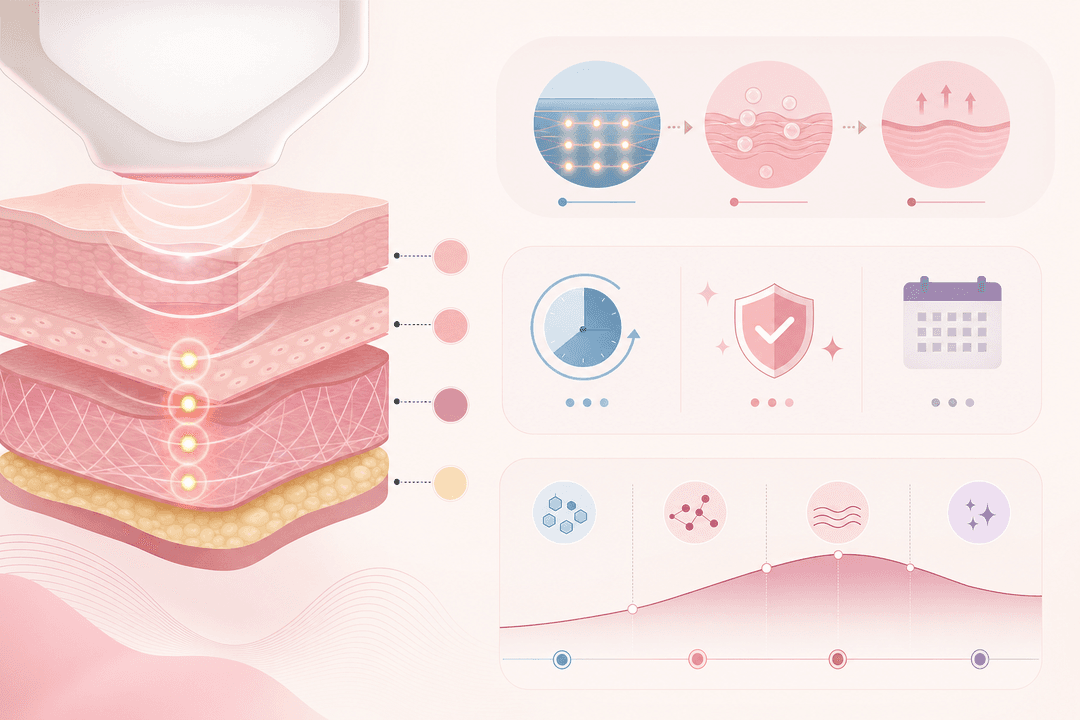
Ultherapy definitely has higher pain levels. Since HIFU concentrates strong heat at a single point, areas near bone (chin tip, cheekbones, forehead) can feel tingling or a bone-vibrating sensation. Pain is typically NRS 6-7, and topical anesthesia alone is insufficient—some clinics combine nerve blocks or sedation anesthesia.
Thermage feels more like a warm massage (NRS 4-5). The tip cools the skin as it progresses, and since heat is dispersed rather than burning a single point continuously, it's relatively more tolerable.
Recovery is immediate daily activity resumption for both. Ultherapy may cause minor swelling or bruising immediately after, but most resolves within 48 hours. Thermage leaves redness for only about 2-4 hours.
Effect onset timing: Ultherapy shows full results 6-12 weeks later (peak collagen genesis), while Thermage appears 4-8 weeks in. Duration is typically reported as 12-18 months for Ultherapy and 6-12 months for Thermage, but individual variation is significant and depends on home care and sun protection habits.
Clinical Evidence A 2021 Journal of Cosmetic Dermatology meta-analysis found that 82% of Ultherapy monotherapy patients maintained 'satisfied' or higher ratings even 12 months later, while 68% of Thermage patients were satisfied at the 6-month mark. However, a group that combined both treatments at 3-month intervals maintained 89% satisfaction even 18 months later.
The real reason costs differ by 2-3 times
Ultherapy costs on average 1.5-2 times more than Thermage. For full-face treatment, Ultherapy ranges from 1.5 to 2.5 million won, while Thermage is 0.8 to 1.5 million won.
This difference stems from technical difficulty and equipment manufacturing costs. Ultherapy requires real-time ultrasound imaging to target each layer precisely, and the cartridge (consumable) unit cost per shot is approximately 3,000-5,000 won. Genuine brand devices also come with higher after-sales and training costs.
While Thermage tips are also expensive, a single tip can be used for up to 900 pulses, making the per-shot cost lower. However, the latest FLX model costs approximately 30% more than the older CPT model.
The important thing is that 'expensive ≠ automatically better'. There's no need to start with Ultherapy for 20-year-olds' elasticity management, and conversely, repeating only Thermage on 40-year-olds' sagging has limitations. The best value is choosing what matches your skin condition and goals.
- Ultherapy cartridge per-shot cost: 3,000-5,000 won
- Thermage FLX per-shot cost based on 900 pulses: approximately 1,500-2,000 won
- Combo treatment (Ultherapy + Thermage) average cost: 2-3.5 million won
Please remember this above all
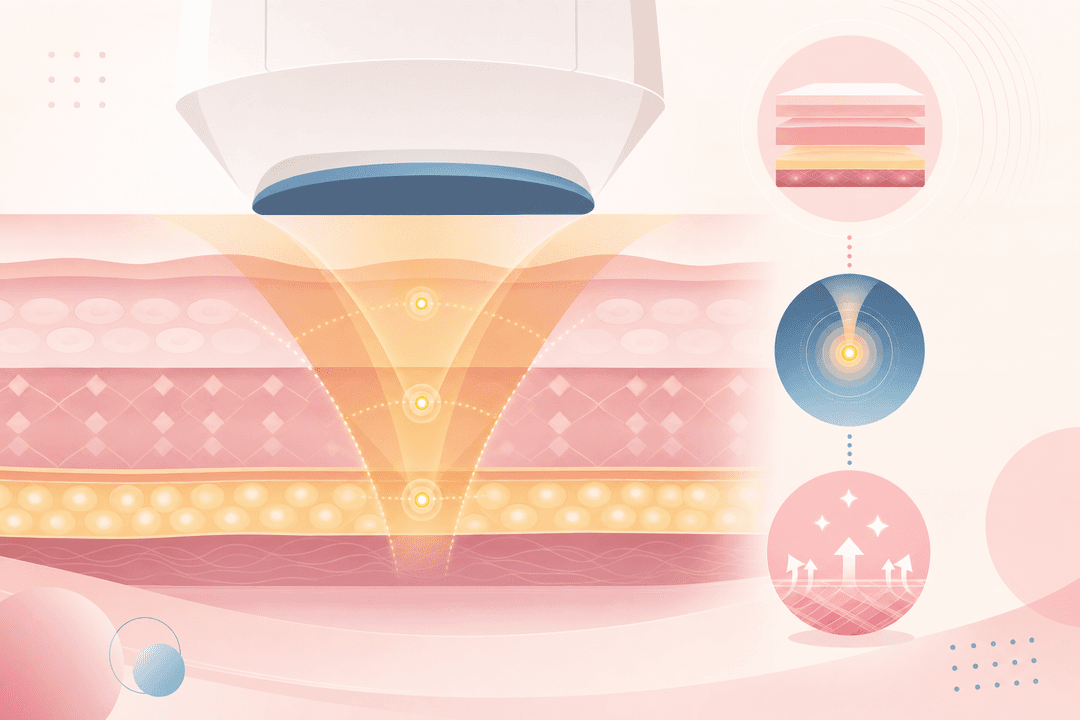
Ultherapy and Thermage are both 'lifting,' but with different targets and mechanisms. If sagging and contour are your concerns, prioritize Ultherapy; if elasticity and texture are concerns, Thermage comes first. If both are needed, sequential combo is also a good choice.
Verifying genuine devices is essential. Korea has many similar-to-Ultherapy HIFU devices (Shrink, Utran, Doublo) and similar-to-Thermage RF devices (Tenthera, ND Yag, etc.), which differ in output, safety certification, and after-sales service. Before treatment, be sure to ask about the device model name and MFDS approval status.
Finally, home care determines how long results last. Post-treatment sun protection (SPF50+ PA++++), collagen boosters like retinol and peptide serums, and adequate hydration reportedly extend effects by over six months.
- Genuine Ultherapy: FDA approval 2009, MFDS-approved device name verification essential
- Thermage FLX: Launched 2017, equipped with Total Tip 3.0·4.0 real-time impedance sensor
- Combo protocol: Adding Thermage 3-6 months after Ultherapy maintains 89% satisfaction at 18 months
- Daily SPF50+ sun protection extends average lifting effect duration by 34% (2020 Korean Dermatological Association)
Commonly Misunderstood Facts
Misconception Ultherapy is definitely more effective than Thermage
Truth The two treatments target different layers and play different roles. Ultherapy excels at sagging while Thermage is superior for elasticity and texture—there's no absolute 'better' comparison. Choosing what matches your goals is what matters.
Misconception Results last 10 years after one session
Truth Typical duration is 12-18 months for Ultherapy and 6-12 months for Thermage. Since aging continues, repeat treatments are necessary for maintenance, and home care and sun protection determine how long results last.
Must-Check Before Treatment
- !!Verify genuine device status and MFDS approval!! — Similar devices show significant differences in output and safety
- Not recommended during pregnancy/breastfeeding, with dermatitis/keloid-prone skin, or for areas with metal implants (teeth/fillers)—or these areas must be excluded
- Avoid saunas, alcohol, and high-intensity exercise for 48 hours post-treatment — heat stimulation worsens swelling
- Discontinue irritating skincare (retinol, AHA) 1 week before and after treatment
- If you have high pain sensitivity, pre-consult on anesthesia options (topical/nerve block/sedation) is essential
Frequently Asked Questions
Can I get Ultherapy and Thermage on the same day?
It's possible, but a 3-6 month interval is typical. Same-day treatment doubles heat stimulation, increasing swelling and erythema risk. The standard approach is Ultherapy for SMAS lifting first, then Thermage for texture refinement after effects stabilize.
Should I get Ultherapy in my 20s?
Not recommended for early-to-mid 20s. Since SMAS sagging doesn't begin in earnest, dermis collagen regeneration (Thermage, InMode) alone suffices. Ultherapy applies strong heat stimulation to tissue, so starting too early may exhaust your skin's recovery capacity. Consider it from mid-to-late 30s onward.
Is Shrink exactly the same as Ultherapy?
Shrink uses the HIFU principle but is a Korean similar device, not genuine Ultherapy. It has lower output and ultrasound imaging precision compared to Ultherapy and lacks FDA approval, but costs about 60% less, making it popular as a cost-effective alternative. Effectiveness and safety depend more on practitioner experience.
What's the difference between Thermage CPT and FLX?
FLX is the latest model launched in 2017, featuring a real-time impedance sensor that reads skin thickness and moisture to automatically adjust output. Compared to CPT, FLX shows lower pain with comparable or slightly better results. However, it costs about 30% more.
What side effects can Ultherapy cause?
!!The most common are temporary swelling, erythema, and minor bruising (resolving within 48 hours). Rarely, nerve damage can cause facial sensory reduction or asymmetry, which mostly recover within 3-6 months, but risk increases with low-experience practitioners or excessive output==. Checking the practitioner's experience and cases beforehand is important.
Can I get a refund if there's no effect?
Getting a refund for unsatisfactory results is difficult for medical treatments. Individual variation is significant and the 'no effect' standard is vague. However, if equipment malfunction or treatment error is clear, consumer dispute resolution is possible—so keep your contract and before-and-after photos.
This content is for informational purposes and does not replace medical advice. Please consult a specialist before treatment.