3-Step Analysis of the Aqua Peel Procedure Principle – Action Mechanism by Skin Layer
K-Dia Editor4,91427 min read
▸Aqua Peel is not simply a water injection; it is a mechanism in which low-molecular-weight hyaluronic acid binds to the dermal ECM to create a moisture storage structure.
▸Depending on the HA concentration (15-20 mg/ml) and cross-linking method (non-cross-linked/low-cross-linked) of each product, the diffusion speed and duration differ by more than twofold.
▸The appropriate products and injection depths are completely different for restoring the skin barrier in your 20s and supplying moisture to the deep dermis in your 40s.
Information as of June 2026
Getting the Right Aqua Peel
72 Hours of Moisture Binding in the Dermal Layer
HA Concentration 15-20mg/ml
Average Duration 4-6 Months
Aqua Peel, Is It Really Just 'Water' Infused?
Aqua Peel is It is known as a procedure that adds moisture to the skin, similar to a water-glow injection. That is only half true. In reality, the core process involves injecting low-molecular-weight hyaluronic acid (HA) into the dermis to bind it with the extracellular matrix (ECM). It is not simply about pouring in moisture, but rather a principle that creates a structure where the skin attracts and retains moisture on its own.
Hyaluronic acid in the dermis can bind up to 1,000 times its own weight in moisture. Aqua Peel directly supplies this HA to increase the moisture storage capacity within the dermis. According to a 2021 announcement by the Korean Dermatological Association, extracellular matrix reorganization occurs for 72 hours after injection, and this period is the golden time for the effects to settle.
The problem is that the HA concentration, molecular size, and cross-linking method vary from product to product. These differences determine the diffusion speed and duration across different skin layers. In this article, we summarize everything from the 3-step action mechanism of Aqua Peel to differences by product type and suitable candidates based on skin type, all at the dermal layer level.
Key The key to Aqua Peel is not 'injection' but 'combination'. The duration of the effect is determined by how stably HA attaches to the ECM in the dermal layer.
3-Step Mechanism That Works Differently by Skin Layer
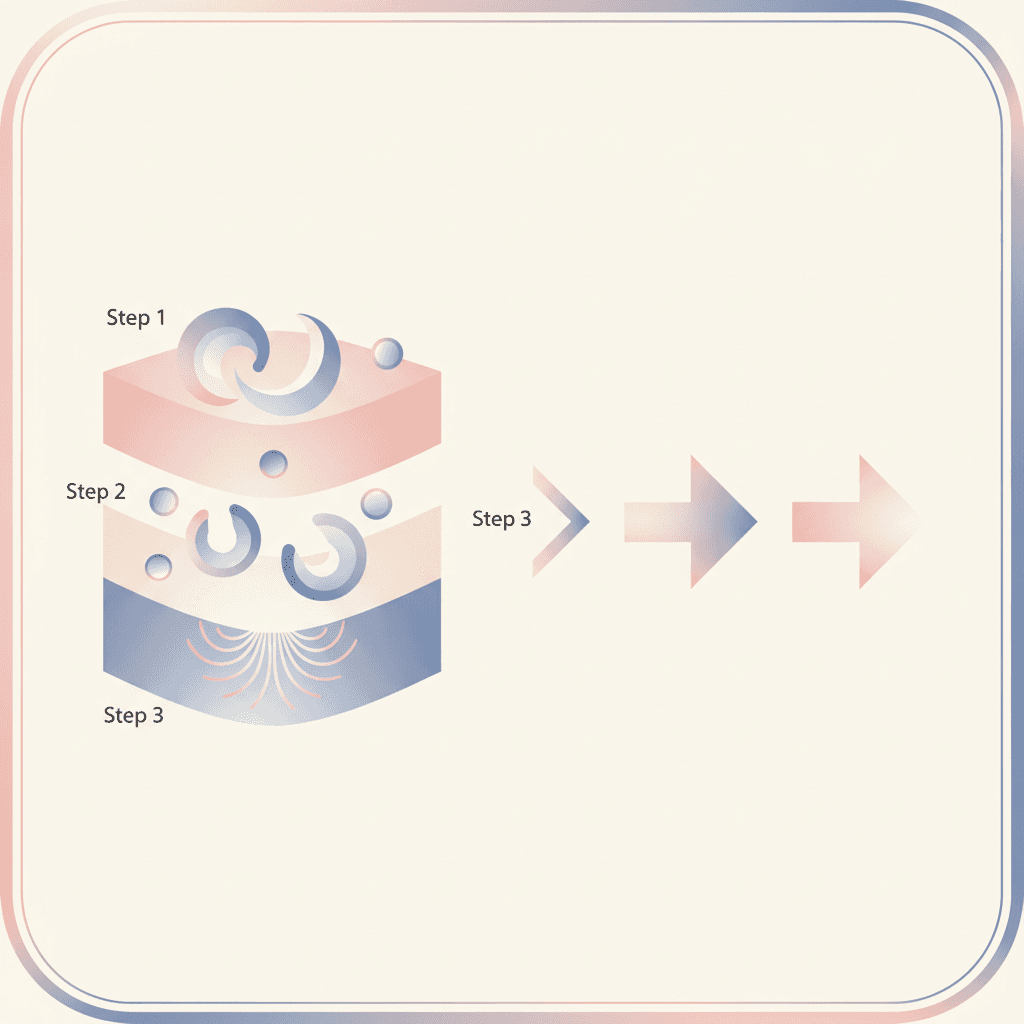
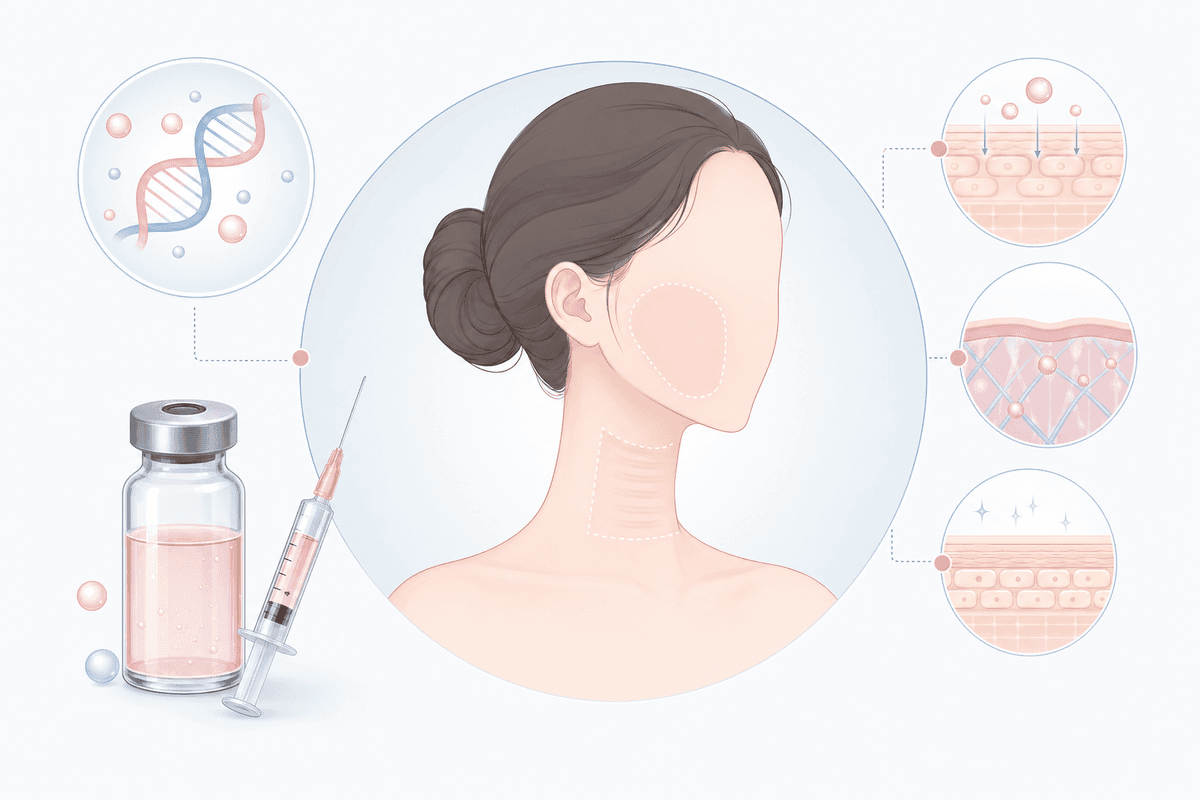
AI-Generated Illustration
Aqua Peel works differently depending on the injection depth. In the epidermal layer (0.1-0.3 mm), immediate hydration and swelling of the stratum corneum occur; In the upper dermis (0.5-1.5 mm), HA diffuses between collagen and elastin fibers; and In the middle dermis and below (2 mm), autologous HA synthesis through fibroblast stimulation is added.
Stage 1 (Immediately after injection - 24 hours): Low molecular weight HA mixes with tissue fluid, and an immediate hydration reaction begins. At this time, the moisture content on the skin surface increases by an average of 35-40%, and a glow appears. Non-crosslinked products such as Restylane Vital have a faster diffusion rate during this stage.
Stage 2 (24-72 hours): HA binds with glycosaminoglycans (GAGs) within the ECM, forming a moisture-retaining structure. The three-dimensional arrangement of HA stabilizes at a dermal pH (approx. 5.5) and temperature (37 degrees), and during this process, an increase in dermal thickness of 0.2-0.4 mm is observed via ultrasound.
Stage 3 (3 days-2 weeks): Fibroblasts recognize external HA and increase autologous HA synthesis through the TGF-β (transforming growth factor-β) signaling pathway. A 2019 paper in Dermatologic Surgery reported that this effect persists for up to 4 weeks after injection.
Upper dermal HA diffusion rate: 48 hours for non-crosslinked products, 72-96 hours for low-crosslinked products
ECM binding rate: Approximately 60-70% of injected HA is integrated into the dermal structure within 72 hours
Increase in autologous HA synthesis rate: Average 25-30% compared to pre-procedure (at 4 weeks)
Comparison of HA concentration and crosslinking method by product type
Aquapeel products are broadly divided into non-crosslinked HA and low-crosslinked HA. Non-crosslinked molecules move freely without intermolecular bonds, resulting in a fast diffusion rate and strong immediate effects, but they are degraded within 2-3 months by the body's hyaluronidase enzyme.
Low-crosslinked products loosely link HA chains with a crosslinking agent such as BDDE (1,4-Butanediol diglycidyl ether) to slow down the degradation rate. However, due to its high viscosity, it requires slight pressure during injection, and while dermal diffusion takes more than 72 hours, it lasts for an average of 4-6 months.
The products most commonly used in Korea are Restylane Vital (non-crosslinked, HA concentration 20 mg/ml), Juvederm Volite (low-crosslinked, HA concentration 12 mg/ml), and Belotero Revive (low-crosslinked, HA concentration 18 mg/ml). Vital focuses on surface hydration, while Volite and Revive reach the middle dermis and aim for long-term effects.
The higher the HA concentration, the greater the immediate swelling effect, but the increased viscosity may lead to greater pain during injection. Concentrations of 15mg/ml or less can be injected with a 32G needle, but for 18mg/ml or higher, a 30G or smaller needle must be used.
Clinical According to an analysis of 2020 KFDA approval data, non-crosslinked products showed higher satisfaction for shallow wrinkles in the early 20s, while low-crosslinked products showed higher satisfaction for volume reduction in the deep dermal layer after the age of 30.
Product Type
HA Concentration
Crosslinking Method
Duration
Injection Depth
Restylane Vital
20mg/ml
Non-crosslinked
2-3 months
Epiderm-Upper Dermis
Juvederm Volite
12mg/ml
Hypo-crosslinked
4-6 months
Middle Dermis
Belotero Revive
18mg/ml
Hypo-crosslinked
4-5 months
Upper-Middle Dermis
Product selection and duration depend on individual skin condition and metabolism May vary depending on the speed.
Classification of Suitable Targets by Age Group and Skin Type
Early 20s (Dry Skin Type): Since the ability to synthesize HA in the dermal layer is still high, non-crosslinked products alone are sufficient. Injecting Restylane Vital into the epidermal-dermal boundary (0.5-1mm) prevents moisture evaporation from the stratum corneum, and repeating this every 2-3 months accumulates the skin barrier improvement effect.
Mid-to-late 30s (Start of Elasticity Loss): This is the time when dermal thickness begins to decrease. Injecting low-crosslinked products into the middle dermal layer (1.5-2mm) fills the spaces between collagen fibers, restoring volume. Juvederm Volite is suitable for this layer.
Ages 40 and older (accompanied by deep wrinkles): Since HA self-synthesis is reduced by more than 30%, external supply is essential. Cumulative injection of low-crosslinked products at intervals of 3-4 months thickens the dermis layer, providing a natural base when combined with fillers later.
Sensitive/Atopic Skin: Although HA is a low-irritation ingredient, it may react to crosslinking agents (BDDE). We recommend selecting non-crosslinked products or products certified with a BDDE residue of 2 ppm or less (such as Belotero), and observing for 48 hours after the test injection.
20s: Focus on surface hydration, non-crosslinked products at 2-3 month intervals
30s: Mid-dermal volume, low-crosslinked products at 4-5 month intervals
40s and older: Increase dermal thickness through cumulative injections, 3-4 month intervals + consider combining with fillers
How is it different from Hydro-Glow Injections and Skin Boosters?
Hydro-Glow Injections inject complex ingredients such as vitamins, amino acids, and PDRN into the epidermal layer, whereas Aqua Peel injects a single ingredient, HA, into the dermal layer. While water-glow injections provide an immediate, intense glow, 70% of them are expelled from the epidermis within 48 hours, whereas Aqua Peel aims for long-term effects through dermal adhesion.
Skin Boosters refer to a product line similar to Aqua Peel but with the addition of polynucleotides (PDRN) or peptides. Combinations like Rejuran HB provide stronger signals for fibroblast proliferation, making them advantageous for improving scars and pores, but they cost 1.5 to 2 times more than single HA.
The selection criteria are clear. For immediate glow and event preparation, choose water-glow injections; for dermal moisture retention and long-term improvement, choose Aqua Peel; and for scars and pores, choose Skin Boosters. Many clinics suggest a management protocol that rotates three treatments every 2-3 months.
Tip: You can receive the Hydrating Injection and Aqua Peel on the same day. Injecting in the order of Water Glow (surface layer) → Aqua Peel (dermis) 30 minutes later ensures both surface gloss and deep hydration.
The effect of Aqua Peel is determined by product selection (HA concentration and cross-linking method) / injection depth (targeting the dermis layer) / management timing (the 72-hour golden time). Even with the same product, injecting it into the surface layer produces immediate shine, while injecting it into the middle layer produces volume recovery, resulting in completely different results.
The 72 hours after the procedure is the period during which HA binds with the ECM, so you must avoid drinking alcohol, saunas, and high-intensity exercise. If the temperature of the dermis layer rises during this period, the activity of HA-degrading enzymes increases, which can shorten the duration by 30%. Conversely, applying a hypoallergenic moisturizer to maintain the epidermal barrier extends the effect.
Product Selection: Non-crosslinked 20mg/ml for those in their 20s, low-crosslinked 15-18mg/ml for those in their 30s and older
72-Hour Care: Avoid saunas and alcohol to secure 30% of the duration, extend the effect with hypoallergenic moisturization
Cumulative Effect: Repeated 3 or more times increases autologous HA synthesis by 25-30%, allows for gradual extension of the treatment interval
Aqua Peel vs. Water Glow Injection vs. Skin Booster
Aqua Peel [Dermal Moisture Retention]
HA Single Ingredient
Injection into Mid-Dermal Layer (1.5-2mm)
Duration 4-6 Months
Long-term Volume Restoration
Promotes Self-HA Synthesis through Dermal ECM Binding
Hydration Injection [Instant Gloss]
Vitamin & Amino Acid Complex
Injection into Epidermal Layer (0.3-0.5mm)
Duration 2-4 Weeks
For Event Preparation
70% Elimination within 48 Hours, Repeatable Essential
Skin Booster [Adds Regeneration Signal]
HA+PDRN/Peptide
Injection into Upper-Middle Dermis
Duration 4-8 Months
Scar & Pore Improvement
Fibroblast Proliferation Effect, Cost 1.5-2 Times Higher
Guide to Choosing the Right Aqua Peel for My Skin
Early 20s, Dry but Good Elasticity Skin
Apply a non-crosslinked HA product (Restylane Vital) to the superficial layer (0.5-1mm) at 2-3 month intervals
High self-HA synthesis ability allows for sufficient maintenance of stratum corneum moisture with external supply alone
Mid-to-late 30s, simultaneous progression of volume loss and fine wrinkles
Apply a low-crosslinked HA product (Juvederm Volite) to the middle dermal layer (1.5-2mm) at 4-month intervals
As dermal thickness reduction begins, fill the spaces between collagen fibers to restore volume
After age 40, accompanied by deep wrinkles and skin sagging
Accumulated injection of low-crosslinked products at 3-4 month intervals + combined with fillers
External supply is essential as HA autosynthesis is reduced by more than 30%, also advantageous as a filler base
When you want immediate effects on a budget of 500,000 won or less
Combination of 1 session of Hydro-Glow Injection + 0.5cc of Aqua Peel
Hydro-Glow secures surface gloss, while Aqua Peel secures dermal moisture on the same day, maximizing cost-effectiveness
Misconceptions Common Sense
Misconception The skin remains hydrated after just one Aqua Peel treatment
Truth HA in the dermal layer is gradually broken down by enzymes in the body. Non-crosslinked products must be repeated every 2-3 months, and low-crosslinked products every 4-6 months to maintain effectiveness; however, with cumulative injections, self-synthesis increases, allowing the intervals to be gradually extended.
Misconception The higher the HA concentration, the better
Truth Concentrations of 20mg/ml or higher have high viscosity, causing significant pain during injection, and if injected into the surface layer, a bead-like sensation may remain. For the thin skin of people in their 20s, 15mg/ml or less is more natural.
Things to Must Avoid Before and After Aqua Peel Procedure
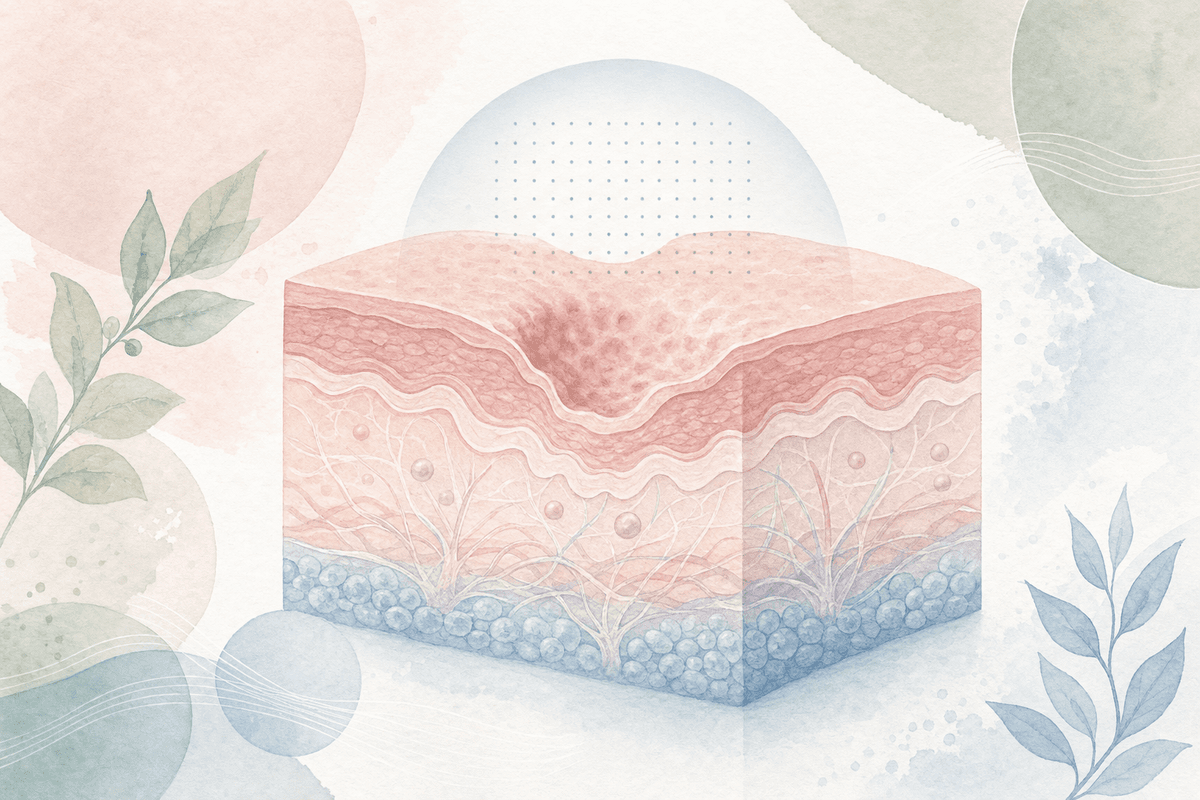
AI-Generated Illustration
Within 72 hours after the procedure No saunas, steam rooms, or high-intensity exercise (activation of HA-degrading enzymes when dermal temperature rises)
No alcohol on the day of treatment (vasodilation increases HA diffusion speed, worsening edema and bruising)
Stop using cosmetics containing exfoliating ingredients like AHA and BHA for one week (damage to the epidermal barrier promotes HA release)
No strong massage or pressure on the injection site (asymmetry occurs if HA migrates before binding to the ECM)
No procedure during pregnancy or breastfeeding (although HA safety has been established, the possibility of residual crosslinking agent BDDE should be considered)
Frequently Asked Questions
Can I go to work immediately after getting an Aqua Peel?
Only needle marks and slight redness will remain, and you can apply makeup immediately. If micro-needles of 32G or larger are used, marks disappear within 2-4 hours; however, since low-crosslinked products have high injection pressure and may cause bruising, we recommend the procedure 3 days prior to an important event.
Can I receive this on the same day as a water glow injection?
It is possible and actually recommended. If you inject the water glow injection into the surface layer first, and then apply the Aqua Peel to the middle dermis 30 minutes later, you can achieve both surface gloss and deep hydration simultaneously. However, please ensure the total injection volume does not exceed 2cc.
When do I feel the effects?
Gloss appears immediately, but the real effect begins after 3 days. Over 72 hours, HA binds to the dermal ECM, increasing skin thickness, and starting from the second week, self-HA synthesis increases, improving elasticity.
How many sessions are required for the effects to accumulate?
Self-HA synthesis increases by 25-30% with 3 or more repetitions, and the interval between treatments can be gradually increased. Treatments begin at intervals of 3-4 months, and intervals of 6 months are possible starting from the 5th session.
Are there any side effects or complications?
Since HA is a natural component of the body, allergic reactions are rare; however, if you are sensitive to the cross-linking agent (BDDE), redness or itching may occur. If an overdose is injected, a bead-like lump may remain, and rarely, vascular embolism (injection into blood vessels) has been reported, so you must receive the treatment from a specialist who can accurately measure the depth of the dermis.
How much does it cost?
Depending on the product and injection volume (usually 1-2cc), it is approximately 200,000 to 500,000 won per session. Non-crosslinked products (Restylane Vital) are relatively cheaper, while low-crosslinked products (Juvederm Volite) are about 100,000 won more expensive. Promotions offering 10-20% off for a 3-session package are common.
This content is for informational purposes only and does not replace medical advice.
Be sure to consult a specialist before the procedure.
Find the right hospital for you at K-Dia