Three Ear Reshaping Methods: Is Incision the Only Answer?

- Correction is possible without incision, but there are specific conditions.
- Ear correction is divided into three methods depending on the degree of protrusion and cartilage elasticity.
- Non-incisional methods are suitable for protrusions within 15 degrees, while incisional methods are suitable for protrusions of 30 degrees or more.
- Non-incisional thread fixation satisfaction rate: 78%
- Incise method recurrence rate: Less than 5%
- Cartilage graft addition rate: Approximately 30%
Ears Stick Out When Hair is Tied Up
You stop in front of the mirror while tying up your hair. It's the moment you realize both ears stick out more than you thought. They look fine when you let your hair down, but why is that?
Ear surgery methods vary depending on the protrusion angle and cartilage elasticity.
If the angle is within 15 degrees, a non-incisional method using threads is used. If it's over 30 degrees, an incise method to fold the cartilage is performed. If the cartilage itself is weak, a graft is added.
The appropriate method is determined by how much of your ear is visible from the front.
Non-Incisional Thread Fixation: For Angles Within 15 Degrees
The non-incisional method involves fixing the cartilage with threads through an incision behind the ear. It leaves minimal scarring and has a quick recovery, but its effectiveness is maintained only when the angle is within 15 degrees.
Beyond this range, the threads can loosen, increasing the risk of recurrence.
This method is suitable for cases with firm cartilage and mild protrusion. According to the Korean Society of Plastic and Reconstructive Surgeons (2022), the satisfaction rate for non-incisional thread fixation is reported to be 78%.
However, if the angle is large or the cartilage is weak, you should consider the following method.
OX Quiz
Non-incisional thread fixation is effective for all prominent ears.
Check the answer
X Non-incisional methods are only suitable for mild protrusion within 15 degrees. If the angle is large, the threads can loosen, increasing the risk of recurrence, so an incise method should be considered.
Incise Method: Folding Cartilage to Reduce the Angle
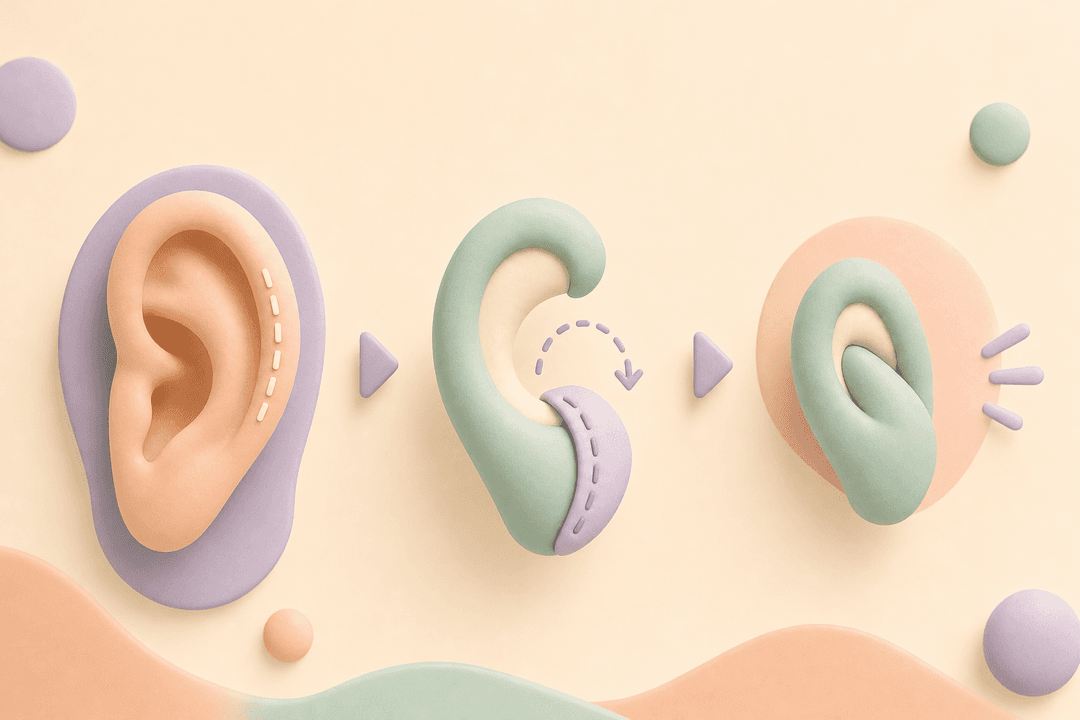
The incise method involves making a 3-4 cm incision behind the ear to directly fold and suture the cartilage. It is chosen for protrusions over 30 degrees or when non-incisional methods are unlikely to be effective.
The recurrence rate is low, less than 5%, but you must accept the scarring and recovery period (about 2 weeks).
In cases where the cartilage is thick or hard, a portion may be removed. However, there's something many people overlook here.
If the cartilage itself is weak, the angle can reopen even after folding. In such cases, a cartilage graft is added.
Clinical Note The incision site is designed along the crease behind the ear to minimize scarring. Absorbable sutures are used, eliminating the need for removal.
Key Takeaways
Ear surgery methods are determined by two factors: protrusion angle and cartilage condition. Non-incisional methods are for mild protrusion within 15 degrees, incise methods for over 30 degrees, and cartilage grafts are considered for weak cartilage.
Check how much of your ear is visible from the front when standing in front of the mirror. If more than 1 cm of your ear rim is visible, an incise method is likely suitable.
Pre-operative CT scans to check cartilage thickness and elasticity can reduce the risk of recurrence.
- Consider incise method if more than 1 cm of ear rim is exposed from the front
- Cartilage graft addition rate: Approximately 30%
Comparison of Ear Surgery Methods
Non-Incisional Thread Fixation [Mild Protrusion]
- Suitable Angle: Within 15 degrees
- Recovery Period: 3-5 days
- Scar: Minimal
- Recurrence Risk: Moderate
For cases with firm cartilage and mild protrusion
Incise Method [Moderate to Severe]
- Suitable Angle: Over 30 degrees
- Recovery Period: Approx. 2 weeks
- Scar: 3-4 cm behind the ear
- Recurrence Risk: Less than 5%
For large angles or thick cartilage
Cartilage Graft Addition [Weak Cartilage]
- Graft Site: Rib or ear cartilage
- Recovery Period: 3+ weeks
- Additional Cost: Yes
- Long-term Durability: High
For thin or inelastic cartilage
Must Check Before Ear Surgery
- Discontinue aspirin and anticoagulants 2 weeks before surgery (risk of bleeding)
- Avoid sleeping in positions that fold or press the ears for 1 month after surgery (risk of recurrence)
- Visit the clinic immediately if signs of infection (fever, swelling, discharge) occur
Frequently Asked Questions
How do I choose between non-incisional and incise methods?
If more than 1 cm of your ear rim is visible from the front or the protrusion angle is over 30 degrees, the incise method is suitable.
When can I start exercising after surgery?
Light walking is possible after 3 days, and strenuous exercise after 1 month. Avoid activities that put pressure on the ears.
What are the most common complications after surgery?
Infection and hematoma are the most common. Early management is crucial, so follow instructions for cold compresses and antibiotic use.
References
- Clinical Guidelines for Otoplasty — Korean Society of Plastic and Reconstructive Surgeons, 2022
- Otoplasty Techniques and Outcomes — Plastic and Reconstructive Surgery, 2021
Lumi's Word
Ear surgery methods are divided based on angle and cartilage condition. Check yourself from the front in the mirror. If more than 1 cm of your ear rim is visible, it's time to consider the incise method. If you have concerns, it's recommended to first check your cartilage condition with a CT scan.
This content is for informational purposes only and does not substitute medical advice. Always consult with a specialist before surgery.