7 Reasons Why Breast Augmentation Costs Differ by Twofold

Even for the same 'breast augmentation,' the cost varies significantly depending on the type of implant, incision site, insertion site, medical team experience, and anesthesia method. There are over five types of FDA-approved implants alone, and prices and surgical difficulty are applied differentially depending on whether they are cohesive gel, teardrop, or round shapes. Factors such as whether revision surgery is required, additional procedures (extent of pectoral muscle dissection), and hospital infrastructure (on-site anesthesiologist) ultimately…
From Implants to Surgical Techniques: A Complete Breakdown of Pricing Factors
- 7 Key Cost Variables
- 5-8 Types of Implant Brands
- 30% Difference in Difficulty by Incision Method
"Why is the quote so different?" — The Most Common Question
The most frequent question we hear in consultations is, "Why is it more expensive here than elsewhere?" In reality, even when searching for the same procedure, quotes can vary by tens of percent from one clinic to another.
This difference isn't simply a "brand premium." It's a complex interplay of seven variables: implant material, surgical technique, anesthesia type, surgeon's experience, and the scope of post-operative care.
Understanding the impact of each variable on the cost will allow you to accurately assess "where your money is going" when you receive a quote.
In this article, we'll break down the cost structure based on 5 types of MFDS-approved implants, 3 incision methods, and 2 placement options.
Key Takeaway 70% of the cost difference stems from 'implant type + surgical complexity.' The remaining 30% is attributed to clinic infrastructure and the scope of care.
Variable 1: Implant Type — Base Price Determined by Brand and Material
Domestically, 5-8 types of MFDS-approved implants are available, including major brands like **Mentor**, **Motiva**, **Natrelle**, **Sebbin**, and **Polytech**. Mentor received FDA approval in 2006, while Motiva received CE marking in 2010 and Korean approval in 2017.
Cohesive gel implants, which maintain their shape even if ruptured, are typically 10-20% more expensive than round implants due to their superior form retention. Tear-drop (anatomical) implants require anti-rotation surface treatment (texturing), increasing manufacturing costs.
Even within the same brand, options like **Smooth** vs. **Textured** surfaces, **Round** vs. **Tear-drop** shapes, and **Dual Gel** can result in hundreds of thousands of won difference in implant cost alone.
According to a 2023 presentation by the Korean Society for Aesthetic Plastic Surgery, the most commonly used implants in Korea are Motiva Ergonomix and Mentor MemoryGel, both utilizing 6th-generation or higher cohesive gel technology.
| Implant Characteristics | Round | Tear-drop | Dual Gel |
|---|---|---|---|
| Material Structure | Single-layer silicone | Anatomically separated layers | Dual-layer gel structure |
| Risk of Rotation | Low | High (Texturing required) | Low |
| Relative Price | Baseline | +15-25% | +20-30% |
| Suitable Cases | Natural volume | Lack of upper pole volume | Both feel and shape |
- 5-8 types of FDA-approved implants distributed in Korea
- Price difference between cohesive gel and tear-drop implants: 10-25%
- Dual gel structure increases manufacturing cost by 20-30%
Variable 2: Incision Location and Surgical Difficulty — The Hidden Technical Fee
There are three main incision locations: **under the arm (axillary)**, **below the areola**, and **inframammary fold (IMF)**. Even with the same implant, the surgical time and difficulty vary depending on the incision method, which is reflected in the technical fee.
Axillary incisions require endoscopic equipment and involve a longer dissection path, taking an average of 20-30 minutes longer. Areolar incisions hide scars within the areola border but require caution for those planning future breastfeeding due to potential damage to mammary ducts.
IMF incisions offer the most direct dissection, resulting in shorter surgery times, but scars can be visible when lying down or without a bra. A 2020 Seoul National University Hospital study reported that axillary incisions had a slightly lower reoperation rate of approximately 5%.
Endoscopic procedures incur additional costs for equipment depreciation and sterilization, which are included in the final quote. Some clinics offer the use of an endoscope as an optional choice.
Clinical Insight For incision methods, 'dissection accuracy' is more crucial than scar location. Results and costs vary depending on the use of an endoscope and the surgeon's skill level.
Variable 3: Placement — Over the Muscle vs. Under the Muscle, the Reason for a 30% Difference

Implant placement is divided into three categories: **over the muscle (subglandular)**, **under the muscle (submuscular)**, and **Dual Plane**. The placement affects the dissection area and anesthesia depth, which directly impacts the cost.
Placing implants under the muscle requires lifting the pectoralis major muscle, taking an average of 15-20 minutes longer for dissection compared to over-the-muscle placement. Dual Plane placement involves placing the upper part under the muscle and the lower part over the muscle for a natural shape, but it is the most complex.
According to a 2019 presentation by the Korean Society of Plastic and Reconstructive Surgeons, data shows that submuscular placement in lean individuals (BMI under 18) reduces the incidence of capsular contracture by approximately 10-15%.
Submuscular placement also requires a longer recovery period of 3-5 days and more intense initial pain, leading to extended pain medication prescriptions. All these factors accumulate in the clinic's care costs.
Caution Implant placement should not be unilaterally decided by the surgeon. It must be determined by considering the patient's body type, skin thickness, and implant size. Always confirm this during your consultation.
- Surgical time difference between submuscular and subglandular placement: 15-20 minutes
- High level of dissection complexity for Dual Plane placement
- Reduces capsular contracture by 10-15% in lean individuals (submuscular)
Variables 4-5: Anesthesia Method and Medical Team — Safety Infrastructure Costs
Breast augmentation typically involves **general anesthesia**, but costs vary depending on whether an anesthesiologist is present. Clinics where an anesthesiologist continuously monitors the patient's condition differ in safety and cost structure from those where a nurse anesthetist is responsible.
According to a 2021 Ministry of Health and Welfare notice, the anesthesia fee increases by an average of 20-30% when an anesthesiologist is involved, but emergency response is 2-3 times faster. This is particularly crucial for Dual Plane placements, which can take over 2 hours.
The lead surgeon's experience is also important. Technical fees are adjusted based on board certification (5+ years post-specialty training) and experience in breast reconstruction. Revision surgeries are priced 30-50% higher due to increased complexity.
Some clinics offer "all-in-one packages" bundling anesthesia, implants, and post-operative care. However, it's advisable to get itemized quotes to avoid unexpected additional charges later.
Tip On K-Dia, you can filter by clinics with anesthesiologists on-site, surgeon's experience, and revision case experience. Compare safety infrastructure transparently.
Variables 6-7: Revision Surgery and Additional Procedures — Hidden Cost Traps
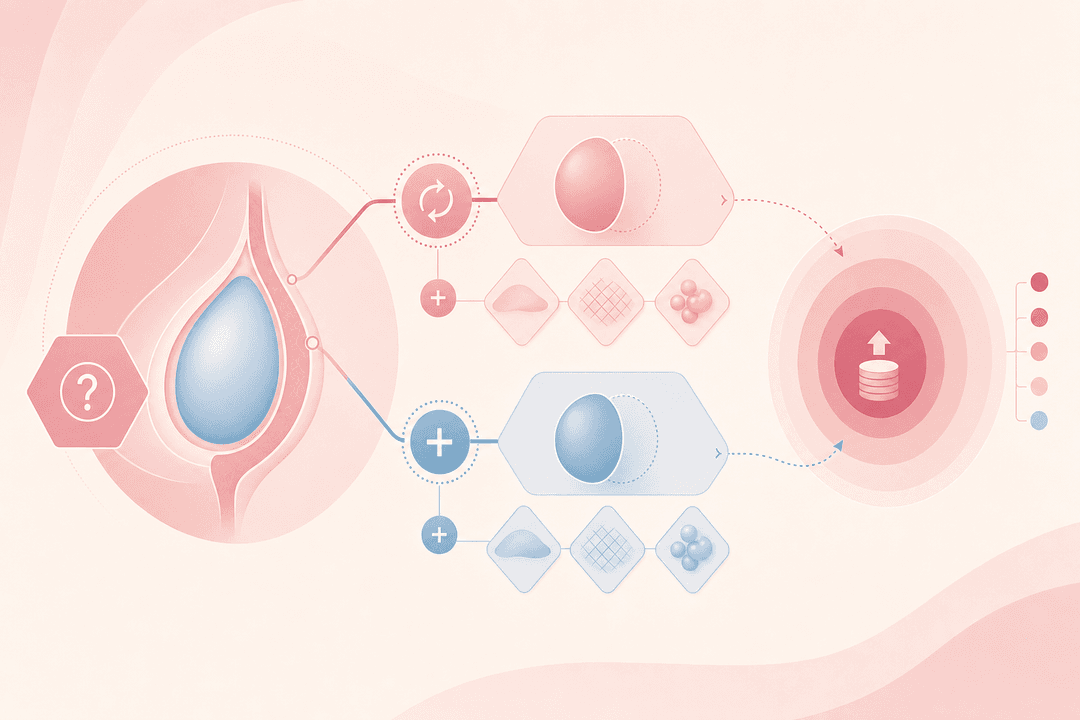
Revision surgeries (implant exchange, capsular contracture removal, repositioning) are, on average, 40-60% more expensive than primary surgeries. This is due to the added steps of removing the existing implant, excising the capsule, and re-dissecting the pocket.
Especially in cases of advanced capsular contracture (Baker Grade 3-4), complete removal of the thickened capsule (Total Capsulectomy) is necessary, which alone can take 30-40 minutes. Data from the Korean Society of Aesthetic Plastic Surgery in 2022 shows that approximately 35% of revision patients also undergo a conversion to the Dual Plane technique.
Additional procedures include **fat grafting (autologous fat mixture)**, **nipple reduction**, and **mastopexy (breast lift)**. Fat grafting requires three steps—harvesting, centrifugation, and injection—adding time and consumable costs.
Some patients have sagging inframammary folds that cannot be corrected with implants alone. In such cases, combining with a mastopexy can increase the total cost by over 50%. Accurate diagnosis during consultation is essential to avoid unexpected additional expenses.
Caution On K-Dia, look for clinics with extensive revision surgery experience. Revision requires delicate dissection techniques and expertise in capsule removal, which are more advanced than primary procedures.
- Revision surgery costs increase by 40-60% compared to primary surgery
- Capsular contracture removal alone adds 30-40 minutes
- 35% of revision patients also undergo Dual Plane conversion
Comparison of 3 Incision Methods — Based on Difficulty, Scar, and Recovery
Axillary Incision [Endoscope Required]
- Dissection Path: Longest (approx. 12-15cm)
- Scar Location: Armpit crease
- Surgical Time: +20-30 min
- Recovery Period: 7-10 days
Includes endoscopic equipment costs. Low reoperation rate.
Inframammary Fold Incision [Direct View]
- Dissection Path: Moderate (approx. 8-10cm)
- Scar Location: Areolar border
- Surgical Time: Baseline
- Recovery Period: 5-7 days
Requires careful consideration if planning future breastfeeding.
Inframammary Incision [Shortest Dissection]
- Dissection Path: Shortest (approx. 5-7cm)
- Scar Location: Inframammary fold
- Surgical Time: -10 min
- Recovery Period: 5-7 days
Potential for scar visibility. Advantageous for revision surgery.
Misconceptions Debunked
Myth "More expensive clinics are always better in terms of skill."
Truth Costs include implant brands, anesthesia methods, clinic interiors, and advertising expenses. First, check the surgeon's experience (years since specialty certification, number of revision cases) and whether an anesthesiologist is on-site. Board certification status with the Korean Society of Plastic Surgeons and experience in breast reconstruction are publicly available information.
Myth "If the implant is good, the results will be good."
Truth Even with the same Motiva Ergonomix implant, results vary significantly depending on placement (over/under muscle), dissection accuracy, and implant size selection. A 2023 presentation by the Korean Society of Aesthetic Plastic Surgery reported that 'appropriate implant size selection' accounted for 40% of patient satisfaction.
5 Essential Items to Check When Getting a Quote
- Is the implant brand and type (round/tear-drop/dual) clearly specified?
- Is the presence of an anesthesiologist and the anesthesia duration included?
- Are additional costs for revision surgery (capsule removal, re-dissection) listed separately?
- Is the scope of post-operative care (compression garment, medication, follow-up visits) detailed?
- Are costs for additional procedures (fat grafting, nipple reduction, mastopexy) disclosed in advance?
Frequently Asked Questions
What's the difference between the 'promotional price' and the 'regular price' at the same clinic?
These are usually conditional promotions that limit the implant brand or incision method. For example, 'limited to axillary incision' or 'limited to specific implant brands.' First, confirm if the surgical method is suitable for you. Even with a promotional price, check if an anesthesiologist is on-site and if the scope of post-operative care is the same.
What exactly is the reason revision surgery costs more than primary surgery?
It involves four steps: removal of the existing implant + capsule excision + dissection of adhesions + re-implantation. Especially if capsular contracture has occurred, completely removing the thickened capsule alone takes 30-40 minutes. The risk of bleeding and infection is also higher than in primary surgery, leading to longer anesthesia times.
Does the price difference between implant brands affect the results?
More important than the brand is the implant 'type' (round/tear-drop, surface treatment, gel structure). Even within Mentor, MemoryGel and CPG have different materials, and with Motiva, Ergonomix and Round have different shape retention. The key is the surgeon selecting the appropriate implant for the patient's body type; the brand name does not guarantee the outcome.
Is it safe to proceed without an anesthesiologist?
Legally, nurse anesthetists are permitted, but anesthesiologists respond 2-3 times faster in emergency situations (sudden blood pressure changes, respiratory issues). Anesthesia on-site is recommended for surgeries longer than 2 hours or for patients with cardiovascular disease history. Even if the cost increases by 20-30%, safety should be the priority.
When do I find out if additional procedures (fat grafting, mastopexy) are necessary?
During the consultation, the doctor will assess your 'rib cage shape, degree of breast ptosis (sagging), and skin elasticity' to determine this. If implants alone cannot address the issue (severe sagging, asymmetry), you may be recommended for mastopexy or fat grafting. At this point, confirm the additional costs and recovery period accurately.
Should I trust a quote that says 'All-in-One Package'?
Check each item individually. It should specify the implant brand, anesthesia method, compression garment, medication, number of follow-up visits, and any promotions for revision surgery. Many people sign contracts based solely on the 'all-in-one' label, only to be told later that certain items are extra costs.
This content is for informational purposes only and does not substitute medical advice. The appropriate method for breast augmentation varies depending on individual body type, health status, and skin elasticity. Always consult directly with a specialist before making a decision. Costs vary by clinic, and the figures in this article represent general ranges.