The 5 Stages of Fat Grafting Surgery and Why the First 72 Hours Are Crucial
K-Dia EditorJust published9 min read

- What determines graft success is not surgical skill, but rather the management in the first 72 hours after surgery.
- The fat grafting process is divided into 5 stages, and each stage has a decisive factor that affects the graft success rate.
- In particular, compression and temperature management within 72 hours after surgery determine 60-70% of the final volume.
Information as of November 2026
Consultation to Recovery: The Real Timeline
72 hours: Critical period for graft survival
Surgery duration: 2-3 hours
Final volume confirmation: 3 months
Everyone focuses on the doctor's skill, but what truly makes the difference is...
You might think the outcome of fat grafting is determined by the doctor's touch. However, the first 72 hours after surgery are what determine the 60-70% graft survival rate.
How you spend your time after leaving the operating table shapes your reflection six months later.
Fat grafting involves five main stages: consultation, harvesting, purification, injection, and recovery. Each stage has a critical timing that influences graft survival.
The period you least want to miss is from the day of surgery to the third day.
Stages 1-2: Consultation and Harvesting – This is where the volume is determined
During the consultation, we match the desired volume for the injection area with the amount of fat that can be harvested.
Typically, 50-200cc of fat is harvested from the abdomen or thighs. At this point, a decision is made on whether to use the centrifuge method or Water-jet. This is where the proportion of pure fat cells is determined.
Harvesting takes 30-40 minutes after the surgery begins. If excessive negative pressure is applied during fat removal, the cells can rupture, while insufficient pressure can lead to contamination with impurities (Korean Society of Plastic and Reconstructive Surgeons, 2023).
This is why proficiency is crucial in this initial stage.
OX Quiz
Cold compresses must be applied continuously for a week after fat grafting.
Check Answer
X Cold compresses should only be applied for up to 48 hours. After 72 hours, switch to warm compresses to increase blood flow and improve graft survival. Continuous cold compresses can actually hinder new blood vessel formation.
Stages 3-4: Purification and Injection – Grafting begins here
The harvested fat is spun in a centrifuge for 3-5 minutes to remove blood and oil layers. This process increases the concentration of pure fat cells to 70-85%.
The purified fat contains approximately 1 to 1.5 million viable cells per cc.
Injection is done in small amounts of 0.1-0.2cc at a time, layered across multiple levels. Injecting too much at once can cause the central cells to die from lack of oxygen.
This is why multi-layered dispersed injection increases the graft survival rate by 20-30%.
Key Point New blood vessel formation begins within 30 minutes after injection. From this point, the next 72 hours are the golden time for graft survival.
Stage 5: Recovery – The 72 hours that determine the next six months
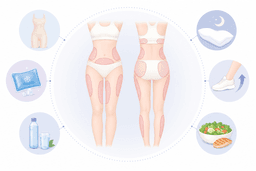
On the day of surgery, 15 minutes of cold compresses, 4-5 times, helps minimize swelling peaks. For up to 48 hours, bending your head down or sleeping on your side can increase pressure on the injected area, causing the fat to shift.
Sleeping upright is the safest option.
After 72 hours, blood vessels begin to surround the fat cells. From this point on, switch to warm compresses to aid blood flow. After 3 months, the final graft survival rate of 60-70% is confirmed, determining the final volume.
Avoid compression within 72 hours for a 15-20% increase in graft survival.
60-70% of the final volume is maintained after 3 months.
Situational Selection Guide
If the amount of fat to be harvested is less than 50cc
Consider the SVF (Stromal Vascular Fraction) enrichment method.
If you only have one week for recovery
Postpone facial fat grafting and first consult about filler alternatives.
Misconceptions
Myth It's better to inject a large amount of fat at once.
Truth Injecting a large amount at once can lead to a necrosis rate of over 40% because the central cells cannot receive oxygen. The principle for increasing graft survival is dispersed injection of small amounts in multiple layers.
Things You Must Adhere To
Do not press or lie on your side in the injected area for 72 hours after surgery.
Avoid saunas, jjimjilbangs, and alcohol for one week (vasodilation can cause bleeding and swelling).
Avoid rapid weight loss for 3 months (fat cells will also shrink).
Frequently Asked Questions
Can I go to work the day after surgery?
It's possible, but since the swelling peaks at 48 hours, it's safer to take 3-4 days off for facial fat grafting.
What happens to the fat that doesn't survive?
It is naturally absorbed by the body over 3 months. If nodules form during this process, they can be identified via ultrasound and removed.
Is it a side effect if the injection area becomes hard?
Slight hardness for 1-2 weeks is a normal reaction, but if it persists for over a month, it may indicate calcification or cyst formation, requiring medical attention.
References
1. Study on Factors Affecting Fat Graft Survival Rate — Korean Society of Plastic and Reconstructive Surgeons, 2023
2. Clinical Guidelines for Autologous Fat Grafting — Korean Society for Aesthetic Plastic Surgery, 2022
Lumi's Word
Fat grafting doesn't end in the operating room; it begins when you return home. If you endure just 72 hours, you'll be glad you did when you look in the mirror six months later. Come back if you have any more questions!
This content is for informational purposes only and does not substitute for medical advice. Always consult with a specialist before undergoing any procedure.
Find a clinic that suits me on K-Dia