Clear Aligners vs. Conventional Orthodontics vs. Laminates: A Complete Comparison of Cost, Duration, and Effectiveness of the 3 Types of Orthodontic Treatments
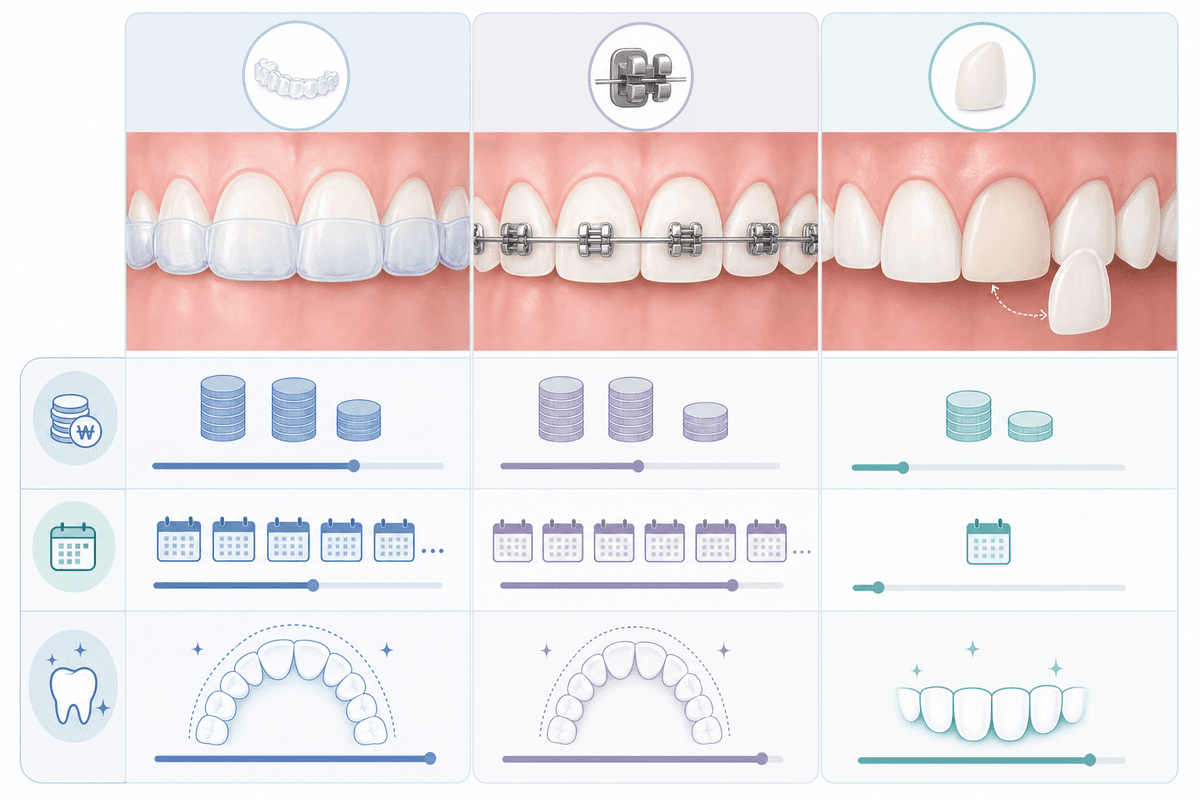
While clear braces (Invisalign) offer superior aesthetics and convenience, conventional orthodontics is more effective for complex malocclusions. Laminates are prosthetics rather than braces; they require tooth reduction and cannot resolve occlusal issues. You must make a choice based on a comprehensive assessment of your occlusal condition, lifestyle, and budget, and the decision cannot be made based solely on a cost comparison.
Selection Criteria from a Dental Specialist
- Clear aligner average: 18 months
- Cost: 1.5-2x that of traditional braces
- Laminate veneer completion: 2 weeks
"Can't clear aligners fix everything?" — This question determines 30% of the outcome.
This is the most common misconception heard in the clinic. "Clear aligners are the latest, so they must be better, right?" To get straight to the point, clear aligners are a system optimized for **mild to moderate malocclusions**. For skeletal malocclusions or cases requiring extraction, traditional braces may be more effective.
According to a 2022 presentation by the Korean Association of Orthodontists, clear aligners are suitable for approximately 60-70% of all orthodontic cases. For the remaining 30-40%, metal brackets or lingual braces yield more accurate results. In particular, when there is a significant skeletal imbalance between the upper and lower jaws, it is difficult to adjust the occlusion with clear aligners alone.
Conversely, there are also many cases where people say, "Laminate veneers can be done in just 2 weeks." Laminate veneers are a **restorative procedure**, not orthodontics. They involve removing 0.3-0.7mm of tooth structure and attaching ceramic shells, which does not resolve occlusion problems. They are solely for aesthetic improvement.
In this article, we will thoroughly break down **clear aligners (Invisalign, Clearline, etc.), traditional braces (metal, ceramic, self-ligating), and laminate veneers** in terms of cost, duration, indications, and pros and cons. Find the option that suits your case.
Key Takeaway The orthodontic method is determined by the **occlusal status**, not by 'trends'. Choosing without a specialist's precise diagnosis doubles the rate of retreatment.
Clear Aligners — The Top Choice for Professionals Who Want to Eat Without Braces
The leading brand for clear aligners is **Invisalign (FDA approved in 1997)**. While there are local brands in Korea like Clearline and A-line, Invisalign stands out in terms of clinical data and algorithmic precision. Invisalign has data from over 14 million cases worldwide, leading to high prediction accuracy.
The average treatment duration is **12-24 months**. Mild anterior crowding takes 6-12 months, while moderate malocclusions require 18 months or more. The principle is to wear them 20-22 hours a day, and a new aligner is replaced every two weeks. The biggest advantage is that they can be removed for eating and brushing.
The cost ranges from **4 to 8 million KRW**. The Invisalign Full package costs 7-8 million KRW, while the Light package (for mild cases) costs 4-5 million KRW. This is 1.5-2 times more expensive than traditional braces. However, the longer appointment intervals of 6-8 weeks are advantageous for busy professionals.
The disadvantage is that **results depend on patient compliance**. If the wearing time is not maintained, tooth movement will not proceed as planned. Furthermore, accuracy is reduced for extraction cases or teeth requiring significant rotation. In such instances, mini-brackets may be used adjunctively.
Tip If you feel the orthodontic force is insufficient during clear aligner treatment, the number of 'attachments' is important. These are resin bumps bonded to the tooth surface; the more there are, the more complex movements are possible.
- Invisalign Full package average: 7 million KRW
- Required daily wear time: 20-22 hours
- Appointment interval: 6-8 weeks
Traditional Braces — For Complex Malocclusions, 'Metal' is Still the Answer
Traditional braces are broadly categorized into **metal brackets, ceramic brackets, self-ligating (Clippy-C), and lingual braces**. Metal braces are the most affordable (2.5-4 million KRW), while ceramic braces offer improved aesthetics (3.5-5 million KRW). Clippy-C has a built-in wire-locking mechanism, reducing friction and speeding up tooth movement (4-6 million KRW).
Lingual braces are attached to the inside of the teeth, making them invisible from the outside. The cost is the highest, ranging from **8 to 12 million KRW**, and initial speech and tongue discomfort may persist for the first 2-3 weeks. However, their orthodontic force is the same as labial (outer) braces.
The average treatment duration is **18-30 months**. Extraction cases or skeletal malocclusions may take over 30 months. Appointment intervals are 3-4 weeks, shorter than with clear aligners. Pain may occur for 2-3 days after each wire adjustment.
The biggest advantage of traditional braces is the precise **3D movement control**. This allows for tooth rotation, extrusion (pulling down), and intrusion (pushing in). A 2019 study in the Journal of Clinical Orthodontics found that traditional braces had a 15% higher success rate than clear aligners for complex occlusal adjustments.
Clinical Insight Space closure after extraction is an average of 4-6 months faster with traditional braces. Clear aligners have a relatively higher risk of root resorption during large movements, so the speed is adjusted.
| Orthodontic Method | Cost | Duration | Aesthetics | Indications |
|---|---|---|---|---|
| Metal Brackets | 2.5-4 million KRW | 18-24 months | All cases | |
| Ceramic Brackets | 3.5-5 million KRW | 18-24 months | All cases | |
| Clippy-C | 4-6 million KRW | 15-22 months | Fast movement | |
| Lingual Braces | 8-12 million KRW | 20-30 months | Complete aesthetics |
Laminate Veneers — The "2-Week Completion" Trap; It's 'Restorative', Not Orthodontics
Laminate veneers are a procedure that involves **removing 0.3-0.7mm** from the front surface of the teeth and attaching ceramic shells. Unlike orthodontics, they do not actually move the teeth; they 'cover' them to correct alignment. While they can improve color, shape, and minor alignment, they **cannot change the occlusion (bite)**.
The cost is **800,000 to 1.5 million KRW per tooth**. For six front teeth, this amounts to 4.8 to 9 million KRW, which is similar to or more expensive than clear aligners. The procedure is completed within 2 weeks over 2-3 visits. While the results are immediate, the roots do not move as they do with orthodontics, which can lead to occlusal imbalance in the long term.
Laminate veneers involve **irreversible tooth reduction**. Once teeth are ground down, they cannot be restored, and if the ceramic chips or fractures, re-treatment is necessary. The average lifespan is 7-15 years, with significant variation depending on maintenance.
Indications include **minor alignment issues, discoloration, and restoration of worn teeth**. They cannot address skeletal problems like protrusion or underbite. Furthermore, if teeth are significantly overlapped or rotated, the amount of tooth reduction increases, posing a risk of nerve damage. In such cases, orthodontics followed by laminate veneers is recommended.
Caution Be wary of advertisements claiming "straight teeth in 2 weeks without braces." Laminate veneers do not resolve occlusion problems, and improper procedures can lead to temporomandibular joint disorders.
- 800,000-1.5 million KRW per tooth
- Tooth reduction: 0.3-0.7mm
- Average lifespan: 7-15 years
Why You Can't Just Look at Cost and Duration — Optimal Choices for Each Case
**College student in their 20s with mild anterior crowding**: Clear aligners (Light) or partial orthodontics are suitable. Duration: 6-12 months, Cost: 3-5 million KRW. Low appointment burden and aesthetically pleasing. However, the occlusion must be stable, and if molar correction is needed, switching to a full package is necessary.
**Professional in their 30s with protrusion and requiring extraction**: Traditional braces (metal or ceramic) are the first choice. Extraction space closure is 4-6 months faster with traditional braces, and anteroposterior movement control is precise. Duration: 24-30 months, Cost: 3.5-5 million KRW. Choose metal if mask-wearing is possible at work, or ceramic if aesthetics are important.
**Self-employed individual in their 40s with discoloration and minor alignment issues**: Orthodontics followed by laminate veneers or all-ceramic crowns are suitable. First, correct the occlusion with braces (12-18 months), then improve color and shape with restorations. Total cost: 8-15 million KRW. If only laminate veneers are done, occlusal imbalance can lead to TMJ problems.
**Teenager in their teens with skeletal malocclusion**: If still growing, functional orthodontic appliances (headgear, facemask) may be needed. Clear aligners are not recommended as they are difficult for growth modification. After 2-3 years of traditional braces, a decision on jaw surgery will be made upon growth completion.
Key Takeaway Comparing costs is meaningless if you don't know your occlusal type. Get an accurate diagnosis through a 1:1 consultation with an orthodontic specialist at K-Dia. This can halve the retreatment rate.
3 Essential Selection Criteria You Shouldn't Miss
**1. Need for Extraction**: For cases requiring extraction, traditional braces are significantly advantageous. Clear aligners have a relatively higher risk of root resorption during large space closure. A 2020 study in the American Journal of Orthodontics found that traditional braces had a 92% success rate for space closure after extraction, compared to 79% for clear aligners.
**2. Patient Compliance**: Clear aligners require wearing them for over 20 hours a day. Traditional braces are safer for teenagers who have difficulty with self-management or professionals with frequent company dinners. Conversely, clear aligners are suitable for those in their 30s and 40s with many meetings and a high priority on aesthetics.
**3. Balance of Budget and Duration**: Laminate veneers are fast (2 weeks) but do not resolve occlusion problems. Traditional braces are long (24-30 months) but can address all malocclusions. Clear aligners fall in between, completing mild to moderate cases within 18 months.
According to the Korean Association of Orthodontists' 2023 guidelines, **cephalometric analysis** and 3D CT scans are mandatory before starting orthodontic treatment. Proceeding without understanding the skeletal pattern increases the retreatment rate by 2.5 times. Even if it costs an additional 100,000 KRW, get a precise diagnosis.
Tip Check your insurance before starting treatment. Orthodontics are generally not covered by national health insurance, but some private health insurance plans may cover a portion of pre-surgical orthodontic costs if diagnosed with 'maxillofacial deformity'. Carefully review your insurance policy.
- Traditional braces success rate for extraction cases: 92%
- Clear aligner success rate for extraction cases: 79%
- Additional cost for retreatment: 1.5-3 million KRW
Clear Aligners vs. Traditional Braces vs. Laminate Veneers: A Quick Comparison
Clear Aligners [Aesthetics + Convenience]
- Cost: 4-8 million KRW
- Duration: 12-24 months
- Appointments: 6-8 weeks
- Wear Time: 20-22 hours/day
- Indications: Mild to moderate
Limited for extraction cases or large rotational movements. Results depend on patient compliance.
Traditional Braces [All Cases]
- Cost: 2.5-6 million KRW
- Duration: 18-30 months
- Appointments: 3-4 weeks
- Wear Time: Fixed 24 hours
- Indications: All
Optimal for complex malocclusions and extraction cases. Precise 3D control.
Laminate Veneers [Immediate Aesthetics]
- Cost: 800,000-1.5 million KRW per tooth
- Duration: 2 weeks
- Appointments: 2-3 visits
- Reduction: 0.3-0.7mm
- Indications: Minor alignment + discoloration
Restorative, not orthodontic. Does not resolve occlusion issues; irreversible tooth reduction.
Misconceptions Debunked
Myth Clear aligners are the latest, so they are always better than traditional braces.
Truth Clear aligners are a system optimized for mild to moderate malocclusions. For skeletal malocclusions or cases requiring significant movement after extraction, traditional braces have over 15% higher success rates. According to a 2020 study in the American Journal of Orthodontics, traditional braces achieved 92% success in space closure after extraction, while clear aligners achieved 79%. Selection should be based on 'case suitability', not just 'latest technology'.
Myth Laminate veneers make teeth straight in 2 weeks without orthodontics.
Truth Laminate veneers are a restorative procedure, not orthodontics. They involve removing 0.3-0.7mm of tooth structure and covering it with ceramic shells, improving appearance but not changing the occlusion (bite). If there are occlusion problems, undergoing laminate veneer placement alone can double the risk of TMJ disorders or veneer fracture. They cannot address skeletal issues like protrusion or underbite.
Must-Check Before Starting Orthodontics
- Do not start without cephalometric analysis — not knowing the skeletal pattern increases retreatment rate by 2.5x
- Beware of exaggerated claims like "finished in one year" — rushing complex cases can increase root resorption risk
- If clear aligner wear time is less than 20 hours/day, tooth movement will be delayed — duration may increase by over 6 months
- Mandatory occlusal evaluation before laminate veneers — treatment in an unstable occlusal state can cause TMJ disorders
- Be cautious of low-cost clear aligner brands — lack of clinical data leads to greater prediction errors and increased retreatment rates
Frequently Asked Questions
Can I drink coffee with clear aligners?
Drinking coffee with aligners in will cause discoloration. When consuming beverages, remove the aligners, drink, brush your teeth immediately, and reinsert them. You can remove them for 2-4 hours a day, so utilize meal and drink times.
Can I undergo MRI scans with traditional braces?
Metal brackets can cause image distortion during MRI scans. Ceramic brackets or clear aligners are non-metallic and pose no issues. If an emergency MRI is anticipated, inform your dentist in advance.
Is orthodontic treatment possible after laminate veneers?
It is possible but limited. Ceramic laminate veneers have poor bracket adhesion, and excessive force can cause fracture. If orthodontics are necessary, the principle is to complete them before placing laminate veneers.
Is it safe to get pregnant during orthodontic treatment?
Orthodontic treatment can continue during pregnancy. However, radiation exposure (X-rays, CT scans) should be avoided, limiting treatment progress checks. If you are planning a pregnancy, consult with your specialist before starting treatment.
What happens if I don't wear my retainers after orthodontics?
Teeth are most unstable for the first 6 months after orthodontic treatment. Not wearing retainers increases the relapse rate by over 50%. The principle is to wear them 24 hours a day for the first year, then during sleep for the next 2-3 years.
Can I switch between clear aligners and traditional braces mid-treatment?
Yes, it is possible. During clear aligner treatment, if movement is not as planned, brackets may be partially attached as an adjunct. Conversely, some cases finish with clear aligners after traditional braces. Costs are subject to separate negotiation.
This content is for informational purposes only and does not substitute for medical advice. Always consult with a specialist before undergoing any procedure.
Find a Dental Clinic Specializing in Orthodontics for You at K-Dia