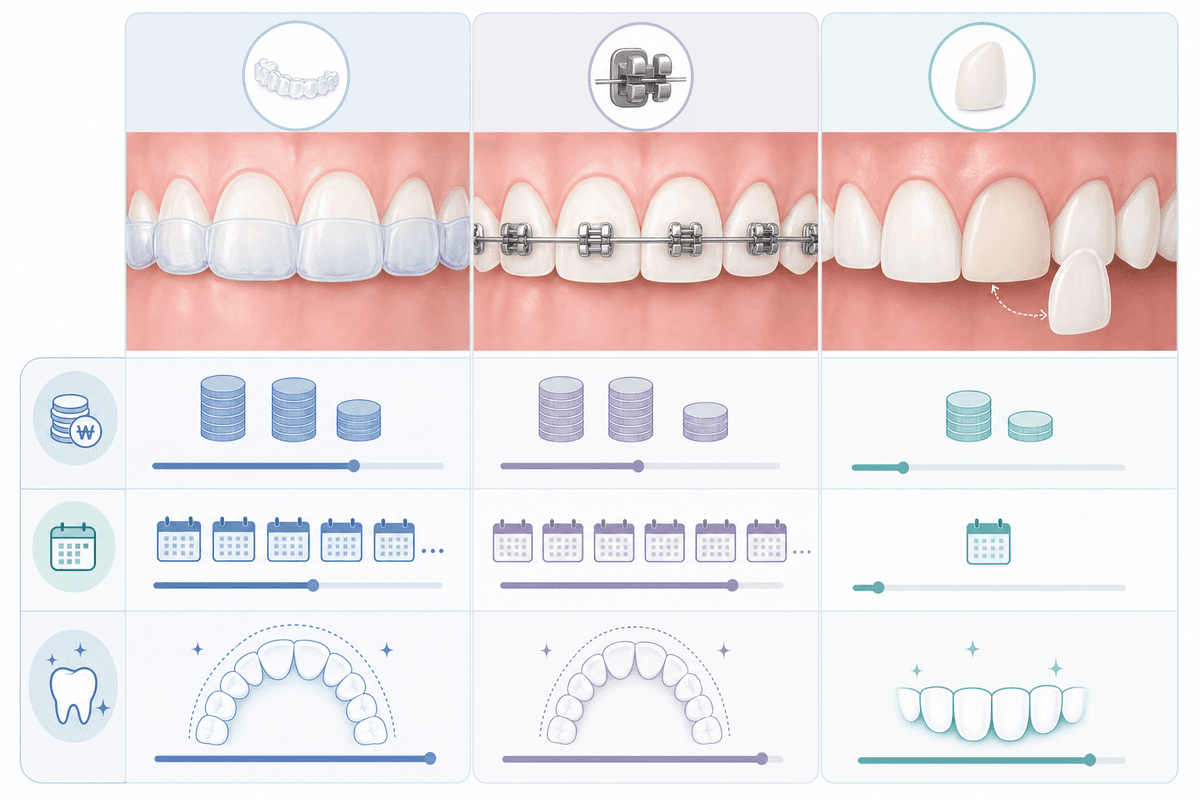
Clear Aligners 2025: Will They Truly Be Invisible?
- The 2025 new material solved "cases that couldn't be done" rather than "things that couldn't be seen."
- The new polyurethane-based material has overcome the physical limitations of existing clear aligners.
- Digital simulation and 3D printing have increased custom precision to 0.02mm.
Information as of September 2026
The Orthodontic Market Transformed by New Materials
- The domestic clear aligner market has grown 3.2 times compared to 2020.
- Tooth movement efficiency improved by 40% with the application of new materials.
- Digital scan accuracy achieved within 0.02mm.
That Moment Your Selfie Smile Looked Awkward
Your smile might look fine from the front, but when you smile from the side, your mouth seems to protrude. Many people end up searching for clear aligners after trying different angles in front of the mirror.
In 2025, the reason clear aligners are gaining popularity isn't just because they're "invisible."
It's because new materials have made previously untreatable cases possible. Cases requiring extraction or severe protrusion, which were once only manageable with metal braces, can now be corrected with clear aligners.
The market's 3.2-fold expansion in three years is due to this potential, rather than just aesthetics.
Polyurethane: A New Way to Withstand Force
Until 2020, most clear aligner devices were made of thermoplastic polyurethane (TPU). The problem was that applying strong force could deform or break the aligners.
Consequently, cases requiring space closure after extraction or molar retraction were often referred back for metal braces.
The situation changed with the commercialization of multi-layered polyurethane starting in 2023.
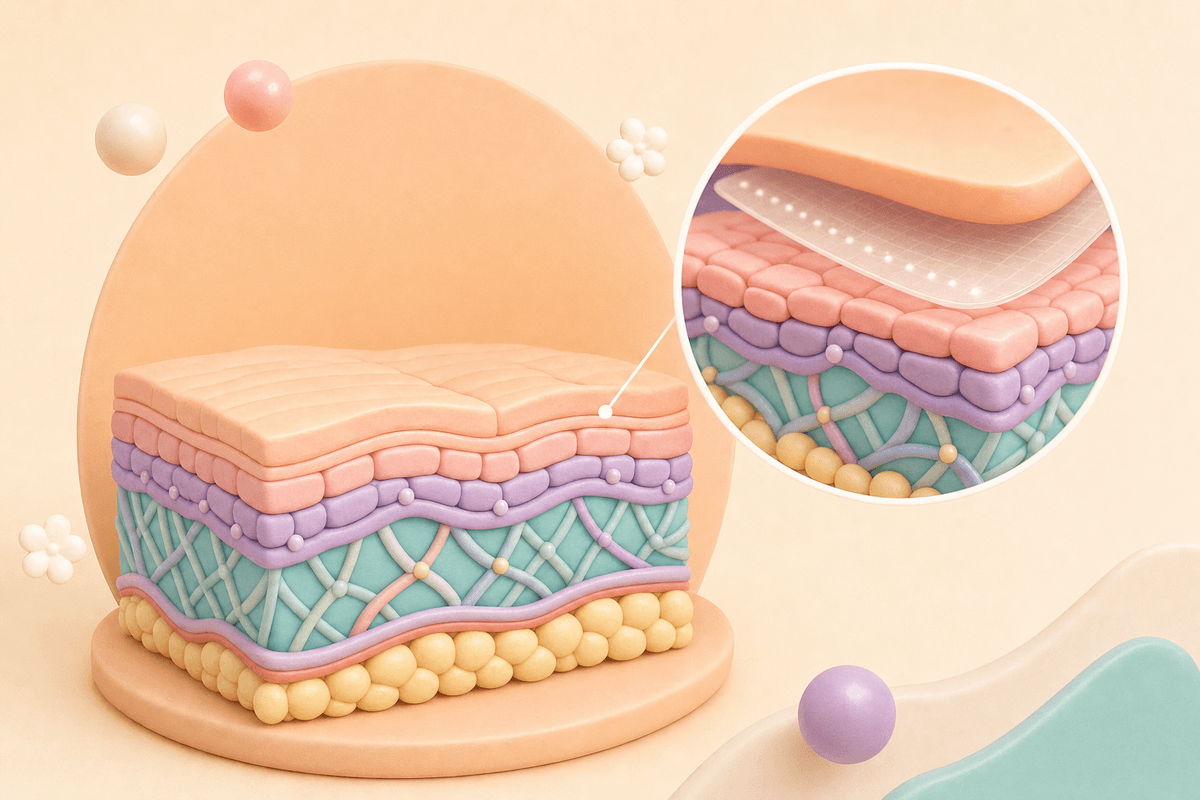
While the exterior is transparent and flexible, the interior features a separate layer with high elasticity, resulting in a 40% improvement in tooth movement efficiency compared to previous materials.
These are still clear aligners, but now they can close even a 3mm extraction space.
OX Quiz
Clear aligners always take longer to treat than metal braces.
Check the answer
X After the introduction of new materials in 2025, the treatment time difference for extraction cases has narrowed to an average of less than 2 months. In some cases, the speed is nearly comparable to metal braces.
Digital Scans Eliminate "Poorly Fitting Aligners"

Another weakness of clear aligners was the inaccuracy of impressions (dental molds).
Taking molds with silicone typically resulted in an error of 0.1-0.3mm. Accumulated errors could lead to a loose fit by the tenth aligner. However, this issue was resolved surprisingly quickly.
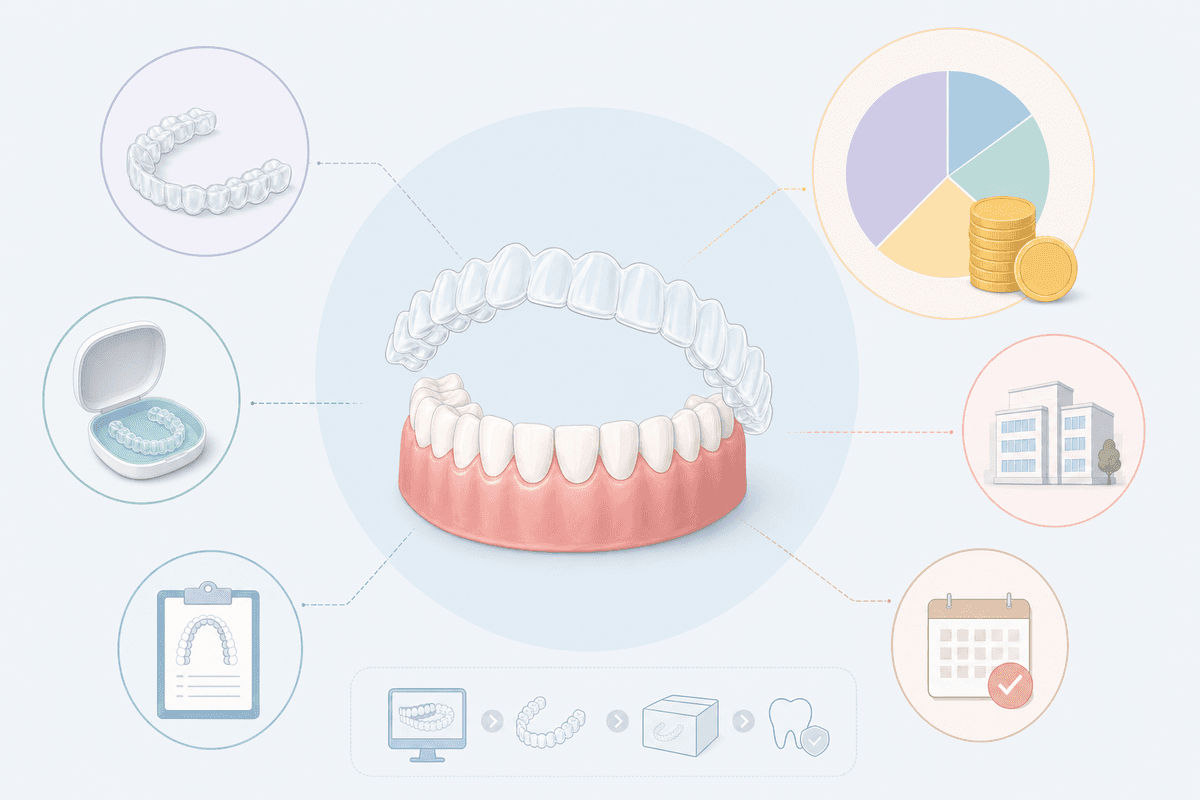
As the precision of intraoral scanners improved to within 0.02mm, cases of ill-fitting aligners have almost disappeared. Manufacturing errors were also reduced due to 3D printing.
Today, in 2025, even when producing 20-30 aligners at once, the fit remains precise down to the last aligner.
Clinical Insight Major domestic clear aligner brands (e.g., Invisalign, ClearCorrect) fully transitioned to digital scan-based production starting in 2024. Silicone impressions are now rarely used.
So, in 2025, Can Clear Aligners Really Work?
To put it simply, they are case-dependent. Despite advancements in new materials and digital technology, skeletal malocclusions (differences in jaw size) still cannot be fully resolved with clear aligners alone.
In such cases, metal braces or orthognathic surgery are necessary.
Conversely, for dental malocclusions (teeth alignment issues), the effectiveness of clear aligners is nearly equivalent to metal braces.
According to a 2024 clinical report by the Korean Association of Orthodontists, the treatment time difference for extraction cases has narrowed to an average of less than 2 months.
If you can commit to wearing the aligners for 22 hours a day and changing them every two weeks, the question is no longer "Can clear aligners work?" but rather "What kind of case is it?"
- Treatment time for extraction cases shows an average difference of less than 2 months compared to metal braces.
- Skeletal malocclusions still require metal braces or combined surgical treatment.
Can My Case Be Treated with Clear Aligners?
If you have protruding front teeth and are scheduled for extraction
Clear aligners with new materials in 2025 are sufficiently capable.
If there is a significant size difference between your upper and lower jaws
Clear aligners alone have limitations; metal braces or combined surgery may be necessary.
Clear Aligners: These Rules Must Be Followed
- !!If you don't wear them for more than 22 hours a day, your teeth won't move as planned!!. They must be worn continuously except during meals and brushing.
- !!Arbitrarily extending the 2-week replacement cycle can lead to loose aligners and reduced effectiveness!!. Strictly adhere to the scheduled replacements.
- !!Drinking hot beverages can deform the aligners!!. Remove your aligners before drinking anything other than water.
Frequently Asked Questions
Are clear aligners really less effective than metal braces?
For dental malocclusions (teeth alignment issues), the effectiveness is almost the same. Skeletal malocclusions (jawbone imbalance) still require metal braces or surgery.
What happens if I sleep without wearing my aligners?
Your teeth will begin to shift back to their original positions. If you cannot maintain the 22-hour wear time, your treatment duration will be longer than planned.
Are there any side effects with clear aligners?
Temporary pain due to aligner pressure and potential gum inflammation are possible. You might experience discomfort when chewing for the first 2-3 days of wear.
Lumi's Insight
What new materials have changed isn't just "invisibility," but "possibility." If you don't have skeletal issues, clear aligners are now a viable option. This is true as long as you get a precise diagnosis and follow the wear instructions.
This content is for informational purposes only and does not substitute medical advice. Always consult with a specialist before undergoing any procedure.