5 Factors Determining Hair Loss Treatment Costs: The Line Between Insurance and Out-of-Pocket Expenses

- A difference of 500 hair follicles can mean a 1 million won price gap.
- Whether it's covered by national health insurance depends on the diagnosed condition and type of medication.
- Hair transplantation is entirely non-covered by insurance, while medication treatment may be partially covered.
- Cost range for 1,000 follicles: 1 million - 3 million KRW
- Medication treatment insurance coverage rate: 70%
- Average number of follicles for transplant surgery: 2,500 - 3,000
1,000 Follicles for 1 Million KRW: The First Cost Factor is Follicle Count
The cost of hair loss treatment is most directly linked to the number of follicles to be transplanted.
According to data presented by the Korean Hair Research Society in 2024, the average cost per follicular unit (FU) is reported to be in the range of 1,000-3,000 KRW.
Even with the same method, the total cost can double depending on whether 1,000 or 3,000 follicles are needed.
The number of follicles is determined by the stage of hair loss progression and the scope of transplantation. If only the receding hairline is corrected, 1,500-2,000 follicles may be needed, while including the crown could require over 3,000.
Dermatologists and hair specialists calculate the required number of follicles through hair density measurements and hair loss grade assessments.
FUE vs FUT: Harvesting Method Affects Unit Cost
The method of harvesting follicles also creates cost differences.
FUE (Follicular Unit Extraction) involves extracting follicles one by one, while FUT (Follicular Unit Transplantation) involves incising a strip of the scalp and separating the follicles.
FUE tends to have a 1.5-2 times higher unit cost per follicle, but it has the advantage of no linear scarring and faster recovery.
An unexpected variable here is skill level. Even with the same FUE procedure, the follicle damage rate varies depending on the operator's experience. A higher damage rate leads to lower graft survival, potentially requiring re-treatment.
Considering not just the initial cost but also the long-term results reveals the true cost-effectiveness.
OX Quiz
Medication treatment for male pattern baldness is covered by health insurance.
Check the answer
X Male and female pattern baldness (androgenetic alopecia) are non-covered items. Only in cases diagnosed as autoimmune diseases, such as alopecia areata, are some medications covered, and even then, the scope of prescription is limited.
Insurance Coverage Crossroads: Diagnosis and Medication Type
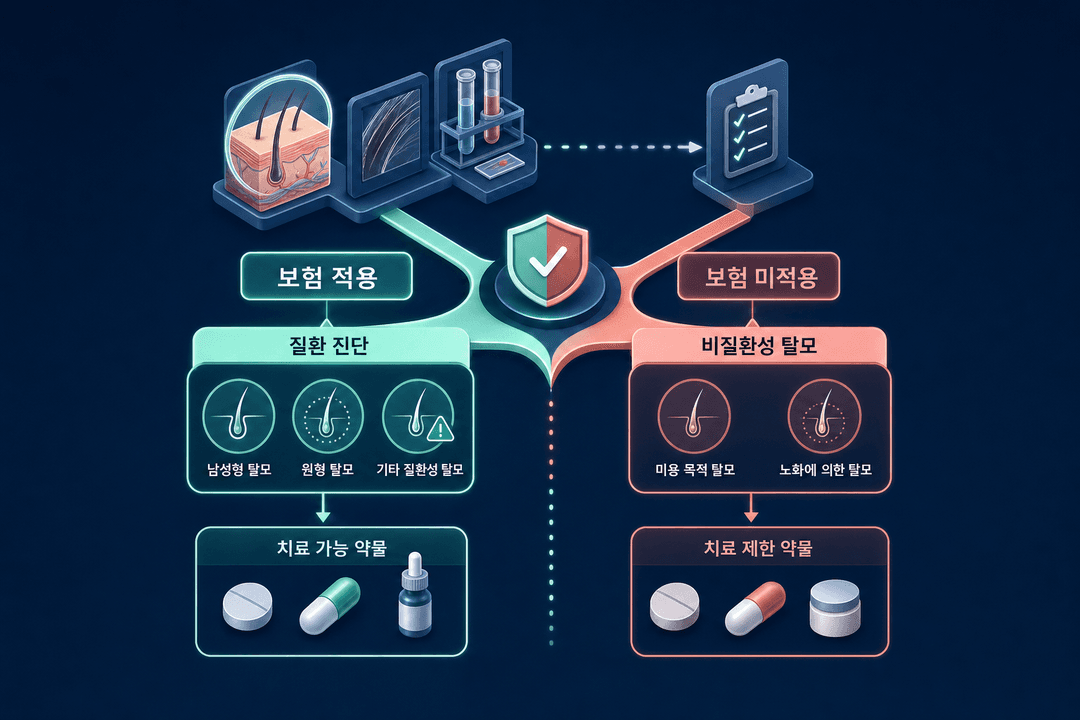
Hair loss treatments covered by health insurance are divided by diagnosis and treatment method.
Male and female pattern baldness (androgenetic alopecia) are non-covered, but in cases classified as autoimmune diseases like alopecia areata, some medications and injections are covered.
However, the scope of prescription is limited, so often only a portion, not the full amount, is covered by insurance.
While medication treatment may be eligible for insurance coverage, hair transplant surgery is entirely non-covered.
Prescription medications require a diagnosis and prescription from a dermatologist or hair specialist, and selection is based on ingredients and mechanisms of action, not brand names.
Caution Advertising of prescription medications to the general public is prohibited. The type of medication and whether to take it must be decided in consultation with a specialist.
Inclusion of Post-Treatment Care: The Final Variable
You should check whether post-treatment care costs are included in the initial estimate.
Post-transplant swelling management, disinfection, suture removal, and follicle survival checks may be billed as additional costs, while some are included in packages.
Graft survival checks are needed at intervals of 3-6 months post-transplant. If this cost is omitted, the total amount could increase by 200,000-300,000 KRW.
The same applies to medication treatment. Don't just look at the initial prescription cost; you need to inquire about the re-prescription cycle and examination costs during the maintenance period to estimate the actual burden.
- Follicle count, method, and inclusion of post-treatment care determine the total cost.
- Insurance is based on diagnosis; transplants are fully self-paid.
Comparison of Cost Structures by Transplant Method
FUE (Follicular Unit Extraction) [Non-surgical]
- Unit cost per follicle: 1,500-3,000 KRW
- Minimized scarring
- Recovery period: 7-10 days
- Fully non-covered
Graft survival rates vary significantly based on skill level
FUT (Follicular Unit Transplantation) [Surgical]
- Unit cost per follicle: 1,000-2,000 KRW
- Leaves a linear scar
- Recovery period: 10-14 days
- Fully non-covered
Cost-effective for large-volume transplants
Medication Treatment [Non-surgical]
- 30,000 - 100,000 KRW per month
- Partial coverage depending on diagnosis
- Requires long-term maintenance
- Prescription medication
Insurance coverage possible for diagnoses like alopecia areata
Misconceptions
Myth Hair transplant surgery is covered by health insurance.
Truth Hair transplant surgery is entirely non-covered. Only some medication treatments are covered depending on the diagnosis, and even then, the scope of prescription is limited, making full insurance coverage rare.
What to Check Before Hair Loss Treatment
- !!Do not decide based on cost alone without a precise scalp examination!!
- !!Do not obtain or take medication without a prescription from a dermatologist or hair specialist!!
- !!Check if post-treatment care and re-prescription costs are included in the estimate!!
Frequently Asked Questions
Who determines the number of follicles and how?
Dermatologists or hair specialists calculate the required number of follicles through hair density measurements and hair loss grade assessments, which varies depending on the scope of transplantation and target density.
If follicles don't grow after transplantation, who pays for re-treatment?
Graft survival rates vary greatly among individuals and depend on the contract terms agreed upon before surgery. Therefore, you should check the re-treatment and warranty policies in advance.
Which comes first, medication treatment or transplantation?
For early-stage hair loss, it is common to slow progression with medication and supplement areas where follicles have already been lost with transplantation. The order is determined by a specialist's diagnosis.
References
- Report on Hair Transplant Costs and Characteristics by Method — Korean Hair Research Society, 2024
- Health Insurance Coverage Standards for Hair Loss Diseases — Health Insurance Review & Assessment Service, 2023
Lumi's Note
Ask about the number of follicles, method, and insurance coverage all at once. Many people miss out on post-treatment care costs by trying to compare a single estimate. Please come back if you have more questions.
This content is for informational purposes only and does not substitute for medical advice. Treatment methods must be decided after diagnosis and consultation with a dermatologist or hair specialist.