Comparative Analysis of 4 Rhinoplasty Methods 2025
K-Dia EditorLast updated · 26 seconds ago5,05125 min read
Augmentation rhinoplasty, osteotomy, hump correction, and tip rhinoplasty each have different purposes and recovery periods, and only 30% of cases are resolved with a single surgery. Autologous cartilage (septal, ear, or rib cartilage) and silicone implants each have distinct advantages and disadvantages in terms of feel, durability, and risk of side effects, and the selection criteria are nasal structure and skin thickness. The main cause of the 12-18% revision rate is 'surgical methods by area…
Which is the right choice for you?
Up to 3 times difference in recovery period depending on surgical method
Material selection determines 60% of result duration
Average domestic rhinoplasty revision rate is 12-18%
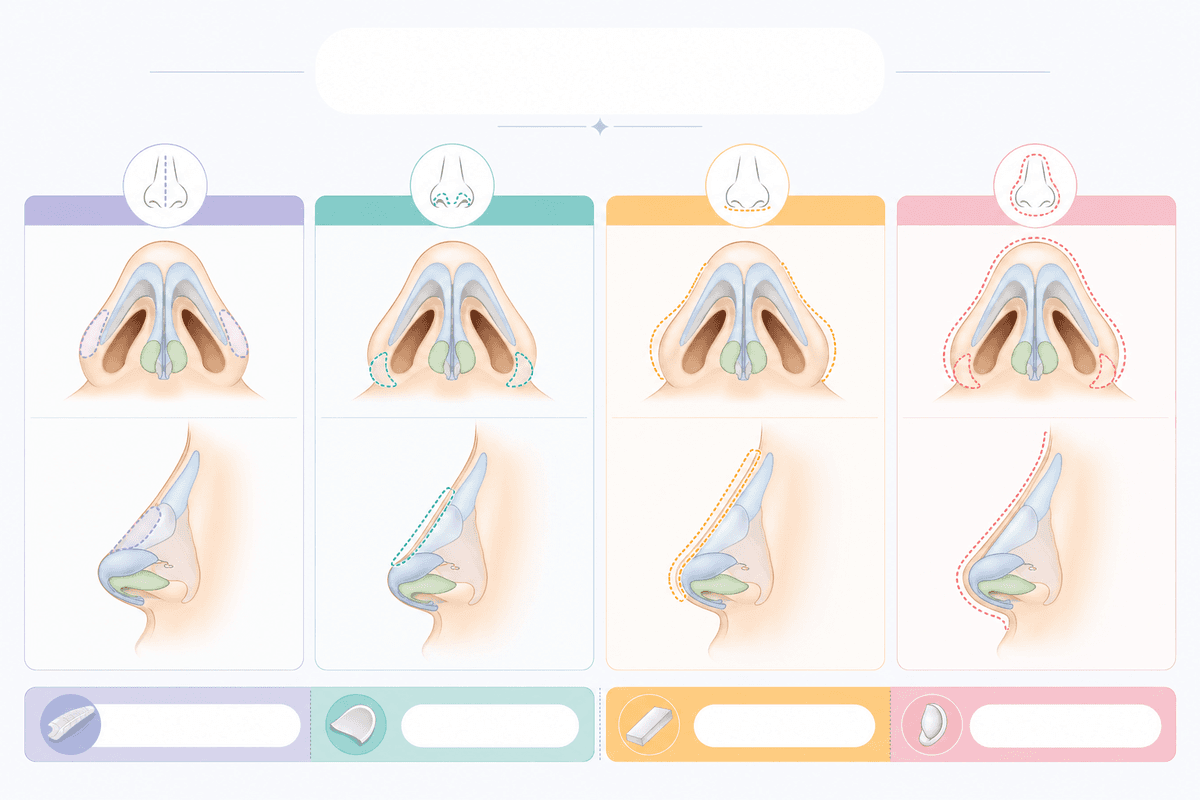
Augmentation Rhinoplasty vs. Osteotomy — Two branches of nose bridge heightening
The most frequently asked question in the clinic is, "Do I just need to raise the nose bridge?" However, hidden within the single phrase "raising the nose bridge" are two completely different approaches: augmentation rhinoplasty and osteotomy.
Augmentation rhinoplasty is a method of adding height by inserting silicone (SilikonePlus, Natrelle, etc.) or autologous tissue into the dorsal part of the nose. The surgery takes an average of 40–60 minutes, can be performed under local anesthesia, and recovery takes about 7–10 days.
Osteotomy is a method of artificially cutting the nasal bridge bone (nasal bone) to rearrange its shape; it is used to narrow a wide nasal bridge or correct a deviated bone. General anesthesia is required, recovery takes 2–3 weeks, and swelling lasts for more than a month.
In over 60% of cases, both surgeries are performed simultaneously. For example, a low and wide nasal bridge must be raised with augmentation rhinoplasty and its width reduced with osteotomy to achieve balance.
The selection criteria are simple. If only height needs to be added without touching the bone itself, choose augmentation rhinoplasty; if the position or width of the bone needs to be changed, choose osteotomy.
Key Point: If the target height of the nasal bridge is 3mm or less, augmentation rhinoplasty alone is often sufficient. If the width is 4mm or more, or if width correction is required, consider combining osteotomy.
Average recovery time for augmentation rhinoplasty: 7-10 days
Average recovery time for osteotomy: 2-3 weeks
Combination rate: Over 60%
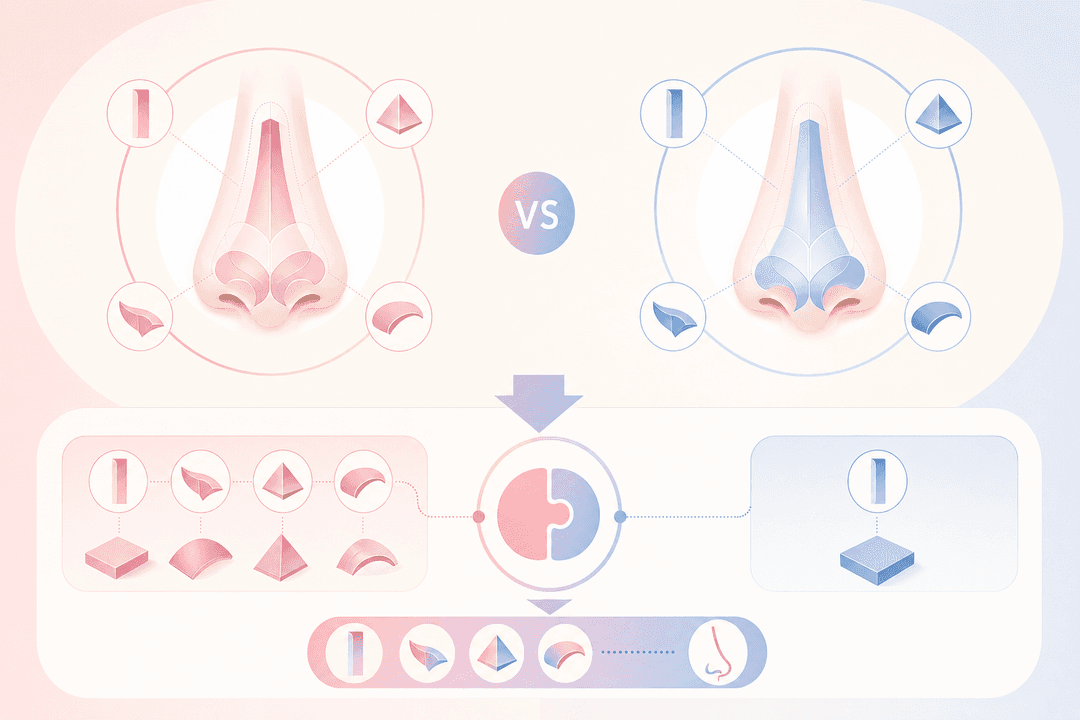
Silicone vs. Autologous Cartilage — Why Material Selection Determines Results
Rhinoplasty materials are broadly divided into silicone implants and autologous cartilage (septal, ear, or rib cartilage). Long-term results reported in clinical practice vary starkly depending on the material selected.
Based on FDA-approved products (SilikonePlus, Implantech), silicone offers a high shape retention rate after implantation and allows for predictable designs due to its ease of sculpting. However, if the skin is thin, the outline of the implant may be visible, and there are reports of the possibility of capsular contracture or displacement with long-term use.
For autologous cartilage, the harvesting volume increases in the order of septal cartilage (7-10mm can be harvested), ear cartilage (10-15mm), and rib cartilage (30mm or more). It has high biocompatibility with almost no rejection reactions, a natural feel, and excellent long-term durability.
The disadvantages are scarring at the harvesting site (1-2cm behind the ear, 3-5cm from the ribs) and increased surgery time (an average of 30-60 minutes extra). Additionally, there is a 10-15% reported possibility that the cartilage may be partially absorbed or bend over time.
While silicone is naturally accepted if the skin thickness is 1.5mm or more, autologous cartilage is recommended for thin skin of 1mm or less. The guidelines of the Korean Society of Plastic and Reconstructive Surgeons also specify the priority of autologous cartilage in revision surgery cases.
Clinical skin thickness measurement is performed using ultrasound, and if it is 1.2mm or less, the probability of the contour showing through in the long term increases by more than 30% when using silicone.
Material
Durability
Tactile
Recovery Period
Risk of Side Effects
Silicone
Over 10 Years
Somewhat Firm
7-10 Days
Capsular Contracture 5-8%
Septal Cartilage
Permanent
Very Natural
10-14 Days
Absorption 5-10%
Rib Cartilage
Permanent
Natural
14-21 Days
Bend 10-15%
Hump Nose Surgery — Just Trimming and It's Over? Balance is Key
Hump nose surgery is a method of removing the protruding bone and cartilage in the middle part of the bridge of the nose. The surgery takes an average of 60 to 90 minutes, and local anesthesia is possible if performed without osteotomy.
The problem is that "shaving it down alone lowers the nose." If only the hump is removed, the height of the nose decreases by an average of 2 to 3 mm, and the nasal bridge appears relatively flat. Therefore, augmentation rhinoplasty or cartilage grafting is performed in combination in over 70% of cases.
Additionally, removing the hump can make the width of the nasal bone appear wider, so osteotomy to narrow the width is often added. Cases involving only simple hump removal account for only 30% of the total.
Recovery takes 10 to 14 days when performed alone, and over 3 weeks when combined with osteotomy. It takes 3-6 months for the swelling to completely subside and the final contour to be established.
Caution: If only the hump is removed without height enhancement, the most frequently reported complaint after 6 months is that it "looks lower than before." Pre-operative simulation is essential.
Cases where only the hump is removed: 30%
Ratio of rhinoplasty and osteotomy combined: 70%
Final contour confirmed: 3-6 months
Nose tip surgery — a completely different area from the bridge of the nose
Nose tip surgery is a procedure that changes the position, angle, and size of the nose tip by adjusting the angle and strength of the alar cartilage. It is an anatomically different field from augmentation rhinoplasty, and the surgical difficulty is higher.
The three main surgical techniques are alar cartilage resection, tying suture, and cartilage graft (shield graft, cap graft). Partial resection of the alar cartilage elevates the nasal tip, tying sutures narrow the tip, and grafts produce a protruding effect.
Since the skin of the nasal tip is often thick and the cartilage weak, ear cartilage or septal cartilage is used as reinforcement in over 80% of cases. As a general rule, artificial implants such as silicone are not used for the nasal tip.
The recovery period is longer than that of augmentation rhinoplasty, averaging two weeks. Swelling of the nasal tip persists for more than a month, and the final shape is confirmed after six months to one year.
If only the tip of the nose is operated on, the balance with the bridge of the nose may appear disrupted; therefore, in reality, it is performed simultaneously with augmentation rhinoplasty in over 65% of cases.
Tip Wearing glasses is prohibited for at least 4 weeks during the recovery of the nose tip. The same applies to sunglasses. Wearing contact lenses is recommended upon returning to work.
Procedure
Purpose
Recovery Period
Reinforcement Material Usage Rate
Alar Cartilage Resection
Nose Tip Elevation
10-14 Days
50%
Cartilage Binding
Nose Tip Narrowing
14 Days
60%
Cartilage Grafting
Nose Tip Protrusion
14-21 days
90%
Combined Surgery vs. Single Surgery — When and How to Combine
More than 70% of rhinoplasty procedures in Korea combine two or more surgical techniques. Cases completed with a single surgery are limited to simple cases, such as 'slightly raising the nasal bridge.'
The most common combinations are augmentation rhinoplasty + tip rhinoplasty (45%), augmentation rhinoplasty + osteotomy (30%), and augmentation rhinoplasty + tip rhinoplasty + osteotomy (15%). Hump nose surgery is also mostly performed in conjunction with augmentation rhinoplasty or osteotomy.
The advantage of combination surgery is that overall balance can be achieved in a single procedure, but the recovery period is extended and the risk of side effects increases. The surgery time averages 2-3 hours, and recovery takes more than 3 weeks.
Combination surgery is highly preferred in cases where skin elasticity is good and tissue recovery is fast, such as in the early 20s. On the other hand, for those 40 years and older, about 30% choose staged surgery considering the burden of recovery.
The selection criteria are the 'target change amount' and the 'possible recovery period.' To proceed without interrupting your social life, a single procedure or a combination of two is recommended; if a long leave is possible, a combination surgery is recommended.
Key Points
For three months after combination surgery, there are many prohibited items, such as blowing your nose forcefully, wearing glasses, and sleeping on your stomach. Please check in advance if you can adjust your lifestyle patterns.
Combination surgery rate: over 70%
Average surgery time: 2-3 hours
Recovery period: over 3 weeks
Criteria for selecting revision surgery — The same method only repeats the same results
The revision rate for rhinoplasty is reported to be an average of 12-18% in Korea. The biggest cause is 'mismatch of approach by area during the initial surgery.' For example, there are many cases where attempts to resolve nasal tip issues with augmentation rhinoplasty fail.
When performing revision surgery, it is essential to select different materials and surgical techniques than those used during the initial procedure. The rate of replacing silicone noses with autologous cartilage is 60%, and the rate of converting single surgeries into complex surgeries is 70%.
Furthermore, one must wait at least six months after the initial surgery for the tissues to stabilize and for the revision surgery to be safe. Performing revision surgery within three months increases the risk of inflammation and necrosis by more than three times.
The Korean Society of Plastic and Reconstructive Surgeons recommends 3D CT scanning before revision surgery. Accurate assessment of the bone and cartilage condition, as well as the distribution of scar tissue, is necessary to formulate a surgical plan.
The recovery period for revision surgery is, on average, 1.5 times longer than for the initial surgery, and swelling also persists for a longer period. If you proceed too quickly without sufficient consultation and planning, there is a high probability that it will lead to a third surgery.
Caution
To accurately determine the combination of materials and surgical procedures suitable for your case, 3D CT analysis and a one-on-one consultation with a specialist are essential. Find a hospital with extensive experience in revision surgery on K-Dia.
Revision rate 12-18%
Material change rate 60%
Safety waiting period minimum 6 months
Compare the 4 Major Rhinoplasty Methods at a Glance
Augmentation Rhinoplasty [Adding Height]
Surgery time: 40-60 minutes
Recovery: 7-10 days
Materials: Silicone · Autologous cartilage
Anesthesia: Local possible
Simple rhinoplasty that only raises the height of the nasal bridge Case
Osteotomy [Width/Angle Correction]
Surgery Time: 90-120 minutes
Recovery: 2-3 weeks
Materials: Bone rearrangement
Anesthesia: General anesthesia required
Correction of wide or deviated nasal bridge
Nose Tip Augmentation [Nose Tip Shape Adjustment]
Surgery Time: 60-90 minutes
Recovery: 2 weeks
Materials: Ear/Nasal Septum Cartilage
Anesthesia: Local and general anesthesia are both possible
Changing the position, angle, and size of the tip of the nose
Common Misconceptions
Misconception Silicone always has many side effects, and autologous cartilage is always safe
Truth Silicone has proven long-term safety based on FDA-approved products, and the side effect rate is less than 5% if the skin thickness is 1.5mm or more. Conversely, the possibility of absorption or bending of autologous cartilage is reported to be 10-15%, and there is no material that is absolutely safe. The important thing is to make a choice that fits your skin thickness and nasal structure.
Misconception: If you only operate on the tip of the nose, you do not need to touch the bridge.
Truth: The number one reason for revision surgery is the complaint that the height balance with the bridge of the nose is disrupted after tip surgery, making it look 'awkward.' In fact, tip-only surgeries account for only 35% of the total, while 65% are performed in combination with augmentation rhinoplasty or osteotomy. The nose is a single structure, so accidents involving the separation of parts are dangerous.
5 Things Absolutely Forbidden After Rhinoplasty
Do not wear glasses or sunglasses for 4 weeks after surgery — Can cause positional deformation of the nasal bone or cartilage
Do not blow your nose hard or rub it for 2 weeks — Risk of bleeding and infection increases threefold
Do not sleep on your stomach or side for one month — Can cause increased swelling and asymmetry
Do not expose to saunas, steam rooms, or high-temperature environments for 3 months — Possibility of implant displacement
Do not subject the nose to strong impact (ball sports, etc.) for 6 months — Risk of fracture and deformation
Frequently Asked Questions
How much can be achieved with only augmentation rhinoplasty? Is recovery possible?
For rhinoplasty alone, you can return to your daily life in an average of 7 to 10 days. However, it takes about 3 months for the swelling to completely subside. You can wear glasses after 4 weeks.
Will autologous cartilage not be absorbed?
The absorption rate for septal and ear cartilage is reported to be 5-10%, while for rib cartilage it is about 10-15%. It is common practice to design the initial shape slightly higher to account for absorption. It is rare for it to disappear completely.
Does recovery take twice as long if the tip and bridge are treated simultaneously?
The recovery period for combined surgery is about 1.5 times longer than for a single surgery. For example, even if you combine rhinoplasty (10 days) and the tip (14 days), it takes about 3 weeks, not 24 days. Swelling lasts longer, but the duration is by no means double.
What should I do if the bridge of the nose looks too low after hump nose surgery?
If the procedure is completed without height enhancement after hump removal, the nose actually becomes 2-3mm lower. In this case, it is common practice to add augmentation rhinoplasty using autologous cartilage or silicone after 6 months. It is best to plan this in advance during the initial surgery.
How many months later is revision surgery possible?
You must wait at least 6 months for the tissue to stabilize and the scar to mature. Revision surgery within 3 months is not recommended as the risk of inflammation and necrosis increases by more than three times.
Are surgical methods different for people in their 20s and 40s?
People in their 20s have faster tissue recovery, so the rate of complex surgeries is high, whereas about 30% of people in their 40s choose staged surgery to consider the burden of recovery. Differences in skin elasticity also influence the selection of materials.
This content is for informational purposes only and does not replace medical advice. Always consult a specialist before the procedure.