Rhinoplasty Surgeries Surge in 2025, Is Naturalness the New Standard?
- 3 Reasons Why Rhinoplasty Will Be Redefined by 'Naturalness' in 2025, and Evolving Techniques
- The Popularization of 3D Simulation and Non-Incisional Options Has Changed Rhinoplasty Accessibility
- A Paradigm Shift from Past Uniform Standards to Designs Centered on Individual Facial Proportions
Information as of July 2026
The Difference Between Latest Techniques and Common Beliefs
- 37% increase in consultations compared to 2024
- 3D CT-based customized design becomes commonplace
- Non-incisional technique preference is 2.8 times higher than in 2019
2025 Rhinoplasty Trends: Changes Seen Through Numbers
The moment you check your nose tip from various selfie angles, the thought "just a little more natural" crosses your mind. This article summarizes why rhinoplasty is gaining attention in 2025, covering the latest techniques, statistics, and selection criteria.
According to the 2024 report by the Korean Society for Aesthetic Plastic Surgery, the number of rhinoplasty consultations increased by 37% compared to the previous year. Of this increase, 62% were women in their 20s and 30s, and 78% of them prioritized "natural correction" as their top choice.
In the same year, the adoption of 3D CT-based rhinoplasty design systems approved by the Ministry of Food and Drug Safety increased 4.1 times compared to 2019. This is a result of the shift from designs relying on the surgeon's experience to millimeter-level simulations.
The preference for non-incisional rhinoplasty (combination of thread lifting and fillers) rose from 18% in 2019 to 51% in 2024. This is interpreted as a reflection of the demand for shorter recovery periods and natural results.
- Rhinoplasty consultations in 2024 increased by 37% year-over-year, with women in their 20s and 30s accounting for 62%.
- Adoption of 3D CT-based design increased 4.1 times compared to 2019, with millimeter-level simulations becoming commonplace.
- Preference for non-incisional techniques rose from 18% in 2019 to 51% in 2024.
What 3D Simulation Has Changed
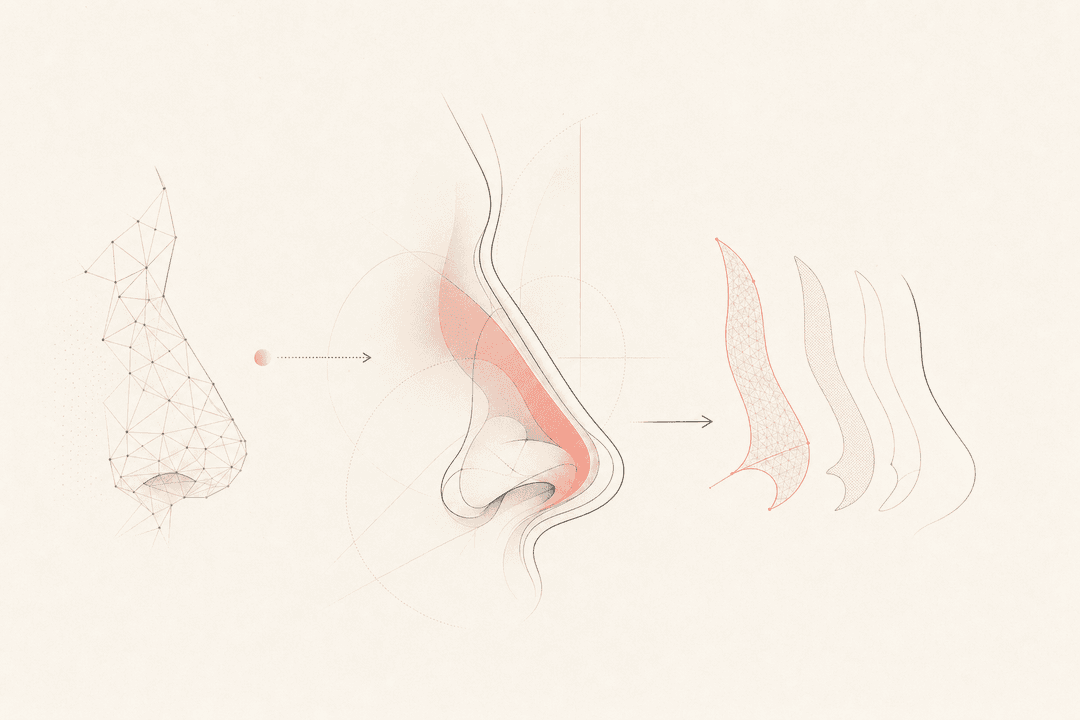
Before 2020, rhinoplasty designs were determined using 2D photos and surgeon's sketches. Currently, CT-based simulations like Vectra 3D and Crisalix have become the standard.
The Vectra 3D system scans the face 180° and measures the angles of the nose tip, glabella, and lips to the nearest 0.1mm. A 2023 report from the American Society of Plastic Surgeons (ASPS) showed that patient satisfaction in the simulation group was 22% higher than in the non-simulation group.
In Korea, the use of 3D software approved by the Ministry of Food and Drug Safety has surged since 2022. A 2024 survey by the Korean Society of Plastic and Reconstructive Surgeons found that 68% of responding clinics had adopted 3D simulations in their consultations.
Simulations quantify parameters such as nasal bridge height, nasal tip rotation angle, and columella length. Patients can preview the results on a 3D model before surgery, and surgeons use this as a reference during the procedure.
Clinical Insight 3D simulations are used to design the nasolabial angle (the angle between the nose tip and the upper lip) within the range of 95-105°. Studies suggest that angles below 90° can give a lifted appearance, while angles exceeding 110° can result in a droopy look.
- Vectra 3D system scans the face 180° and measures to the nearest 0.1mm.
- Patient satisfaction in the simulation group was 22% higher than in the non-simulation group (ASPS 2023).
- 68% of Korean clinics have adopted 3D simulations for consultations (Korean Society of Plastic and Reconstructive Surgeons 2024).
True or False Quiz
Rhinoplasty using 3D simulation always results in higher satisfaction than surgery without simulation.
Check the Answer
False While the 2023 ASPS report showed a 22% higher satisfaction rate for the simulation group, it does not mean it is *always* higher. Simulation is a predictive tool, not a guarantee of results; the surgeon's skill and individual tissue response ultimately determine the outcome.
Non-incisional vs. Incisional: Selection Criteria for 2025
Non-incisional rhinoplasty involves combining thread lifting and fillers to augment the nasal bridge or lift the nose tip. It is performed without incisions, and the recovery period is typically 3-5 days.
Incisional rhinoplasty involves an incision inside the nostrils or on the columella to insert cartilage or implants. The recovery period is 10-14 days, and it surpasses non-incisional methods in terms of duration and scope of correction.
In a 2024 survey by the Korean Society for Aesthetic Plastic Surgery, the top reason for choosing non-incisional surgery was "shorter recovery period" (43%), while for incisional surgery, it was "long-lasting results" (51%).
The duration of non-incisional rhinoplasty ranges from 12-18 months depending on the type of threads used, and fillers last 6-12 months. Incisional rhinoplasty, using implants (silicone/Gore-Tex) or autologous cartilage, offers semi-permanent results.
| Category | Recovery Period | Duration | Need for Revision |
|---|---|---|---|
| Non-incisional (Threads + Fillers) | 3-5 days | 12-18 months | Required |
| Incisional (Implants) | 10-14 days | Semi-permanent | Not required |
| Incisional (Autologous Cartilage) | 10-14 days | Semi-permanent | Not required |
Recovery and duration may vary depending on individual tissue response and the scope of the procedure.
- Non-incisional rhinoplasty recovery: 3-5 days; Incisional rhinoplasty recovery: 10-14 days.
- Top reason for choosing non-incisional: "Shorter recovery" (43%); Top reason for choosing incisional: "Permanent results" (51%).
- Non-incisional results last 12-18 months; Incisional results are semi-permanent.
Autologous Cartilage vs. Implants: What the Data Says
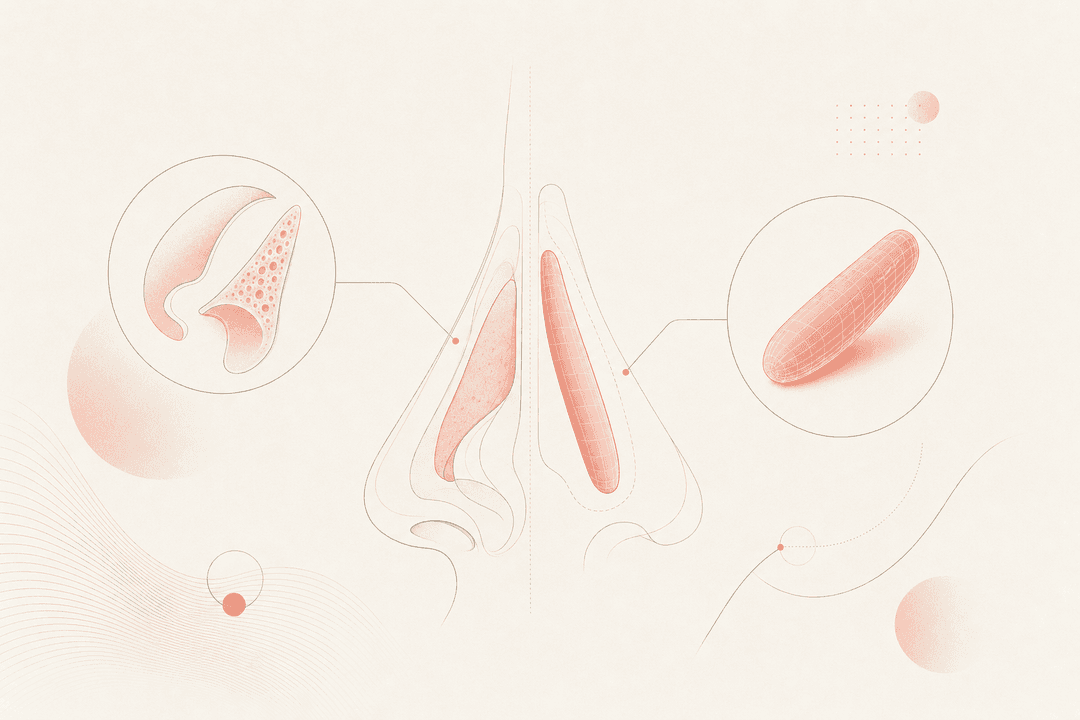
Autologous cartilage involves harvesting cartilage from the patient's ear, rib, or septum to reconstruct the nose. A 2023 report from the Korean Society of Plastic and Reconstructive Surgeons shows that the proportion of autologous cartilage use increased from 32% in 2018 to 49% in 2023.
Commonly used implants include silicone, Gore-Tex, and Medpor. Silicone is often used for nasal bridge augmentation, while Gore-Tex is frequently used for tip support. The FDA approved silicone implants in 1976 and Gore-Tex in 1993.
The advantage of autologous cartilage is its biocompatibility. As it's the patient's own tissue, the risk of foreign body reaction is low. However, it requires an additional incision at the harvesting site, and studies suggest an absorption rate of 10-20%.
Implants allow for shorter surgery times and precise achievement of desired height. However, long-term capsular contracture has been reported. A 2022 US clinical data study showed a 10-year capsular contracture rate of 8-12% for silicone implants.
Caution The absorption rate of autologous cartilage varies significantly among individuals. Some studies report that cartilage used for the nose tip can absorb 15-20% in the first six months before stabilizing. Initial overcorrection is often employed to compensate for this.
- The proportion of autologous cartilage use increased from 32% in 2018 to 49% in 2023.
- Autologous cartilage absorption rate is 10-20%, stabilizing after absorbing 15-20% in the first 6 months.
- Capsular contracture rate for silicone implants after 10 years is 8-12% (US 2022).
Why Customized Design Has Become the Standard
Until the early 2010s, rhinoplasty often aimed for a "Western-style high nose bridge" as the standard. Currently, designs tailored to individual facial proportions are mainstream.
A 2024 survey by the Korean Society for Aesthetic Plastic Surgery found that 78% of respondents desired "natural correction," while only 22% wanted "significant changes." In 2015, this ratio was reversed at 55% vs. 45%.
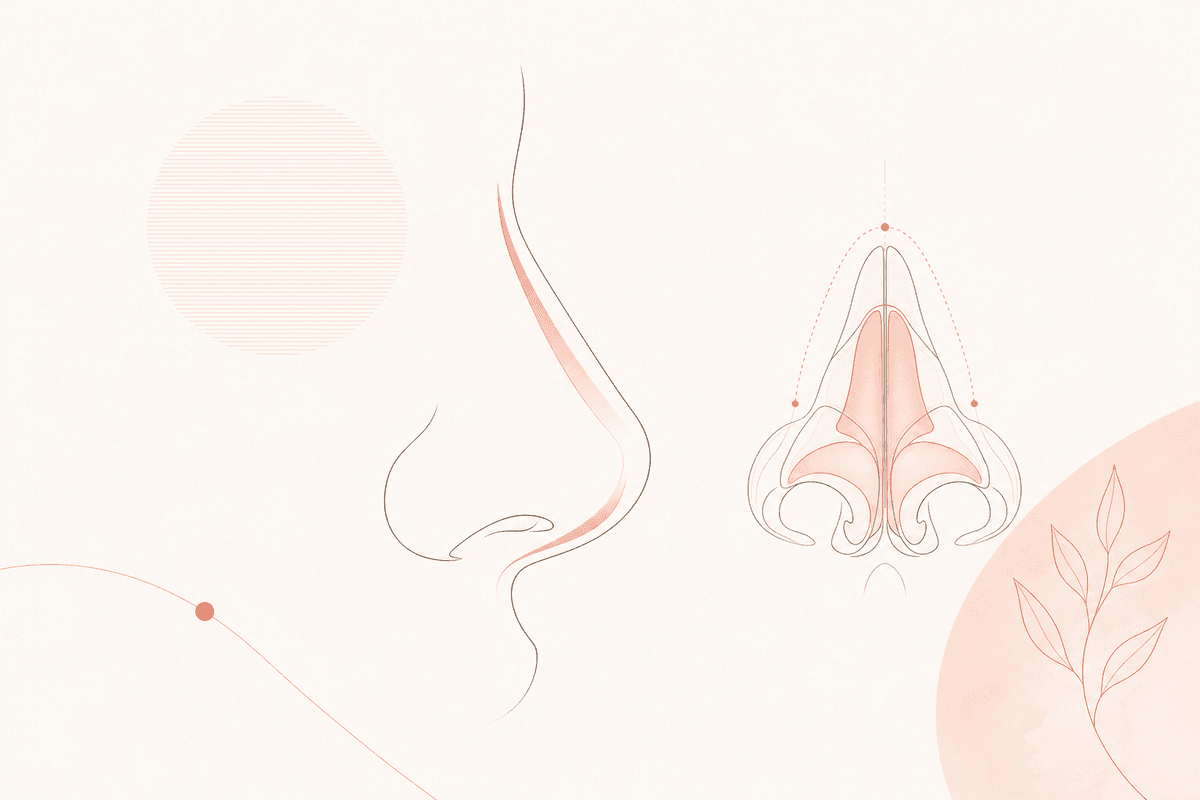
Customized design is based on the E-line (connecting the glabella, nose tip, and chin) and the ratio of nasal dorsum height to facial length. Generally, the ideal E-line for Asians is considered when the nose tip is positioned 1-2mm behind the line.
3D CT analyzes facial bone structure to calculate the safe range for nasal bridge augmentation. Skin thickness, nasal bone width, and septum condition are all considered.
- Preference for "natural correction" increased from 55% in 2015 to 78% in 2024.
- Based on the E-line, the ideal position for the nose tip for Asians is 1-2mm behind the line for a natural look.
- 3D CT analyzes skin thickness, nasal bone width, and septum condition for design.
Key Takeaways: 3 Transitions That Shaped the Trend
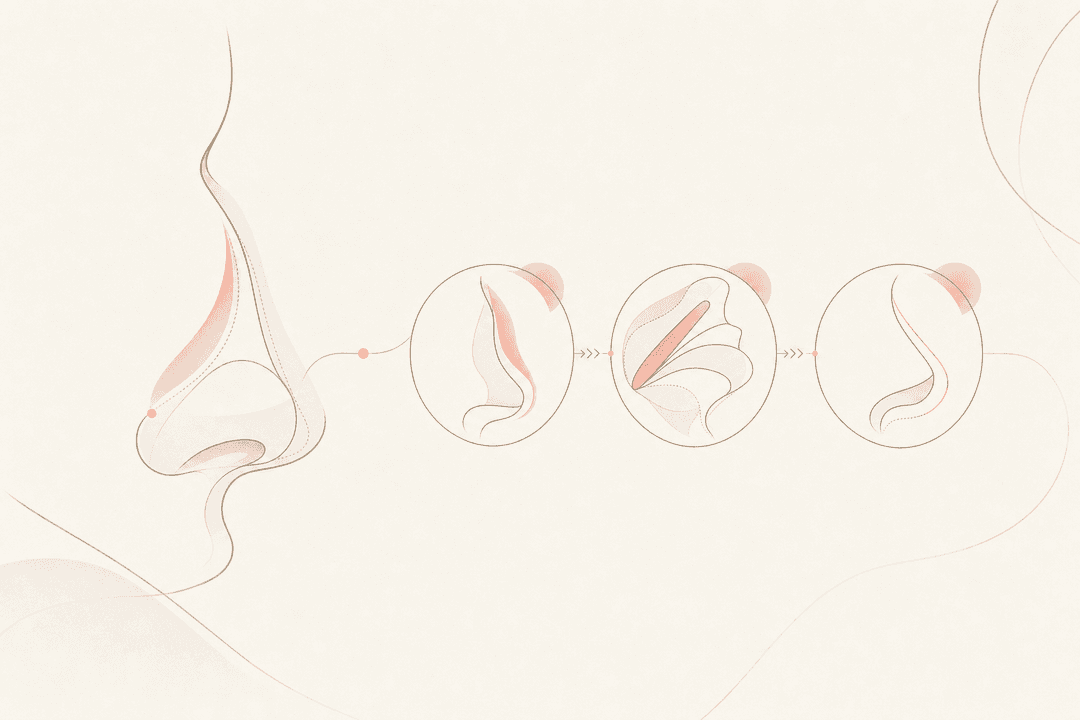
The surge in rhinoplasty in 2025 is a result of the convergence of changes in technology, aesthetic consciousness, and accessibility. 3D simulations have improved the accuracy of outcome prediction, and non-incisional options have reduced the burden of recovery.
The standard for naturalness has shifted from a uniform height to a focus on individual facial proportions. This change is linked to the SNS selfie culture and reflects the demand to avoid results that look good only from "certain angles."
- When choosing rhinoplasty, check 3D simulation, non-incisional options, and the proportion of autologous cartilage use first.
- The standard for naturalness is concretized by three factors: E-line, nasolabial angle, and facial proportions.
- Prioritize non-incisional for faster recovery, and incisional for permanent results.
Non-incisional vs. Incisional Rhinoplasty Comparison
Non-incisional (Threads + Fillers) [Fast Recovery]
- Recovery: 3-5 days
- Duration: 12-18 months
- Revision needed
- No scarring
Quick return to social life, but requires regular touch-ups.
Incisional (Implants) [Permanent Results]
- Recovery: 10-14 days
- Duration: Semi-permanent
- No revision needed
- Incision inside nostrils
Longer initial recovery period, but long-term maintenance.
Incisional (Autologous Cartilage) [Biocompatible]
- Recovery: 10-14 days
- Duration: Semi-permanent
- Absorption rate: 10-20%
- Additional harvesting site
Minimizes foreign body reaction, compensates for absorption with initial overcorrection.
Rhinoplasty Selection Guide by Situation
If you need to return to work within a week
Consider non-incisional rhinoplasty (threads + fillers) first
With a recovery of 3-5 days, the bruising and swelling management period is short, allowing for a quick return to social life.
If you are in your early 20s and getting rhinoplasty for the first time
Choose a clinic that mandates 3D simulation
You can reduce the risk of overcorrection by previewing changes in facial proportions beforehand.
If you desire permanent results and have a budget of over 3 million KRW
Incisional rhinoplasty with autologous cartilage
It offers high biocompatibility and long-term maintenance without revision, but requires securing an initial recovery period.
If you only want to slightly enhance your nasal bridge
Non-incisional filler-only procedure
If only the nasal bridge needs correction without altering the tip, it can be done with a recovery of 2-3 days and a cost of 500,000-800,000 KRW.
Common Misconceptions
Misconception Rhinoplasty is always more beautiful when it's higher.
Truth A 2024 survey showed that 78% preferred natural correction, indicating that designs tailored to individual facial proportions lead to higher satisfaction. According to the E-line standard, a nose tip positioned 1-2mm behind the line is considered natural.
Misconception Non-incisional rhinoplasty has weak effects.
Truth The duration of non-incisional rhinoplasty is 12-18 months, and it can sufficiently correct nasal bridge height by 2-3mm. However, for permanent results, incisional surgery is more suitable.
Pre- and Post-Rhinoplasty Precautions
- Avoid wearing glasses for 2 weeks after surgery – pressure on the nasal bridge can shift the implant.
- Refrain from facial massages and saunas for 72 hours after non-incisional procedures – risk of thread displacement before fixation.
- !!Smoking delays healing due to reduced blood flow; mandatory to quit smoking for at least 2 weeks before and after surgery!!
- Be careful to avoid impacts or collisions to the nose – avoid strenuous exercise and contact sports for 3 months post-surgery.
- ==Pain at the autologous cartilage harvesting site (ear/rib) may persist for 1-2 weeks; confirm pain medication prescription.==
Frequently Asked Questions
Is there an extra charge for 3D simulation?
Most clinics include it in the consultation fee or offer it for free. Some charge a consultation fee of 100,000-200,000 KRW, which is deducted if you proceed with surgery.
Can I go back to work immediately after non-incisional rhinoplasty?
Same-day return to work is difficult due to immediate bruising and swelling. A recovery period of 3-5 days is generally recommended, and makeup can cover the results sufficiently after about 5 days.
Does harvesting autologous cartilage change the shape of the ear?
Since cartilage is harvested from behind the ear, there is almost no visible change in the ear's outer appearance. Scars from the harvesting site are hidden within the folds behind the ear and are not noticeable.
Can implants be removed at any time?
Yes, but if it has been more than 6 months since insertion, a capsule may have formed, requiring additional recovery time for removal. The nose shape may not return to its original state after removal.
What are the most common side effects of rhinoplasty?
Short-term effects include bruising, swelling, and asymmetry, most of which resolve within 2-4 weeks. Long-term issues reported include implant capsular contracture (8-12%) and autologous cartilage absorption (10-20%). Infection and bleeding occur in less than 1% of cases, but require immediate hospital visit if they occur.
What is the revision surgery rate?
A 2023 report by the Korean Society of Plastic and Reconstructive Surgeons indicated a revision surgery rate of approximately 15% within 5 years of the primary surgery. The reasons for revision surgery were, in order, asymmetry, dissatisfaction with height, and implant displacement.
Lumi's Note
The reason rhinoplasty is booming in 2025 is ultimately because technology now allows us to achieve "naturalness that fits my face." While 3D simulations and non-incisional options have broadened the choices, what's truly important is knowing clearly what results you desire. There's no single method that's perfect for both recovery time and duration, so prioritize what matters most and consult with a professional. You've likely put a lot of thought into this, and I'm rooting for you to make the best choice!
This content is for informational purposes only and does not substitute for medical advice. Always consult with a specialist before undergoing any procedure.