Complete Analysis of 3 Forehead Lift Surgery Methods 2025
K-Dia Editor5,17225 min read
Forehead lift surgical methods are classified into coronal, endoscopic, and direct incisions depending on the location and extent of the incision, each with distinctly different suitability and recovery periods. Since its introduction in Korea in 2003, the endoscopic forehead lift has been the most preferred method among office workers in their 30s and 40s, as it allows for fascial layer dissection while minimizing scarring. A comprehensive assessment of the degree of eyebrow sagging, forehead height, and hairline position is required, and…
Information as of June 2026
From Incision Method to Endoscopy
3 Key Methodologies
Difference in Recovery Period: 7-21 Days
Domestic Introduction of Endoscopy: 2003
Forehead Lift: It’s All About Where and How You Lift
The most common misconception heard in the clinic is, “Aren’t all forehead lifts similar surgeries?” A 3cm difference in incision location changes the results and recovery period by more than 30%.
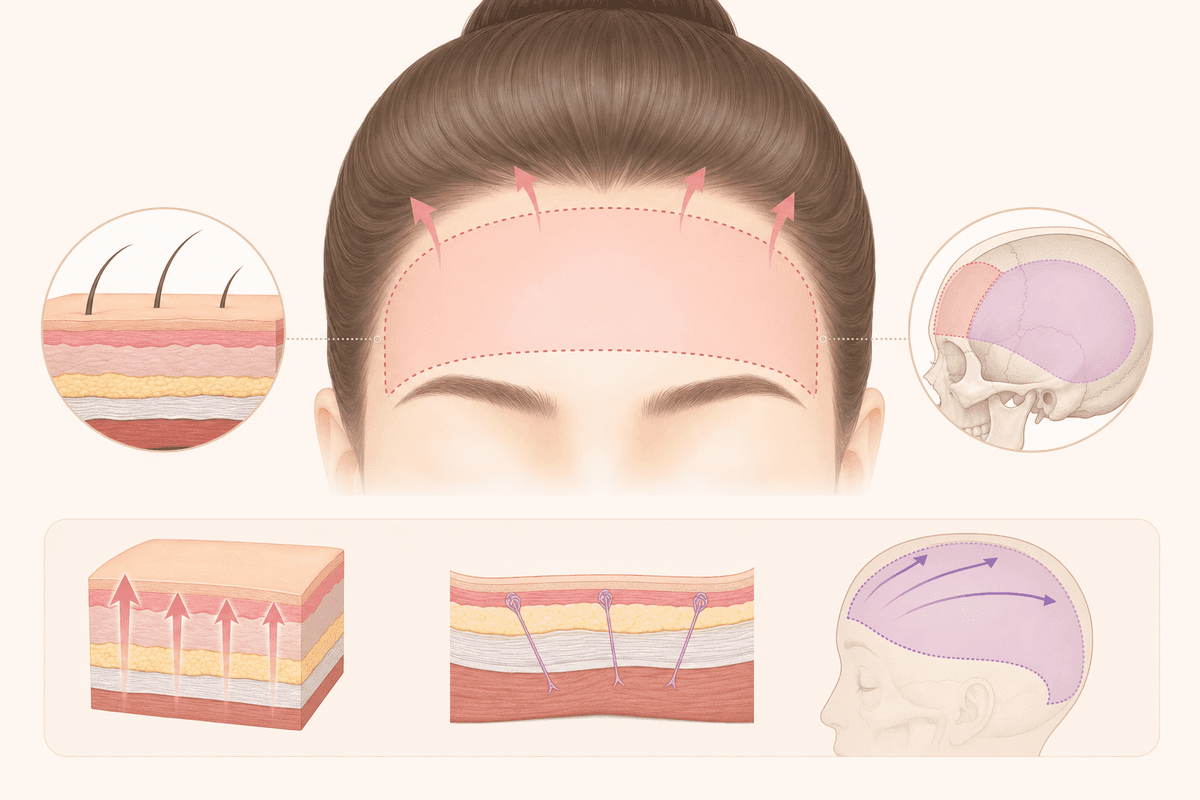
Forehead lift surgical methods are broadly classified into three types: **Coronal Lift**, **Endoscopic Lift**, and **Direct Brow Lift**. Each method differs completely in incision location, dissection range, and fixation method.
According to statistics from the Korean Society of Aesthetic Plastic Surgery as of 2025, the endoscopic method accounts for approximately 62% of all forehead lifts, while the coronal lift accounts for 15% and the direct lift for 23%. These ratios fluctuate annually depending on patient age groups and requirements.
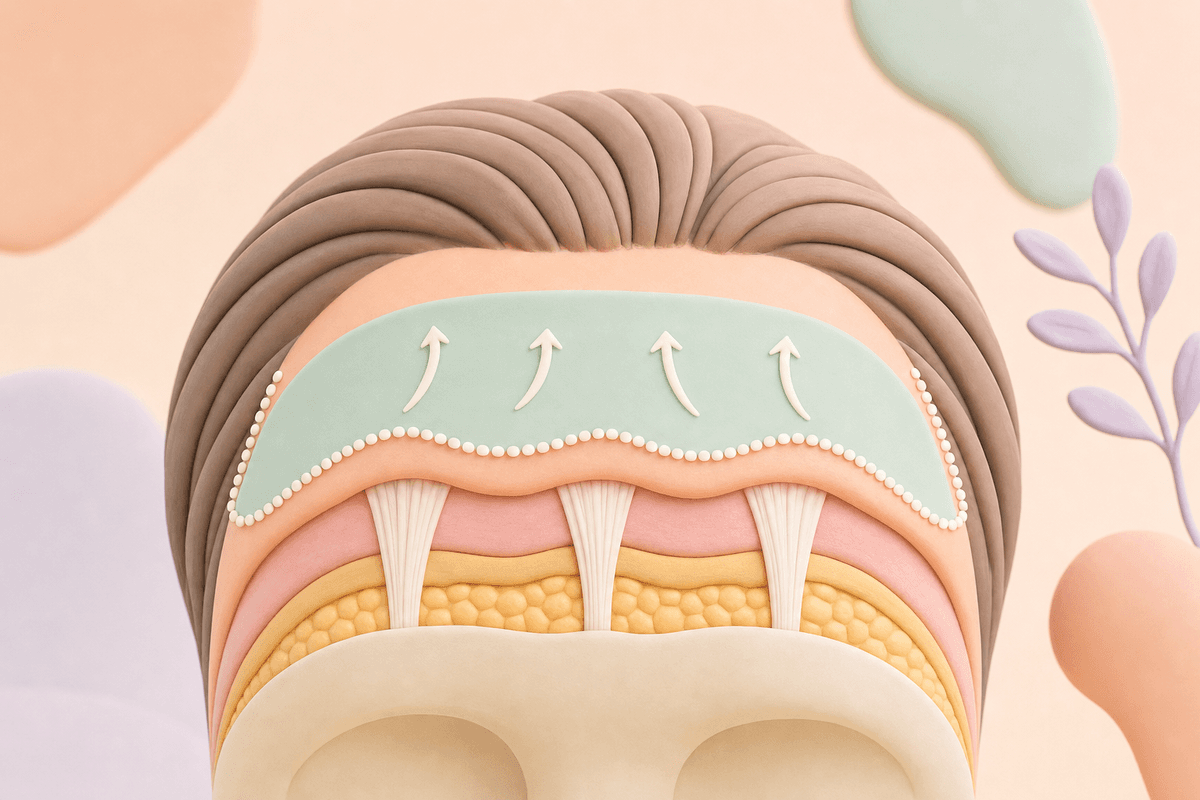
The key to choosing a surgery is not 'how much to lift,' but 'which layer to separate and where to fix it.' If only the skin is pulled, recurrence is rapid, and long-term maintenance is possible only if the SMAS layer is dissected as well.
Even for the same 'forehead lift,' the scar location, anesthesia time, and recovery period differ by more than double depending on the incision location. First, identify your hairline height and eyebrow sagging pattern.
Coronal Lift — Maximum Lift, Long Recovery
Coronal Lift is a method that involves making a long curved incision from above the ear to above the ear, starting 5-7 cm behind the hairline.** Although it is a classic method used since the 1970s, it is still chosen when the forehead height needs to be significantly lowered or the eyebrows need to be raised by more than 5mm.
The incision line is long, resulting in a wide dissection range and extensive separation of the subperiosteal or subfascial layers. Since the entire forehead is pulled backward and fixed, the **elevation range is the largest at 5-8mm**.
The disadvantages are that the recovery period is long, ranging from 14 to 21 days, and scalp numbness may persist for 3 to 6 months. According to a 2022 report by the Korean Society of Plastic and Reconstructive Surgeons, approximately 18% of patients who underwent coronal incision experienced temporary sensory loss.
It is suitable for cases where the hairline is low (less than 5cm) or where the forehead height needs to be reduced while the eyebrows are raised simultaneously. Conversely, for people who already have a high forehead (6cm or more), the endoscopic method is recommended because the incision line is noticeable.
Incision length: 20-25cm (both above the ears)
Recovery period: 14-21 days (based on complete disappearance of swelling)
Lift height: 5-8mm (based on eyebrows)
Duration of paresthesia: Average 4-5 months
Endoscopic Brow Lift — Why Korean Office Workers Choose It
Endoscopic Brow Lift is a method in which **3-5 incisions of 1-1.5cm are made inside the hairline, and the dissection process is monitored in real-time using an endoscopic camera**. It was officially introduced in Korea in 2003 and is currently the most preferred method among people in their 30s and 40s.
The incision is small, so the scar is barely visible, and the recovery period is short, ranging from 7 to 10 days. Since dissection is performed using an endoscope (4mm diameter, using equipment such as the Karl Storz Hopkins II) to avoid blood vessels and nerves, there is less bleeding and bruising.
Dissection is performed at the subperiosteal or subfascial layer, and the forehead tissue is fixed using a biodegradable fixation device such as Endotine®. Endotine is made of polylactic acid (PLA), which received FDA approval in 2004, and is gradually absorbed over 6 to 8 months.
The elevation is 3 to 5mm, which is smaller than that of a coronal incision, but it is suitable for office workers who desire a natural improvement. However, the effectiveness is limited if the forehead height is already high (6.5 cm or more) or if there is severe skin sagging.
In clinical endoscopy, the 'precise depth of dissection' is just as important as the 'small incision.' If the dissection is performed too deeply subperiosteally, there is a risk of forehead paresthesia, and if it is performed too shallowly, recurrence occurs quickly. Skill level determines the results.
Item
Endoscopic method
Coronal incision method
Number of incisions
3-5
1 (long curve)
Incision length
Each 1-1.5cm
20-25cm
Recovery Period
7-10 days
14-21 days
Elevation Range
3-5mm
5-8mm
Frequency of Paresthesia
Approx. 5%
Approx. 18%
Direct Incision Method — Just above the eyebrow, local improvement
Forehead Lift — Direct Incision Method — Just Above the Eyebrows, Local Improvement
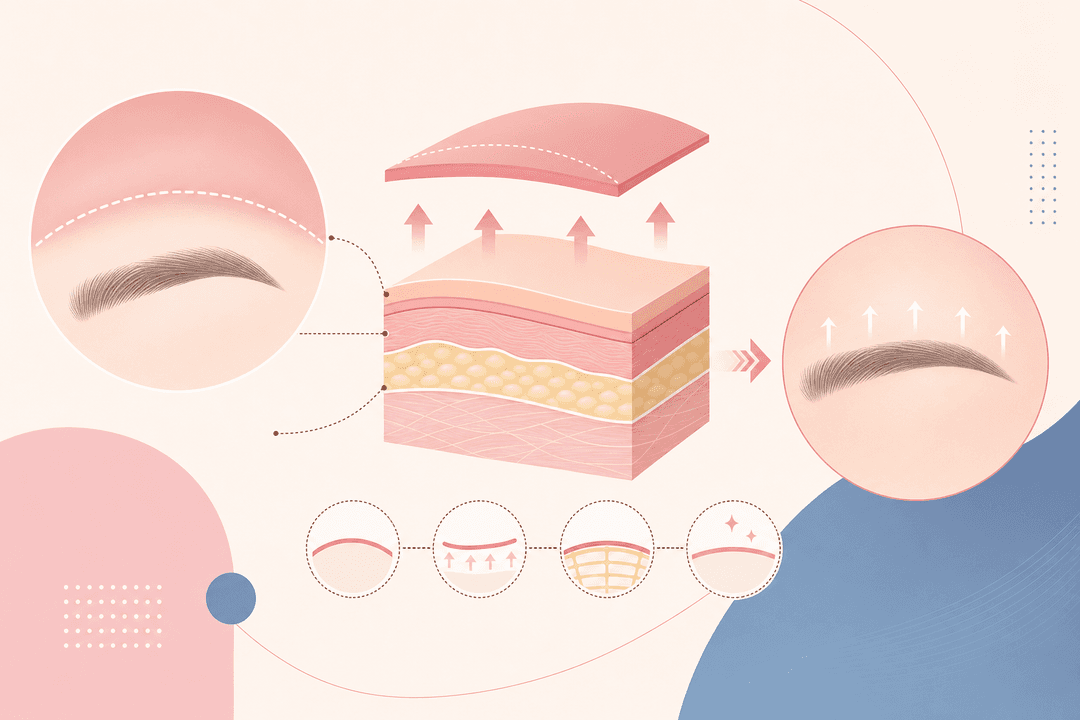
The Direct Brow Lift is a method that involves **making an incision 2-3 cm just above or below the eyebrows to remove excess skin**. Since it focuses on lifting only the eyebrows rather than the entire forehead, it is also called a 'partial lift'.
The surgery time is the shortest at 30-40 minutes and can be performed under local anesthesia. Recovery is fast, allowing you to return to daily life in 5-7 days, but since the incision is located near the eyebrows, the **scar may be relatively noticeable**.
It is mainly recommended for the elderly (60s and older) or male patients. Men often have thick eyebrows that can conceal the scar, and the elderly frequently desire rapid improvement without the burden of general anesthesia.
The disadvantage is that the forehead wrinkles themselves are not improved, and since only the eyebrows are lifted, the overall harmony may be compromised. To improve both the forehead and eyebrows together, the endoscopic method or the coronal incision method is suitable.
Surgery Time: 30-40 minutes
Anesthesia: Local anesthesia available
Recovery Period: 5-7 days
Scar Location: 2-3 cm above or below the eyebrows
Which method is right for me? — 4-Point Checklist
When determining suitability for a forehead lift, you must consider four factors: **forehead height, degree of eyebrow sagging, skin elasticity, and hairline position**. Deciding on surgery simply because of "many wrinkles" carries a risk of overcorrection.
**Forehead height 5.5cm or less + low hairline**: Consider the coronal incision method. The incision line is hidden behind the hairline, allowing you to lower the forehead while raising the eyebrows.
**Forehead height 6-7cm + eyebrow sagging 3-4mm**: The endoscopic method is optimal. It results in small scars and fast recovery, making it suitable for office workers.
**Over 60 + eyebrow sagging only + burden of general anesthesia**: Consider the direct incision method. However, scar management (application of silicone gel, sun protection) must be continued for at least 3 months.
**Good skin elasticity + only wrinkles**: Non-surgical procedures such as Botox (Botox, 20-30U glabella/forehead) or fillers (Restylane, Juvederm 0.5-1cc temporal area) may be more effective. Consider surgery only when there is structural sagging.
Tip There are specific hospitals with strong recovery care and forehead lift surgical methods tailored to your case — Check out hospitals offering 1:1 consultations on K-Dia.
72 Hours Post-Surgery — The Golden Time That Determines Results
Forehead Lift — 72 Hours Post-Surgery — The Golden Time That Determines Results
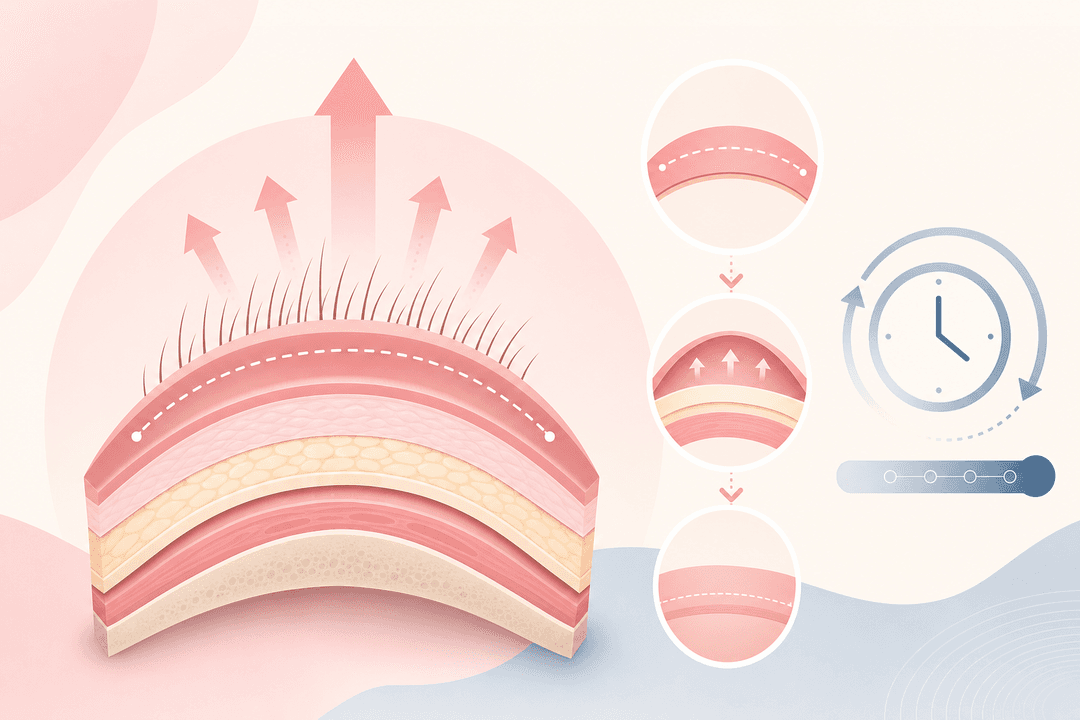
The first three days after a forehead lift determine half of the recovery. During this period, the dissected tissue is fixed in its new position, and most complications, such as hematomas or infections, occur at this time.
**Day of Surgery ~ 48 Hours**: Keep your head elevated above your heart (using 2-3 pillows) and apply cold compresses for 10 minutes every hour. Do not remove the forehead compression bandage without instructions from medical staff.
**48-72 Hours**: Showering is permitted, but be careful to avoid direct contact of water with the incision site. You must continue taking KFDA-approved antibiotics (cephalosporins or fluoroquinolones) without fail to reduce the risk of infection to less than 1%.
**7-10 Days**: Time for suture removal. While absorbable sutures are sometimes used in the endoscopic method, the coronal incision method mostly uses non-absorbable sutures, which are removed on days 7 to 10. Please begin scar management (silicone sheets, UV protection) after removal.
Elevated blood pressure during recovery (vigorous exercise, sauna, drinking) increases the risk of hematoma by 3 to 5 times. For 2 weeks after surgery, avoid activities that raise your heart rate above 120 bpm, and as a general rule, refrain from drinking alcohol for at least 3 weeks.
Caution: Hospitals with lax recovery management have unstable outcomes. Carefully check and select the aftercare system at K-Dia.
Cold compress frequency: 10 minutes every hour, for the first 48 hours
Antibiotics: 5-7 days (based on doctor's prescription)
Suture removal: 7-10 days (varies depending on incision method)
Resumption of exercise: Light walking after 2 weeks, strength training after 4 weeks
Comparison of the 3 Major Forehead Lift Methods
Endoscopic Method [Most Chosen by Office Workers]
3-5 Incisions (1cm each)
Recovery 7-10 days
Elevation 3-5mm
Scar is barely visible
For ages 30-40, forehead height around 6cm, when natural improvement is desired
Coronal Incision [Maximum Elevation]
Long curved incision 20-25cm
Recovery 14-21 days
Elevation 5-8mm
Risk of paresthesia 18%
When forehead lowering + eyebrow raising are needed simultaneously
Direct Incision Method [Local Anesthesia Possible]
Incision above eyebrow 2-3cm
Recovery 5-7 days
Eyebrow only lifted
Scar is noticeable
Over 60, or when general anesthesia is burdensome
Common Misconceptions
Misconception All forehead lifts are similar, and you just need to choose the right hospital
Truth A 3cm difference in incision location completely changes the recovery period and scar location. Even for the same 'forehead lift,' recovery is required for a coronal incision (21 days), an endoscopic method (10 days), and a direct incision (7 days). To ensure high satisfaction without the need for revision surgery, you must first identify your forehead height, hairline position, and eyebrow sagging pattern, and then select the appropriate method.
Misconception Endoscopy is always better because it is the latest technology
Truth The endoscopic method leaves smaller scars and allows for faster recovery, but the elevation is limited to 3-5mm. If eyebrows are severely sagging (6mm or more) or if the forehead height needs to be lowered simultaneously, the coronal incision method may be more suitable. It is not 'latest=best', but 'the best method suited to my structure'.
Absolute contraindications before and after forehead lift
Discontinue anticoagulants such as aspirin, Omega-3, and ginkgo biloba starting 2 weeks before surgery (risk of bleeding increases 3-fold)
Do not lie with your head low or face down for 48 hours after surgery (risk of hematoma)
Avoid saunas, steam rooms, and hot showers for 2 weeks after surgery (worsens swelling, sutures may separate)
Absolutely no alcohol for 3 weeks after surgery (vasodilation → bleeding/infection)
Avoid contact with cosmetics or hair dye on the incision site before suture removal (risk of infection)
Frequently Asked Questions Question
Endoscopic forehead lift and coronal incision, which leaves less scarring?
The endoscopic method leaves smaller, more prominent scars. There are 3 to 5 incisions, each 1-1.5 cm in size, which are hidden inside the hairline and are barely visible from the outside. The coronal incision creates a long incision line of 20-25 cm, but it is located 5-7 cm behind the hairline and is not visible unless the hair is tied up. If you have a predisposition to scarring (keloid tendency), please consult with the medical team beforehand.
When can I wash my hair after surgery?
You can wash your hair 3-4 days after surgery for the endoscopic method and 7 days after surgery for the coronal incision method. However, please be careful not to let water touch the incision site directly, and do not rub soap vigorously. Use a mild shampoo (pH around 5.5), and as a general rule, use a hairdryer on cool air mode while maintaining a distance of at least 20cm.
Can the eyebrow shape become unnatural after a forehead lift?
Overcorrection can result in an unnatural eyebrow position, resembling a 'surprised expression.' This problem occurs particularly in endoscopic procedures if the fixation device (Endotine) is installed too high. It is important to clearly agree on the target elevation range (3-5mm vs. 5-8mm) with the medical team before surgery and to plan a procedure that considers your facial proportions (eyebrow-eye distance, forehead-face ratio).
Can I get a forehead lift and Botox together?
You should avoid Botox for at least 4 weeks after surgery. If Botox induces muscle relaxation during the tissue fixation process immediately after surgery, the fixation strength may weaken. Conversely, there is no problem if you receive Botox up to 2-3 weeks prior to surgery. In the long term, Botox maintenance is possible starting 6 months after the forehead lift.
What are the possible side effects after a forehead lift?
The most common side effects are temporary paresthesia (5-18%, varying by method) and hematoma (1-2%). With the coronal incision method, scalp sensation may remain dulled for 3-6 months, and hair loss (1-2 cm around the incision line) may rarely occur. The endoscopic method is relatively safe, but asymmetry may occur due to misalignment of the fixation device. Infection occurs in less than 1% of cases due to antibiotic use; however, any side effects must be addressed early by communicating immediately with a specialist to prevent long-term complications.
When can I return to work?
You can return to work after 7-10 days for the endoscopic method and after 14-21 days for the coronal incision method. However, since swelling and bruising do not completely disappear at this stage, it is safer to allow 2-3 weeks of buffer time if you have a lot of in-person work. If working from home is possible, there are cases where patients return to work starting from the 5th day following the endoscopic procedure.
This content is for informational purposes only and does not replace medical advice. The most suitable method for a forehead lift varies depending on an individual's forehead height, hairline position, and skin elasticity, and effectiveness and recovery periods differ from person to person. Please be sure to consult thoroughly with a board-certified plastic surgeon before surgery and select the method that is right for you.