Comparative Analysis of 3 Breast Augmentation Methods: Implants vs. Fat Grafting vs. Combination
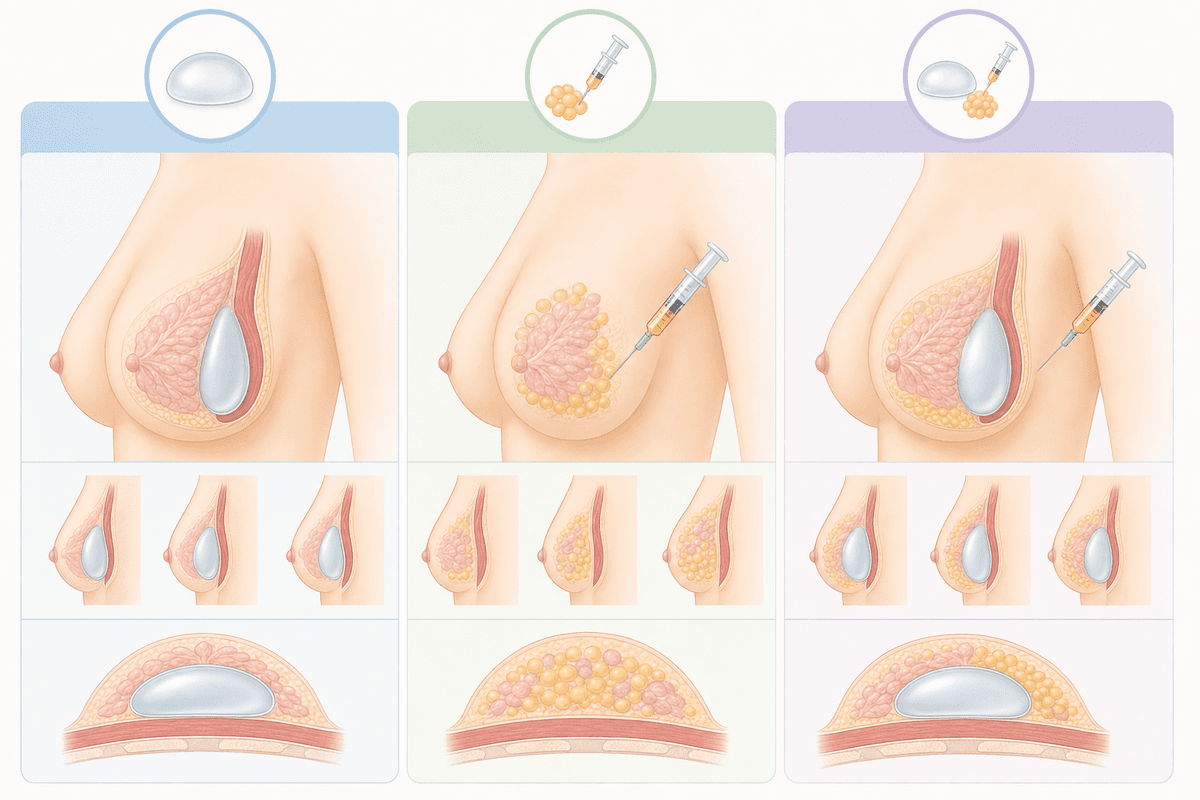
Tactile sensation and the rate of capsular contracture vary by 20–40% depending on the implant insertion site (supermuscular, inframuscular, or dual plane), and body type and tissue thickness are the selection criteria. Fat grafting is limited to 50–150cc per session, and repeated procedures are generally performed 2–3 times; a 5–15% incidence of calcification and cysts must be considered. In combination breast augmentation, fat is added 3–6 months after implant insertion to enhance naturalness…
Information as of June 2026
Selection Criteria by Insertion Site and Material
- Over 8 types of implants
- Average fat graft survival rate of 60-80%
- 30% difference in tactile sensation based on insertion site
Most Frequent Question in Consultations: 'Which method is right for me?'
During consultations, 70% of patients first ask about 'comparing breast augmentation methods.' However, most have never had their breast tissue thickness or rib cage width measured. The choice of method is determined by anatomical conditions, not desired size.
According to 2023 data from the Korean Society of Plastic and Reconstructive Surgeons, 83% of breast augmentations in Korea use implants, 12% use fat grafting, and 5% use a combined approach. However, these ratios reflect suitability rather than patient preference.
This article compares three methods—based on insertion site, material, recovery, and cost—using 15 years of clinical data. To find your ideal case, first check your tissue thickness, rib cage shape, and lifestyle.
Key Takeaway If breast tissue thickness is less than 15mm, consider submuscular insertion; if over 20mm, consider subglandular or fat grafting. Deciding on a method without measurement reduces tactile satisfaction by 30%.
Implant Breast Augmentation: Insertion Site Determines 60% of the Outcome
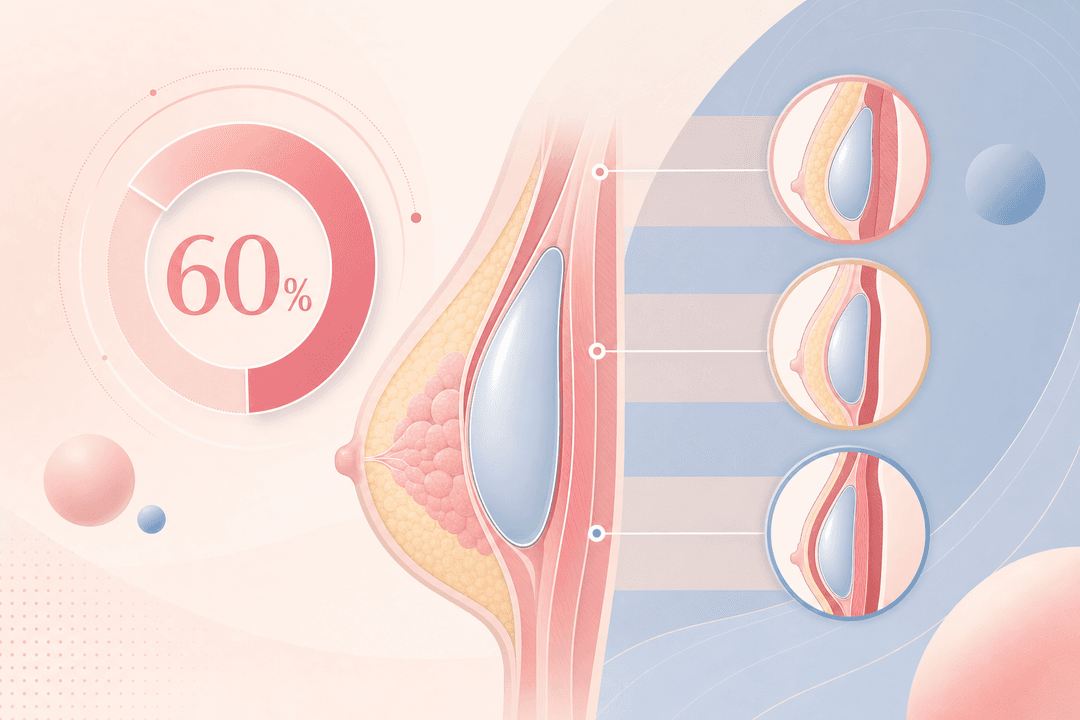
Implants are categorized into three types based on insertion site: subglandular (over the breast tissue), submuscular (under the pectoralis major muscle), and dual plane (upper part under the muscle, lower part over the muscle). Each has different tactile sensations, capsular contracture rates, and recovery periods.
Subglandular augmentation offers faster recovery (2 weeks) and a natural shape, but implant edges can be palpable if the tissue is thin. A 2022 FDA report indicated capsular contracture rates of 12% for subglandular and 8% for submuscular placement.
Submuscular placement results in a softer feel and lower capsular contracture rates, but involves significant pain from pectoralis muscle dissection (4 weeks) and a risk of implant displacement for those with active professions. Dual plane combines the advantages of both but requires experienced surgeons due to its complexity.
Implant material is also crucial. Cohesive gel (high-consistency silicone) maintains its shape well but feels slightly firmer. Teardrop-shaped (anatomical) implants create a natural slope but carry a risk of asymmetry if rotated, necessitating a textured surface.
Popular products in Korea include Mentor MemoryGel, Motiva Ergonomix, and Sebbin Round. Based on 2020 MFDS approval, all have secured long-term safety data for over 10 years.
Clinical Insight Clinics that measure not only tissue thickness but also rib cage width, nipple position, and asymmetry using 3D CT achieve 25% higher patient satisfaction. Find clinics with precise measurement systems on K-Dia.
| Insertion Site | Recovery Period | Capsular Contracture Rate | Suitable Cases |
|---|---|---|---|
| Subglandular | 2 weeks | 12% | Tissue thickness over 20mm |
| Submuscular | 4 weeks | 8% | Thin tissue, less active professions |
| Dual Plane | 3 weeks | 9% | When ptosis correction is also needed |
Fat Grafting Breast Augmentation: Survival Rate and Repeat Sessions are Key Variables
Autologous fat grafting involves harvesting fat from areas like the abdomen or thighs, processing it via centrifugation, and injecting it into the breasts. Unlike implants, it feels natural with no foreign body sensation, but the amount injected per session is limited (50-150cc per side).
The average fat graft survival rate is 60-80%. Since 20-40% of the injected fat is absorbed within three months, 2-3 repeat sessions are common to achieve the desired volume. A 2021 study by the Korean Society for Aesthetic Plastic Surgery found only 35% of patients were satisfied after a single procedure.
Rates of calcification and cyst formation are reported at 5-15%. Over-injection can lead to necrosis of the central fat, causing calcification, which may be confused with findings on mammograms. This warrants caution for individuals over 40.
While studies suggest that combining with SVF (Stromal Vascular Fraction, concentrated stem cells) can increase survival rates by 10-15%, it has not yet received MFDS approval in Korea. Currently, mixing with PRP (Platelet-Rich Plasma) is the legal alternative.
Fat grafting is not suitable for those seeking more than a 1-2 cup increase or for individuals with very thin breast tissue who are concerned about implant visibility. However, it is effective for minor volume enhancement or for refining the contour after implant surgery.
Caution Mammography interpretation can be difficult for six months after fat grafting. If you are over 40 or have a family history of breast cancer, ensure you complete a breast examination before the procedure.
- Average fat graft survival rate 60-80%, with individual variation of ±20%
- Injection volume per session 50-150cc per side; 2-3 sessions are common
- Calcification rate 5-15%, increasing with over-injection
- SVF combination reported to increase survival rate by 10-15%
Combined Breast Augmentation: Synergy and Risks of Implants + Fat Grafting
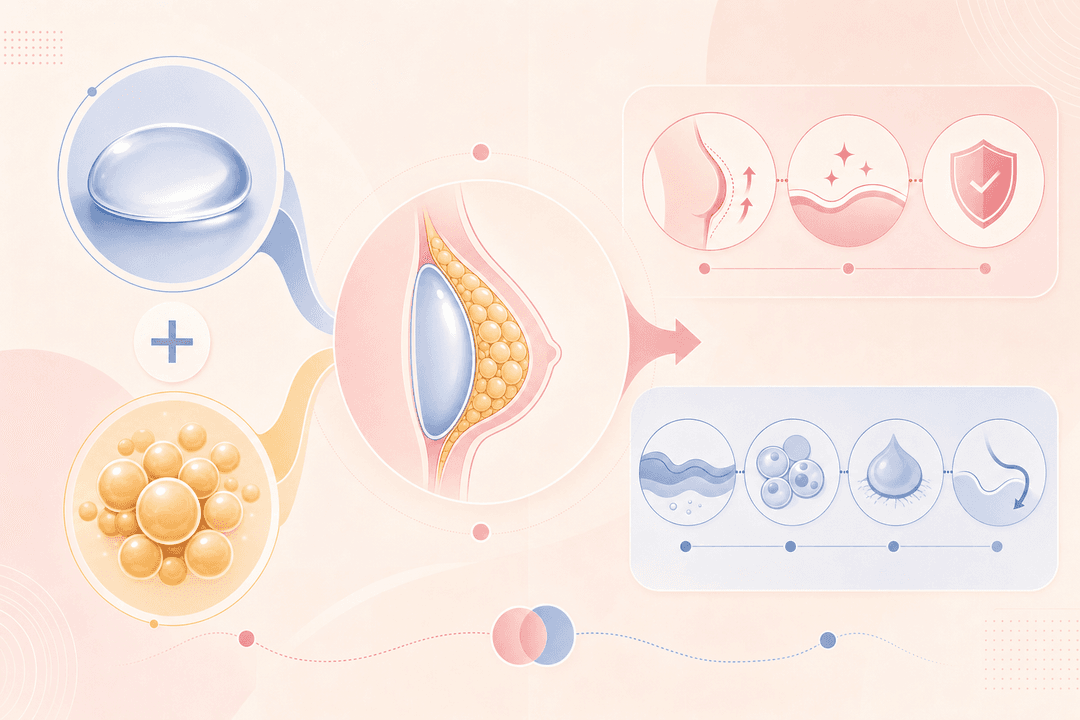
The combined approach involves a two-stage process: first, implants are used to create basic volume, and then, 3-6 months later, fat grafting is performed to refine the contour. Fat is added to areas like the upper breast or inframammary fold where implant edges might be palpable, enhancing naturalness.
A 2020 study in Aesthetic Surgery Journal found that the combined approach resulted in 28% higher tactile satisfaction and a 12% lower revision rate compared to implants alone. However, the total cost increases by 1.8-2 times, and recovery time doubles.
It is important to note that injecting fat immediately after implant placement increases the risk of capsular contracture. Fat grafting should only be performed after a minimum interval of three months, once the tissues have stabilized.
The combined approach is suitable for 'those with thin breast tissue who desire larger breasts' or 'slender individuals concerned about implant visibility.' However, it may not be an option if there is insufficient fat for harvesting.
Tip For the combined approach, a strategic option is to revisit K-Dia 3-6 months after the primary implant surgery, once recovery is complete, to find a clinic experienced in fat grafting. Some clinics specialize in secondary procedures.
Selection Criteria by Case: 3 Variables—Body Type, Age, and Lifestyle
For slender individuals in their 20s (BMI under 18), submuscular implant placement is safer due to thin tissue, but requires tolerance for a longer recovery period (4 weeks) and pain. Fat grafting is not recommended due to insufficient donor sites.
Individuals in their 30s with a standard body type (BMI 20-23) have a wider range of options. For a 1-2 cup increase, subglandular implants are recommended. For prioritizing naturalness, 2-3 sessions of fat grafting are considered. For both larger volume and naturalness, the combined approach is an option.
For those over 40, skin laxity and mammogram screening schedules must be considered. If ptosis is significant with implants alone, a breast lift may be necessary. For fat grafting, the risk of calcification requires consideration of mammogram schedules (every 2 years).
For professions that heavily utilize chest muscles, such as athletes or Pilates instructors, submuscular implant placement carries a risk of displacement. In such cases, subglandular or dual plane placement is more stable.
If you plan to have children, implants have minimal impact on breastfeeding (less than 5% risk of duct damage). However, calcification within the glandular tissue after fat grafting can cause discomfort during breastfeeding, so it is recommended to have the procedure after childbirth.
| Age/Body Type | 1st Recommendation | 2nd Alternative | Precautions |
|---|---|---|---|
| 20s, Slender | Submuscular Implants | Dual Plane | Requires 4 weeks recovery |
| 30s, Standard Build | Subglandular Implants or Fat Grafting | Combined Approach | Depends on desired size |
| 40s and Over | Subglandular + Mastopexy | Implants + Fat Grafting | Breast exam first |
| High-Activity Professions | Subglandular | Fat Grafting | Avoid submuscular |
Recovery, Cost, and Long-Term Maintenance: A Realistic Check of Each Method
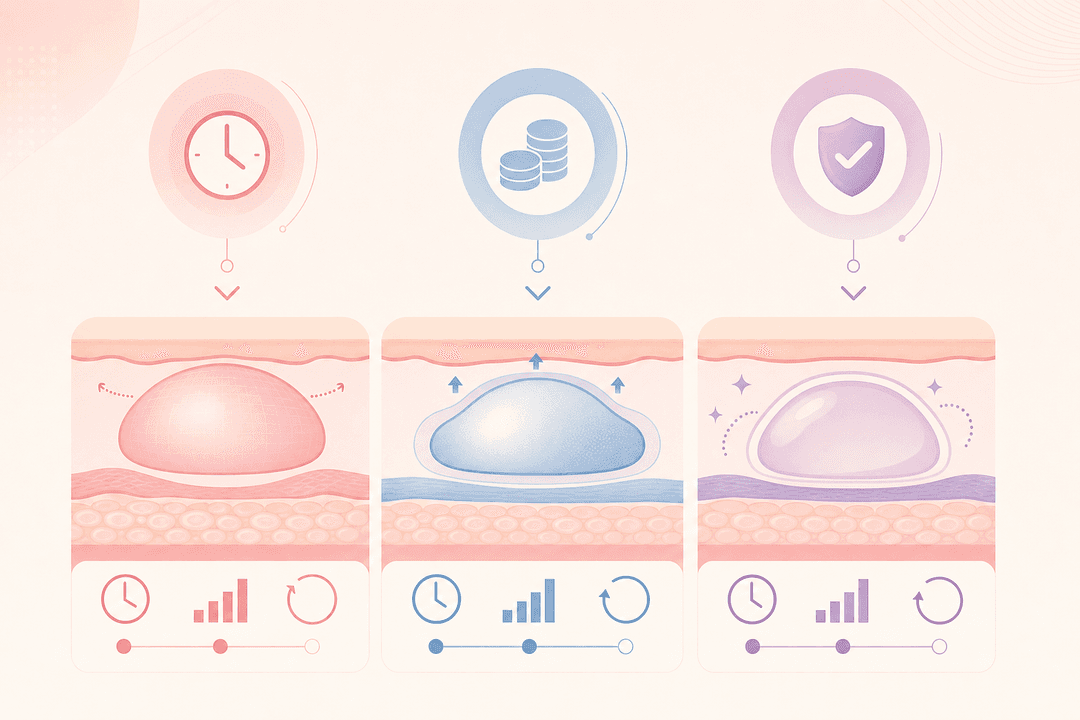
With subglandular implants, you can return to daily activities after 2 weeks, while submuscular placement requires 4 weeks. Fat grafting takes about 1 week, but with 2-3 repeat sessions, the total recovery period extends to 3-6 months. The combined approach requires double the recovery time.
As of 2024 in Seoul, costs are as follows: implants alone range from 6-12 million KRW, fat grafting is 4-8 million KRW per session (total 12-24 million KRW for 2-3 sessions), and the combined approach costs 15-25 million KRW. Revision rates are 15% within 10 years for implants, and 60% require repeat fat grafting sessions.
Implant replacement is recommended every 10-15 years by manufacturers, but many cases last over 20 years. However, replacement surgery is necessary in cases of capsular contracture or rupture, and the cost is about 70% of the initial surgery.
Fat-grafted areas are semi-permanent once they survive, but breast volume will change with weight fluctuations. A loss of 5kg or more typically results in a 10-15% decrease in breast volume.
Long-term satisfaction varies greatly, but a 2019 follow-up study in Plastic and Reconstructive Surgery reported 5-year satisfaction rates of 78% for implants, 71% for fat grafting, and 84% for the combined approach. While the combined method shows higher satisfaction, the cost and recovery burden must be considered.
Key Takeaway While implants may seem cheaper initially, the cumulative cost of 2-3 fat grafting sessions can be similar or higher. Compare based on total cost, recovery time, and potential for repeat procedures.
- Subglandular implant recovery: 2 weeks; Submuscular: 4 weeks
- Fat grafting: 1 week per session, total 3-6 months for 2-3 sessions
- Cost: Implants 6-12 million KRW, Fat grafting total 12-24 million KRW, Combined 15-25 million KRW
- 5-year satisfaction: Implants 78%, Fat grafting 71%, Combined 84%
Key Comparison of 3 Breast Augmentation Methods
Implant Breast Augmentation [Immediate Volume]
- 1-3 cup increase with one surgery
- 2-4 weeks recovery (varies by site)
- Capsular contracture rate 8-12%
- Replacement recommended every 10-15 years
Suitable for those desiring larger size or a one-time completion.
Fat Grafting Breast Augmentation [Natural Feel]
- 50-150cc per session, 2-3 sessions needed
- 1 week recovery (cumulative 3-6 months)
- Survival rate 60-80%
- Calcification rate 5-15%
Prioritizes naturalness, for minor volume enhancement.
Combined Breast Augmentation [High-Level Naturalness]
- Implants + fat grafting 3-6 months later
- Total recovery 5-10 months
- Tactile satisfaction 28% higher
- Cost 1.8-2 times higher
For those with time and budget, seeking exceptional results.
Misconceptions
Myth Fat grafting is always better than implants because it's natural.
Truth Fat grafting is limited to 50-150cc per session, making more than a 1-2 cup increase impossible. With 2-3 repeat sessions, the total cost can exceed that of implants, and the unpredictable 60-80% survival rate makes outcomes uncertain. Implants are more efficient for significant volume enhancement.
Myth Implants must be replaced every 10 years.
Truth While manufacturers recommend replacement every 10-15 years, many implants last over 20 years without issues like rupture or capsular contracture. A 2019 FDA study showed a replacement rate of only 15% within 10 years. Regular check-ups are sufficient to monitor for any problems.
Must-Check Items Before Breast Augmentation
- Precise measurement of tissue thickness, rib cage width, and nipple position using 3D CT or ultrasound.
- For individuals over 40, completion of mammography before the procedure is essential—mammogram interpretation is difficult for 6 months post-fat grafting.
- Avoid over-injection (over 200cc) in a single fat grafting session—significantly increases risk of calcification and necrosis.
- Absolutely no chest muscle exercises (push-ups, bench presses) for 4 weeks after submuscular implant placement.
- Fat grafting for the combined approach is possible only after a minimum of 3 months post-implant placement—concurrent procedures increase the risk of capsular contracture.
Frequently Asked Questions
Is the difference in tactile sensation between implants and fat grafting really significant?
Submuscular implants offer a natural feel, but implant edges may be palpable if the tissue is thin. Fat grafting, being entirely autologous tissue, provides the most natural feel, but the 60-80% survival rate makes volume prediction challenging. The combined approach offers the highest tactile satisfaction but comes with higher costs and time commitment.
What is the total cost for 2-3 repeat sessions of fat grafting?
At 4-8 million KRW per session, the cumulative cost for 2-3 sessions ranges from 12-24 million KRW. This is more expensive than implants alone (6-12 million KRW), but it's an option for those who desire natural results without foreign materials. However, due to individual variations in survival rates, more than three sessions may be needed, requiring budget flexibility.
What happens if capsular contracture develops with implants?
Capsular contracture is the hardening of the tissue around the implant due to excessive scar tissue formation, occurring in 12% of subglandular and 8% of submuscular cases. Mild cases (Baker grades 1-2) are monitored, but severe cases (grades 3-4) require capsulectomy and implant replacement. Post-operative breast massage for three months and regular check-ups are important for prevention.
I exercise a lot; which method is safe for me?
For athletes or Pilates instructors who heavily use their chest muscles, submuscular implant placement carries a risk of displacement. Subglandular or dual plane placement is more stable, and fat grafting is also an alternative. Chest muscle exercises (push-ups, bench presses) must be avoided for at least 6 weeks post-surgery.
Does it affect breastfeeding after childbirth?
Implants have a less than 5% risk of duct damage, so most women can breastfeed. However, there is a slightly higher risk of duct damage with an inframammary fold incision. Calcification within the glandular tissue after fat grafting can cause discomfort during breastfeeding, so it is recommended to have the procedure after childbirth if you plan to have children. Breastfeeding is not possible during any type of breast augmentation procedure.
What are the potential side effects or complications of breast augmentation?
For implants, reported complications include capsular contracture (8-12%), implant rupture (5% within 10 years), infection (less than 1%), and asymmetry (5-10%). Fat grafting complications include calcification (5-15%), cyst formation (3-8%), and asymmetry due to graft failure. The combined approach carries risks from both methods, but managing them in stages is possible. Always consult with a specialist about your tissue condition, lifestyle, and family history before the procedure.
This content is for informational purposes only and does not substitute medical advice. Always consult with a specialist before undergoing any procedure.