Eye Correction vs. Double Eyelid Surgery and Inner Corner Surgery: 4 Diverging Criteria

- It depends on whether your eyelid opening strength is weak or if it's covered by skin.
- Eyelid correction is a surgery to pull the muscles, while double eyelid surgery is a procedure to create a skin crease.
- The purpose of epicanthoplasty is horizontal expansion, while eyelid correction is for vertical expansion.
Muscle vs. Skin: What's Right for My Eyes?
- Eyelid correction effect lasts over 10 years
- 50% cost savings when combined with double eyelid surgery
- Recovery period: 7-10 days vs. 3-5 days
If You Thought Eyelid Correction Was Stronger Than Double Eyelid Surgery
If you thought you didn't need double eyelid surgery if you got eyelid correction, you're only half right. The two procedures address entirely different layers.
Eyelid correction is surgery to tighten the levator palpebrae superioris muscle (the muscle that lifts the eyelid), while double eyelid surgery creates a crease line on the skin.
In fact, over 60% of patients who undergo levator resection surgery also opt for double eyelid surgery. This is because even though the muscle lifts the eye, the effect is only half as visible if the skin covers it.
How to Tell if Your Eyes Have a Muscle or Skin Problem
Look in the mirror and press down on your eyebrows with your hands. If your eyebrows lift along with your eyes, it's a muscle issue. If your eyebrows don't move but your eyelids droop, it's a skin issue.
The former requires eyelid correction, while the latter calls for double eyelid surgery.
If you have ptosis (drooping eyelids), your muscle strength is less than 50% of normal. In this case, double eyelid surgery will create a crease line, but your eyes will still only be half open.
True/False Quiz
Eyelid correction and double eyelid surgery cannot be performed on the same day.
Check the answer
False. They can be performed on the same day, and the cost is reduced by 50% because they share an incision line.
4 Criteria for Differentiating Epicanthoplasty/Lateral Canthoplasty and Eyelid Correction
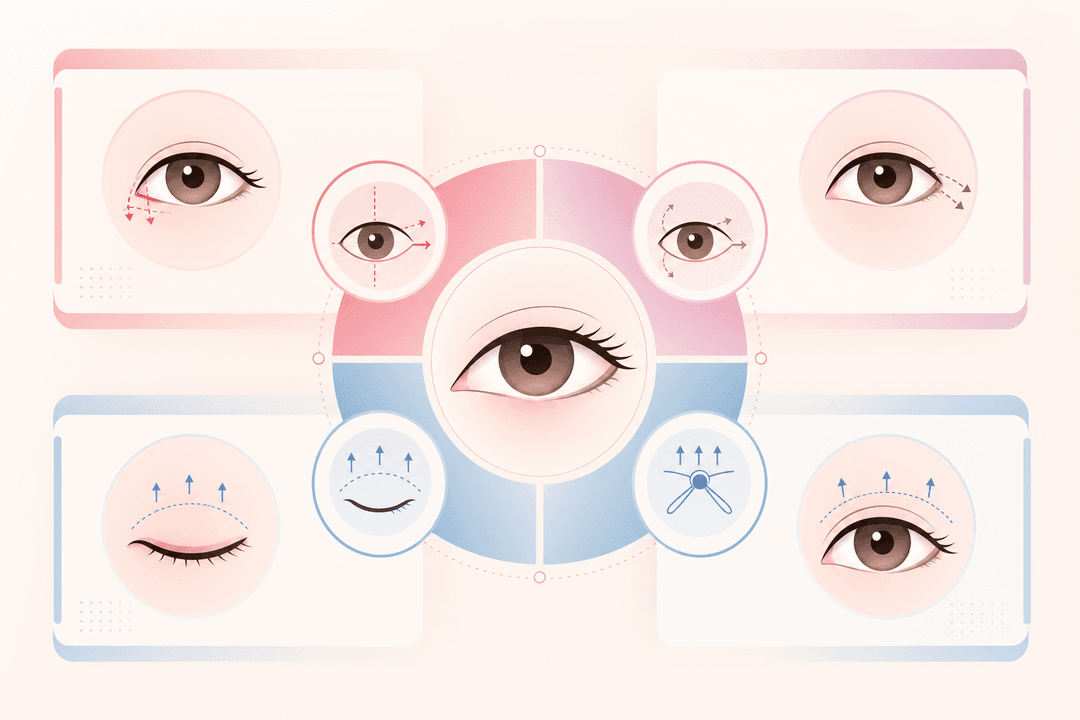
Tucking surgery is for horizontal expansion (widening left and right), while eyelid correction is for vertical expansion (making eyes taller).
If you have severe Mongolian folds or wide-set eyes, epicanthoplasty is recommended. If there's insufficient exposure of the iris, eyelid correction is the answer. About 30% of cases require both.
The recovery periods also differ. You can return to daily life in 3-5 days with epicanthoplasty, but eyelid correction, involving muscle manipulation, takes 7-10 days.
Therefore, office workers often choose tucking procedures, while students on break opt for eyelid correction.
Clinical Insight: The reoperation rate 6 months after eyelid correction is less than 8%. This is lower than for double eyelid surgery (15-20%) because muscle fixation is more stable than skin fixation.
| Item | Eyelid Correction | Double Eyelid Surgery | Epicanthoplasty/Lateral Canthoplasty |
|---|---|---|---|
| Target Condition | Ptosis | Skin Sagging | Mongolian Folds |
| Layer Addressed | Levator Palpebrae Superioris Muscle | Skin + Fat | Medial Canthus |
| Recovery | 7-10 days | 5-7 days | 3-5 days |
| Effect Duration | 10+ years | 5-10 years | Permanent |
Recovery period and results may vary depending on individual conditions.
The Selection Criteria Ultimately Boil Down to These Two Factors
Do your eyebrows lift when you try to open your eyes, and does it feel strenuous? + Is more than 2mm of your iris covered? If the answer to both is yes, eyelid correction should be prioritized.
Normal iris exposure is 10-11mm, but if it's 8mm or less, it's diagnosed as ptosis.
Double eyelid surgery aims for a crease line, while eyelid correction aims to increase eye size. If you desire both, they can be performed on the same day, with approximately a 50% cost reduction.
Honestly, combining double eyelid surgery with eyelid correction generally leads to higher satisfaction than eyelid correction alone.
- Eyelid correction recommended for iris exposure of 8mm or less
- 50% cost savings when combined with double eyelid surgery
Surgery Selection Guide
Eyelid Correction Alone [Ptosis Correction]
- Increases iris exposure by 2mm+
- Muscle fixation results in an 8% recurrence rate
- 7-10 day recovery
Essential if you have a habit of raising your eyebrows
Double Eyelid Surgery Alone [Crease Formation]
- Improves skin sagging
- 5-7 day recovery
- No change in eye size
When eyelid lifting strength is normal
Eyelid Correction + Double Eyelid Surgery [Combined Correction]
- Addresses muscle and skin simultaneously
- 50% cost reduction
- Highest satisfaction rate
When both ptosis and skin sagging are present
Common Misconceptions
Myth: You don't need double eyelid surgery if you get eyelid correction.
Truth: Eyelid correction works on the muscle, while double eyelid surgery works on the skin layer, so their purposes are different. In reality, over 60% of patients undergo both procedures.
Must Check Before Eyelid Correction
- It's essential to correct the habit of raising your eyebrows for 2 weeks post-surgery—muscle fixation can loosen.
- If you have severe dry eye, eyelid correction may worsen it—get a prescription for artificial tears in advance.
- Overcorrection can lead to lagophthalmos (inability to fully close the eyes)—choosing an experienced medical professional is key.
Frequently Asked Questions
How long do the effects of eyelid correction last?
Due to muscle fixation, the results last over 10 years, which is longer than double eyelid surgery (5-10 years).
When is revision surgery needed after eyelid correction?
Revision surgery is needed in less than 8% of cases due to overcorrection or undercorrection and can be performed 6 months later.
Can I get eyelid correction if I have dry eyes?
Yes, but your dry eye symptoms may worsen after surgery, so get a prescription for artificial tears in advance.
Lumi's Insight
Eyelid correction targets muscles, while double eyelid surgery targets skin. Many more people need both than you might think, so be sure to do the eyebrow-pressing test in front of the mirror. Knowing what your eyes need will help you stay firm during consultations.
This content is for informational purposes only and does not substitute for medical advice. Always consult with a specialist before undergoing any procedure.